
Dubai is colder than Delhi: Why are Indian cities hotter than the Arab deserts?
The IMD confirmed it was Delhi's third consecutive heatwave day, driven by persistent dry northwesterly winds, strong glare from the Sun, and clear skies across northwest India.
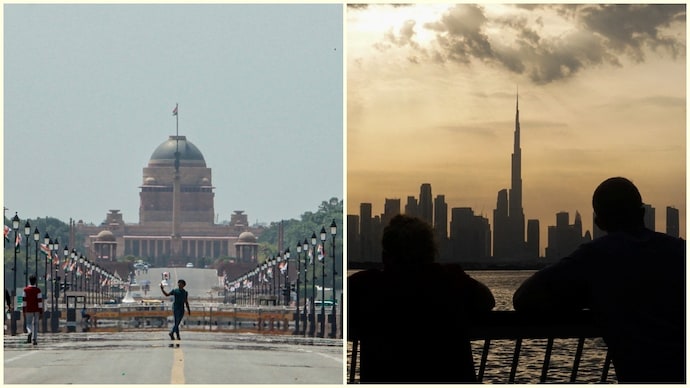

It's a comparison that will make you stop and request a repeat of the fact, just to make sure you heard it right.
Dubai, the sun-scorched desert city synonymous with summer that burns, is today cooler than India's capital.
On Tuesday, April 28, Delhi experienced heat wave conditions with maximum temperatures nearing 43°C, while Dubai is recording temperatures around 30°C.
That's a gap of around 10°C between a landlocked plains city and a desert metropolis.
Welcome to India's 2026 summer.
DELHI'S BRUTAL 2026 SUMMER
The heatwave in Delhi has been building for weeks.
Temperatures breached 40°C around April 21–22, weeks ahead of what was once considered peak heat season, making it one of the earliest and most intense starts on record. By April 26, Safdarjung, the city's primary weather station, logged a maximum of 42.8°C, which was 5.1°C above normal, marking the highest temperature recorded in Delhi so far this year.
The IMD confirmed it was Delhi's third consecutive heatwave day, driven by persistent dry northwesterly winds, strong glare from the Sun, and clear skies across northwest India.
2026 is unfortunately not an anomaly for Delhi.
In 2024, Delhi recorded 12 heatwave days, including a 10-day streak where temperatures exceeded 45°C. In 2025, the first heatwave arrived as early as April 7.
Delhi is also not alone in this losing fight with heat.
Maximum temperatures across large parts of northwest, central, and peninsular India are currently ranging between 40°C and 44°C, with the highest temperature of 45°C recorded in Banda, Uttar Pradesh, according to heat data ranking by AQI.in at 5:12 pm on April 28.
Extreme heatwave conditions are also affecting other major Uttar Pradesh cities including Lucknow, Kanpur, and Prayagraj.
WHY IS DELHI HOTTER THAN DUBAI?
The answer to this question that no one ever expected to ask lies in geography and moisture.
Dubai sits on the Persian Gulf coast, where sea breezes, moderate temperatures and humidity keep nights warmer but days cooler in April.
April in Dubai sees daytime highs of around 34°C, with moderate winds and rising but manageable humidity. Delhi, by contrast, is landlocked on the Indo-Gangetic Plain, exposed to dry, hot winds blowing off the Thar Desert with no oceanic buffer.
But the consequences couldn't be more different.
Delhi's peak power demand this summer is projected to exceed 9,000 MW, well above last year's maximum of 8,442 MW, as air conditioners and cooling appliances run at full tilt.
Dubai has built its city around the heat, with near-universal air conditioning, indoor public spaces, and infrastructure designed for extreme temperatures.
Delhi's millions of outdoor workers, daily-wage earners, and residents in areas without reliable electricity face the brunt directly. Urban heat island effects raise nighttime temperatures and compound heat stress.
The urban heat island effect is a phenomenon in which cities and metropolitan areas experience significantly higher temperatures because of urban construction coupled with scant greenery, which reduces natural cooling.
For now, a series of western disturbances approaching northern India are expected to bring thunderstorms, gusty winds, and short spells of rain between April 28 and 30, offering temporary relief, before the summer reasserts itself.
But the phrase "Delhi hotter than Dubai" is bound to ring in conversations for years to come.