
The silent India-China water war: One turns it into smoke, the other into chips
One is doubling down on the farm, while the other is betting on its factories. That choice may define which nation holds the economic upper hand in the decades ahead.
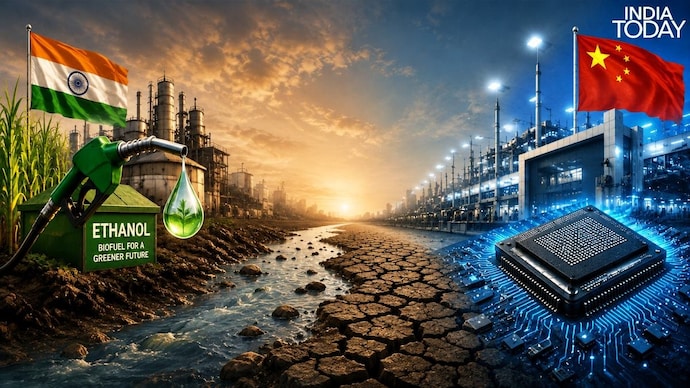

Asia's two biggest powers are locked in a battle over one of the world's most precious resources, and the strategies they've chosen could not be more different.
India and China are both water-stressed, fast-growing global giants. But when it comes to how each country uses its water, the two have taken sharply divergent paths.
One is doubling down on the farm, while the other is betting on its factories. That choice, analysts warn, may define which nation holds the economic upper hand in the decades ahead.
This story was first published in Hindi on our sister platform Kisan Tak. You can read in Hindi here.
WHAT IS INDIA USING ITS WATER FOR?
India is now the world's largest producer and exporter of rice, a title it wears with pride.
But the rice output has grown so dramatically that the government has begun converting surplus rice into ethanol, a plant-based fuel blended into petrol to cut India's dependence on oil imports, 90% of which are currently sourced from abroad.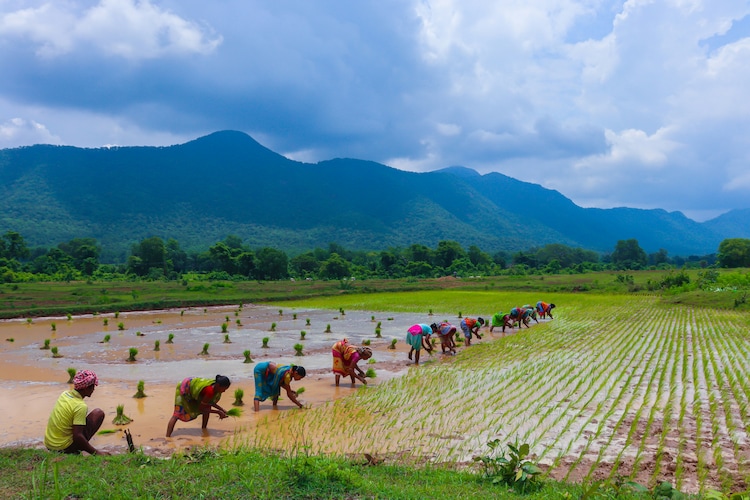
Petrol in India already carries a 20% ethanol blend, and the government has drafted plans to push that to 85%. In 2025, a record 52 lakh tonnes of rice from government reserves was allocated for ethanol production alone.
Furthermore, between 2014 and 2026, ethanol blending has saved India an estimated Rs 1.73 lakh crore in import costs.
The ambition is understandable, but then India's water consumption is equally worrying.
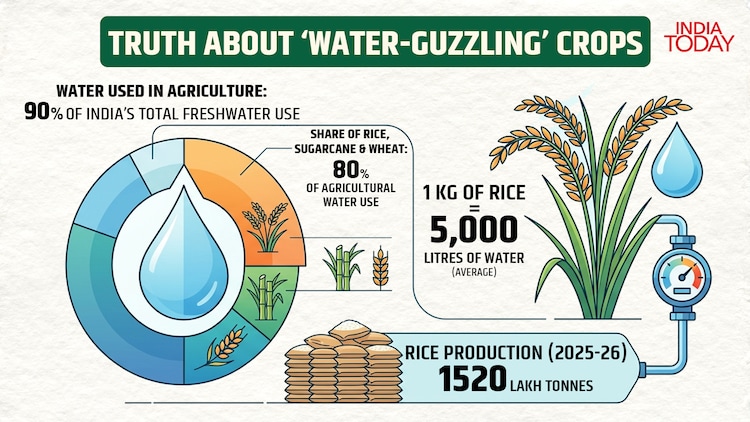
Rice is one of the thirstiest crops on the planet, growing just one kilogram consumes up to 5,000 litres of water. India produced approximately 1,520 lakh tonnes of rice in 2025-26, according to data from the United States Department of Agriculture's (USDA) Foreign Agricultural Service.
India's agricultural sector already consumes 90% of the country's total freshwater, with paddy, sugarcane and wheat alone accounting for 80% of that.
The strain is most visible in Punjab and Haryana, India's primary rice-growing states, where groundwater that was once available 30 feet below ground now requires digging down upto 100 to 200 feet.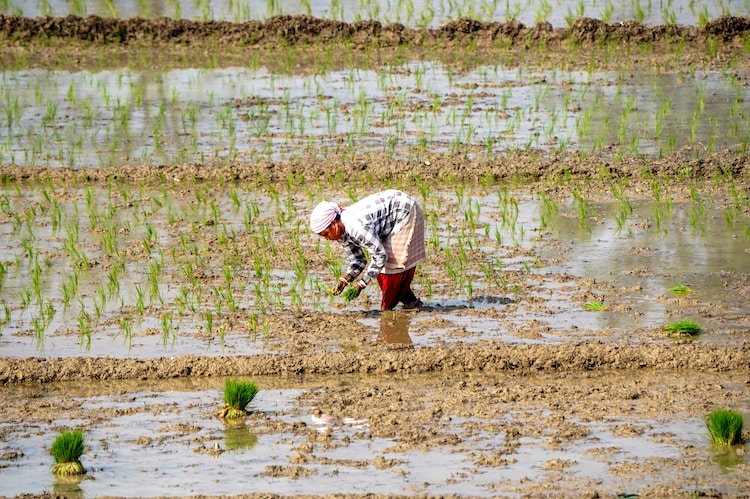
Water tables in these states are dropping by 0.5 to 1 metre every year, and that is a direct consequence of decades of MSP-driven incentives that have locked farmers into growing paddy and wheat over less water-intensive alternatives.
CHINA'S COUNTER MOVE
Now, China looked at the same equation and arrived at a completely different answer.
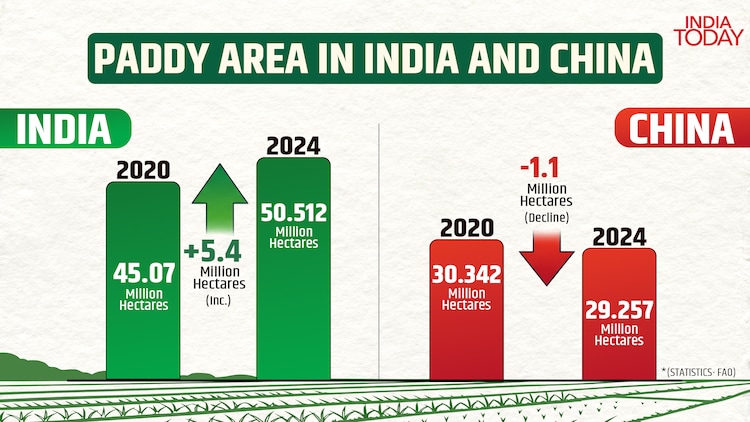
Between 2020 and 2024, while India expanded its rice-growing area by 54 lakh hectares, China reduced its paddy growing land by around 11 lakh hectares, according to Food and Agriuculture Organisation (FAO) data.
The freed-up water was not wasted and was instead redirected into semiconductor plants, electric vehicle battery units, lithium-ion cell factories, and solar panel manufacturing, all of which are industries that extract exponentially more economic value from every litre of water consumed.
The arithmetic can explain.
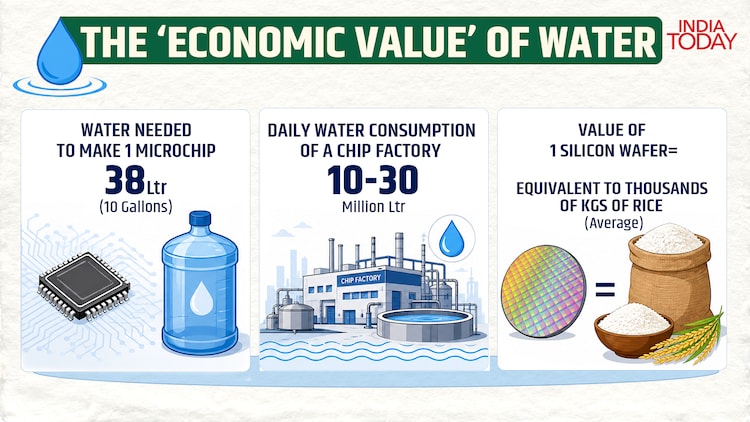
A single semiconductor chip requires roughly 38 litres of water to produce, yet its market value is close to thousands of kilograms of rice. A chip-making factory may consume 1–3 crore litres of water daily, but the GDP it generates per drop is incomparably higher than any paddy field.
It's basically about extracting the maximum value out of each drop of water.
Taiwan illustrated this logic with clarity in 2021, when a drought forced its government to shut off irrigation across 74,000 hectares of farmland to keep TSMC, the world's largest chipmaker, running.
Farmers were compensated, but the factories never paused.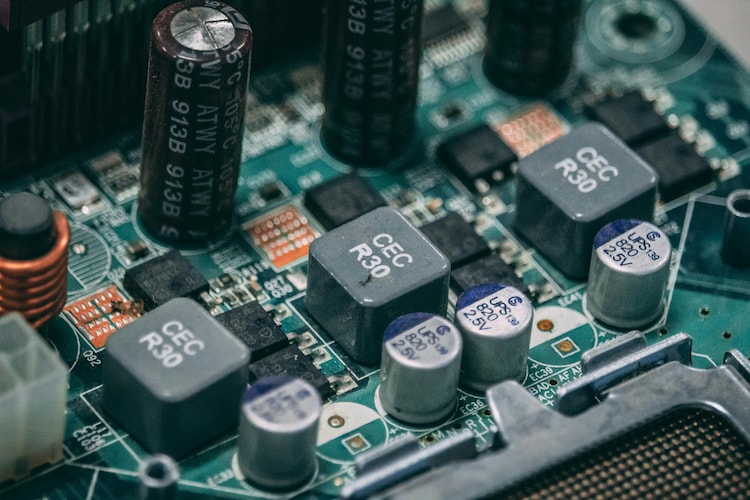
China learnt the lesson and is now systematically shifting water and natural resources away from low-value agricultural use towards high-technology industries like chips, AI infrastructure, EV batteries, and advanced electronics.
AN UNFAIR CHALLENGE
Although the comparison is a compelling one, it's also quite unfair to India.
Nearly 45% of India's population depends on agriculture for its livelihood, making any abrupt pivot politically and socially impossible. Apart from livelihood, rice is deeply ingrained in the daily Indian lives of billions, as it has been for centuries. That cannot change overnight.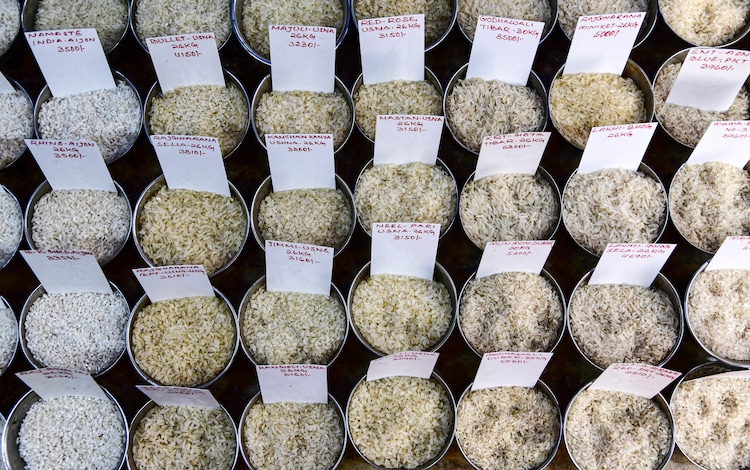
But the choices being made at the policy level are still open to scrutiny.
India is expanding rice cultivation and increasing the rice quota for ethanol, rather than promoting less water-hungry alternatives like maize or crop residue.
Until farmers are given strong enough incentives, either through MSP reforms or otherwise, to shift to pulses, oilseeds, or drought-resistant crops, the groundwater crisis will only get worse.
The bottom line is that China is converting water into microchips and batteries, and India is converting it into rice, and then into fuel.
Both countries face a water-scarce future. But only one appears to be planning for it, drop by drop.