

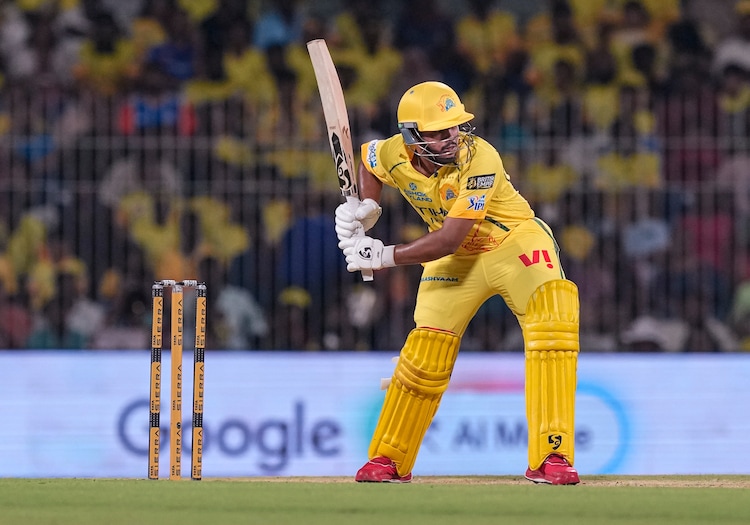
From Virar to Churchgate: The daily grind that toughened up Ayush Mhatre
IPL 2026: Ayush Mhatre's start to IPL 2026 has been inconsistent, much like Chennai Super Kings' own transition phase. But for a player shaped by long train journeys and hard yards in Mumbai cricket, phases like these are not new.
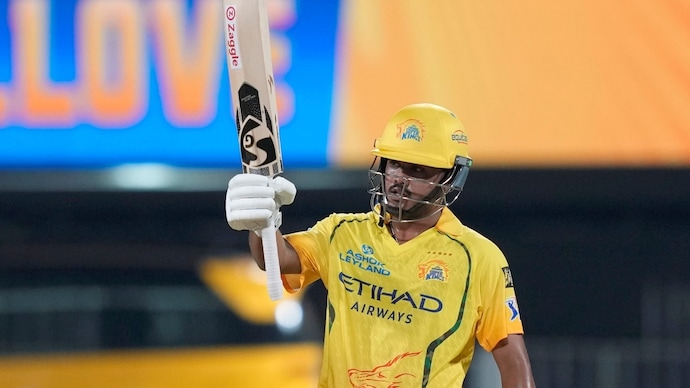
Ayush Mhatre has been CSK bring hope in the dark IPL 2026 times. (Photo: PTI)

New Delhi,UPDATED: Apr 11, 2026 11:51 IST
The world of sport invariably works in cycles. Teams that dominate for long phases eventually come down, before finding a way back up again. That is where Chennai Super Kings find themselves. After more than a decade of consistency, the side is now in a rebuild. The core that defined them has thinned out, and the shift from experience to youth has been inevitable.
Last season, that shift became clearer. Chennai moved away from their trusted core and brought in a group of younger, largely uncapped players to reset the squad. One of those players was Ayush Mhatre. Mhatre added the missing intent to the batting line-up in 2025 as CSK desperately sought after the formula for new-age T20 batting.
This season, though, has not started the same way. Mhatre’s IPL 2026 campaign has been mixed. A 73 against Punjab Kings briefly held together an innings that was falling apart, but in the other two games he has been dismissed for single-digit scores. He has also lost his opening slot, with Sanju Samson and Ruturaj Gaikwad moving up the order despite struggling for runs themselves.
| IPL 2026: CSK vs PBKS Updates, Scorecard |
For a young batter, it is not the easiest phase to navigate. But perhaps that struggle is not very unfamiliar either.
At the ICC Under-19 Cricket World Cup, which India went on to win, Mhatre did not have a smooth tournament with the bat. For large parts, the runs were not coming. He still found ways to contribute. He bowled more than expected, chipped in with off-spin, and stayed involved as captain.
The runs came late. Two fifties in the semi-final and final. India won the World Cup, and Mhatre returned as captain, joining a list that includes Mohammad Kaif, Virat Kohli, Unmukt Chand, Prithvi Shaw and Yash Dhull.
His upbringing has shaped how he handles phases like this.
“I am mentally strong. I used to go from Virar to Churchgate (a train journey of 1:30 hours one side). Sometimes I didn’t even get a seat. I had to stand there. I had to go to the ground and bat. Even after batting, I didn’t get a seat. I had to stand and go,” Mhatre said on JioStar's Dream On.
“It was mentally tough. Sometimes you feel bored, you feel like not going every day. But my aim was to play cricket. I had the motivation to go and bat.”
Those routines were not unusual for a young cricketer in Mumbai. But they do leave a mark. Long travel, little comfort, and the expectation to show up every day and perform.
It is in those years that his game began to take shape.
Mhatre first trained under Mumbai-based coach Prashant Shetty, who worked with him when he was still a young boy trying to find his game. Later, as he moved into school and age-group cricket, Sachin Koli played a key role in guiding him through his teenage years and into higher levels of competition.
Both noticed something early.
“I think a spark was definitely visible,” says Shetty. “The backfoot shots he had, normally at that age, 9 or 10, we don’t see that. I was convinced he is a good talent.”
That base stayed with him as he grew older.
“His backfoot shots were very strong from before,” says Koli. “At higher levels, bowlers don’t pitch it up much. If your backfoot game is strong, you can survive. Seeing those shots, everyone felt he will go far.”
But as his father recalls, ability was only one part of it. The way he responded to situations mattered just as much.
One such instance came in an Under-14 game in Pune.
It was played on a mat wicket, something Mhatre was not used to. Early in his innings, he slipped slightly at the crease. A fielder at cover made a remark about a Mumbai player who could not even stand properly.
Mhatre did not respond. He stayed at the crease.
What followed was an innings that quickly got out of hand for the opposition. He began taking on the bowlers, and when the same player came on to bowl, Mhatre hit him for six sixes in an over.
By the end of the innings, he had scored 256 runs off 94 balls, hitting 36 sixes and 15 boundaries.
There was a reaction. But there was also a correction.
After the game, his father spoke to him about the innings, not to praise it, but to put it in context.
“You showed him. But you cannot go ahead playing with anger. It could have gone the other way too. Don’t keep that in your mind. Play your game.”
It was a small intervention, but one that stayed.
For his coaches, there were other moments that marked his progress.
“I think when he was selected in CSK,” says Shetty. “Playing under MS Dhoni, that was a big moment.
“And when he became India captain. When you are leading the country, there is nothing bigger.”
There was also his early success in first-class cricket with Mumbai, where a big score in a strong dressing room made people take notice.
Right now, though, Mhatre is working through a phase where the runs are not consistent. It is also a phase where roles are shifting, opportunities are not as fixed, and performances are under sharper scrutiny. For a young player in a team that is itself evolving, that uncertainty is part of the process.
What Chennai are going through is not just a dip in form. It is a transition that was always going to take time. The players who defined the team for years are no longer at the centre of it. In their place is a group that is still finding its level, still adjusting to the demands of the league.
It is not a phase that lends itself to quick corrections. Chennai have rarely worked that way.
The decisions over the last two seasons point to a longer plan, one where the focus is on building a core that can last, rather than patching gaps from year to year. The returns in the short term are uneven, but that has not altered the approach.
Players like Ayush Mhatre are part of that thinking. His game has come through Mumbai’s maidans, and his temperament has been shaped by the daily grind of travelling across the city to train and play.
He is still early in that journey. The returns are not consistent yet, and the role is still settling. At the centre of this phase is Stephen Fleming, who has overseen most of the franchise’s success and now guides its next phase.
More importantly, the expectation is not immediate results. It is that this group, over time, becomes the next one that takes Chennai back up again.
IPL 2026 | IPL Schedule | IPL Points Table | IPL Player Stats | Purple Cap | Orange Cap | IPL Videos | Cricket News | Live Score
- Ends