
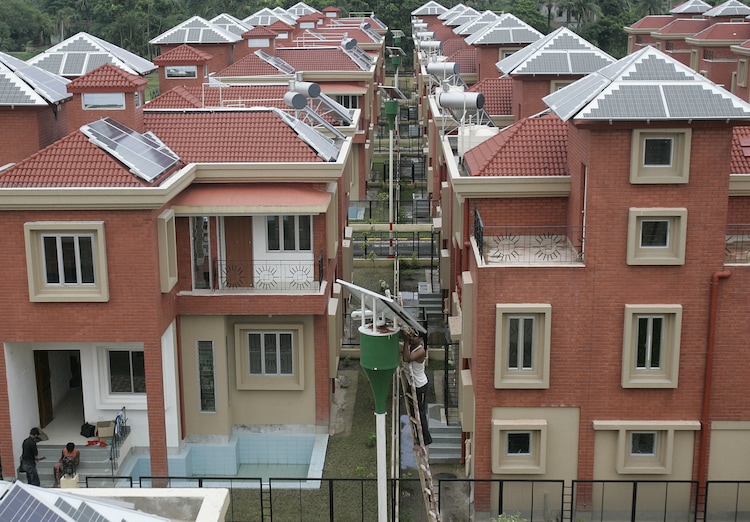
Zero electricity bill, credit for selling surplus: Neighbour's envy driving solar in India
Households across India are turning to rooftop solar through an unusual mix of triggers. From Varanasi to Greater Noida to a village in Maharashtra, neighbours are inspiring each other to go solar. Backed by government subsidies, growing awareness, and most importantly, lower electricity bills, solar is now powering more middle-class households in India than ever.
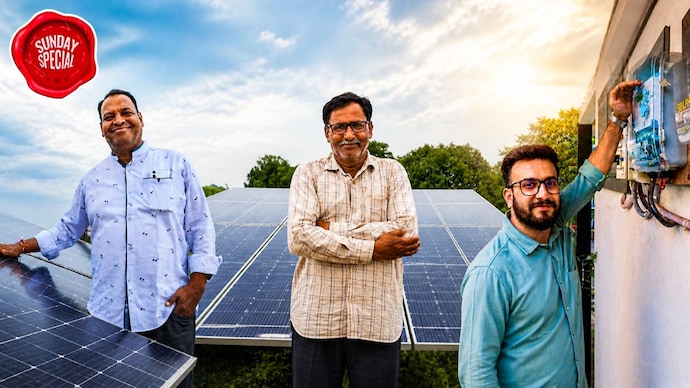
The PM Surya Ghar: Muft Bijli Yojana has installed rooftop solar systems for 30 lakh households across India. (Image: PTI/ India Today)

New Delhi,UPDATED: May 3, 2026 07:00 IST
Two years ago, Rajat Pathak, in Varanasi's Sigra suburb, noticed solar panels atop the roofs of his neighbours. One to the left of his house, another to the right. Pathak got curious about switching to solar. But he was hesitant too. "It would be very sustainable, but solar panels are something that only the well-off can afford," Pathak thought, and his curiosity turned into disappointment.
In 2024, Pathak found out that the entry-level basic 1 kW domestic solar power system, which can power a few fans and light bulbs for several hours on a good sunny day, cost anywhere between Rs 60,000-80,000. That was a significant expense for his household, Pathak said. The PM Surya Ghar Yojana, which provides a heavy subsidy on solar panels, had not been launched. But as the scheme was launched the same year in 2024, the idea of having a solar power system once again came to him.
By 2025, solar panels began appearing across Pathak's colony. "My neighbours Gupta Ji and Rai Sahab also got them on their terraces," he told India Today Digital.
"The houses next door had it, and my dekha-dekhi instinct kicked in. It was definitely a catalyst. I was missing out. Not just government subsidy of around Rs one lakh, envy was a major factor behind me getting a solar system. It was the pull of keeping up with neighbours that helped me slash my electricity bills," said Pathak.
Pathak's Varanasi household is among over 30 lakh Indian households that are now being incentivised by the government and are consuming clean energy.
Envy is counted among the seven deadly sins, but here, it seemed to be working in Pathak's favour. The power of the sun is in abundance across most of India. Where it's not, solar energy has been a boon.
In 2024, when a village in Maharashtra's Satara district first came to discover solar energy, they all made a collective shift. The villagers chose to shift the entire community to solar energy. In Satara, envy or FOMO, didn't work like it did in Varanasi. Here it was a joint transition. Today, the village of 420 people spends nothing on electricity, and the extra electricity the houses generate through the solar panels is stored for later use in the monsoon months when the sun doesn't shine as bright.
It is because of such households that India produced 1,08,494 GWh of solar power in 2025, surpassing Japan to become the world's third-largest solar producer. Solar module manufacturing capacity has nearly doubled from 38 GW in 2024 to 74 GW in 2025. Solar energy reportedly contributed about 9% to India’s total electricity generation in 2025-26.
Across several colonies in Greater Noida that India Today Digital visited, the pull to switch to solar power, or install rooftop systems, was driven by the desire to keep up with neighbours and reduce electricity bills. Solar panels have also appeared atop Greater Noida's bungalows. While the residents in Greater Noida did not openly credit their neighbours for the decision, some admitted there are signs of a ripple effect. The trend is picking up but slowly.
It is because of this trend that around 800 Greater Noida homes are now enjoying zero electricity bills after installing properly sized solar rooftop systems with net metering. Excess electricity they generate is sent back to the power grid, and the residents get unit credits for it.
Fuelling this shift is the PM Surya Ghar: Muft Bijli Yojana, which offers substantial subsidies to households installing rooftop solar systems.
Today, Lucknow is the leading district in rooftop solar installations, overtaking Surat. Earlier, Rajasthan and Gujarat were the top states with solar installations powering houses, but the trend is now being seen in states like Odisha too, which now has nearly 85,000 households under PM Surya Ghar: Muft Bijli Yojana. The combination has made solar power an attractive option for middle-class families who previously hesitated due to cost.
Here's how Indians are moving to solar energy, saving a significant amount of income. We would also learn how rooftop solar adoption in India has surged from roughly one lakh homes in 2016 to nearly 30 lakh by 2025. We would also go through the process of how to install rooftop solar power systems at homes.
THE NEIGHBOUR'S ENVY OVER LOWER ELECTRICITY BILLS
After seeing at least three houses around his own with solar panels, Varanasi-based Rajat Pathak started thinking more seriously. He noticed that his neighbours did not necessarily get massive solar panels. Some had the modest 2 kW systems, which is ideal for smaller households, while others had 6-8 kW setups for larger homes.
"I did not ask them first about how much their electricity bill was reduced, but I knew that it must definitely be helping them save some amount," Pathak said. But later, Pathak ended up having a conversation about the sunshine dividend. It was around a 50% reduction. Two neighbours told me that the big systems save Rs 20,000 a month during the summers, and Rs 10,000 a month in the winters.
"After I saw that my immediate neighbour had got a solar panel installed, I thought I would get one too," Pathak said.
He went for a 4 kW system. Neither too big, nor too small. In peak summers, his two terrace rooms for tenants, which need air conditioning badly when temperatures cross 45 degrees Celsius, now run almost entirely on solar power.
Another resident of the same colony in Sigra's Narendra Dev Nagar, Santosh Malviya, admitted, "Dekha-dekhi mein hi solar lagwaaya hai (We saw each other's solar panels and lower bills, and got them installed)."
Today, Malviya's single-storey house, with the terrace serving as the main roof, generates enough power with its 4 kW solar system to meet much of its needs. He still receives electricity bills, but only about Rs 1,200-1,500 in the peak summer months, which is less than half of what he used to pay earlier.
Through the PM Surya Ghar: Muft Bijli Yojana, launched in February 2024, the Centre offers subsidies of up to Rs 78,000 for residential rooftop systems, depending on size, along with easy financing options. Some state governments also assist around rs 20,000 to Rs 30,000.
In Varanasi's colonies, the scheme's impact is clear on the ground. Residents who once paid heavy summer bills for ACs and fans are now seeing reductions of 40-50% or more in energy expenses.
One house is seemingly inspiring the next, creating a chain reaction that formal campaigns alone could not achieve so rapidly.
A FULLY SOLAR-POWERED VILLAGE IN MAHARASHTRA, MANYACHIWADI
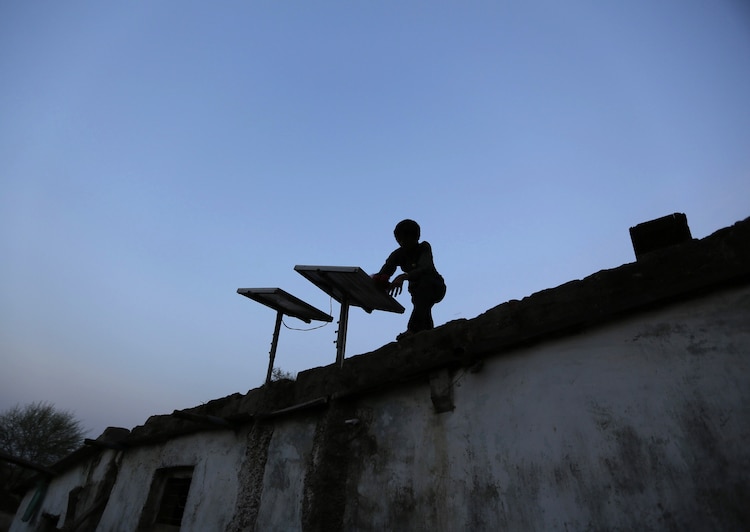
In a village in Maharashtra, calling it the "neighbour effect" may be stretching it. But in Manyachiwadi village in Satara district, the decision to go fully solar was taken collectively, making it a community version of the same trend.
Sarpanch Ravindra Mane, who also works as a journalist, told India Today Digital, "Power cuts used to be common, especially during the long monsoon months. Thick clouds hang over the entire region. These outages once affected students' studies and daily village life. The village chose self-dependence by installing solar systems on homes."
It has been two years since the entire village of Manyachiwadi last received an electricity bill. The excess power generated by the solar panels is stored in inverters for use on cloudy days, when the panels do not produce as much electricity. It must be noted that the village is nestled amid hillocks, and during the monsoon months, it often experiences cloudy weather.
URBAN POCKETS ALSO SEEING SOLAR PANELS SPRINGING UP, HOUSES GETTING ZERO ELECTRICITY BILLS
The same pattern, households inspiring each other to install solar panels, is visible nationwide.
A Gandhinagar resident, Shiven Sharma, who has been using solar power for 16 years, long before the PM Surya Ghar scheme was launched, told India Today Digital about his experience with the system's practical workings.
Sharma said, "We have a 5 kW solar panel system, which cost us about Rs 4 lakhs to install. It produces an average of 18 units of electricity every day. If, over a two-month billing cycle, we produce more units than we consume, we get paid Rs 2.64 per extra unit. And during the monsoon, when our solar energy production may be low because of clouds, if we use excess units from the electricity grid, we pay Rs 9 for every extra unit we use. That's how it works."
Today, however, under the PM Surya Ghar scheme, households apply through a national portal, select empanelled vendors, and receive subsidies directly in their bank accounts after installation and inspection. This streamlined process, paired with state-level top-ups in states like Uttar Pradesh and Maharashtra, has removed much of the earlier financial barrier.
Of course, not every installation is trouble-free. Some early adopters faced delays due to vendor inexperience or confusion over approved panel brands. Roof assessment, system sizing, and proper net metering connections take time. But these hurdles have not slowed the overall solar power adaptation momentum in the area, said Sharma
BILLS REDUCED BY 50% FOR GREATER-NOIDA RESIDENT
Sachin Kumar Attri, a Greater Noida-based software professional, has a 5 kW rooftop solar system on his house. He first got the idea after spotting advertisements in newspapers and on TV. Today, his electricity bill has dropped by nearly 50%, even with two ACs blasting at the home.
The solar panel system cost him around Rs 3 lakh, on which he received a central government subsidy of Rs 78,000 — the capped amount under the PM Surya Ghar: Muft Bijli Yojana — and a state government subsidy of Rs 30,000 from Uttar Pradesh, via Uttar Pradesh New & Renewable Energy Development Agency (UPNEDA).
The subsidy is disbursed directly into the beneficiary's bank account via Direct Benefit Transfer (DBT) after successful installation, net metering commissioning, DISCOM inspection, and verification of documents, typically within 15–30 days of the redemption request.
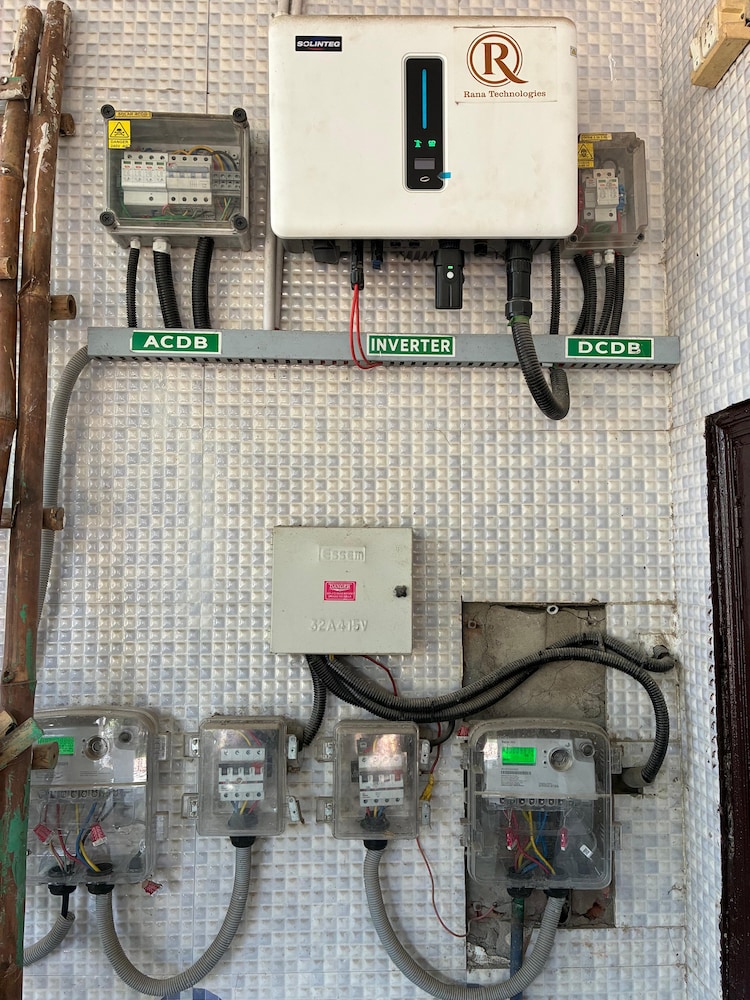
Notably, the central subsidy for residential rooftop solar panels provides up to Rs 78,000 capped at 3 kW equivalent, with tiered support of Rs 30,000–60,000 for 1–2 kW.
In Attri's case, UPNEDA added Rs 15,000 per kW, which goes up to a maximum of Rs 30,000 per consumer for grid-connected residential systems.
The process was smooth for Sachin Kumar Attri. He filled out the necessary form with Noida Power Company Limited (NPCL), the local discom. Applications for subsidy-linked projects often start on the national portal (pmsuryaghar(dot)gov(dot)in), after which vendors handle much of the paperwork.
The NPCL does not assign vendors directly. Attri had to choose from a list of government-empanelled vendors. "The vendor I chose recommended Adani Solar panels. Then he collected all documents and handled coordination. Within about 15 days of approval, the new bidirectional net meter was installed."
Documents required for net metering and subsidy are application forms specifying intent for connection and registration, Aadhaar card, PAN card, bank details, latest electricity bill, proof of ownership or the rent agreement, net metering agreement, among other basic documents.
Sachin's father, Devendra Singh, noted that while there isn't a massive chain reaction yet, several houses in their block now sport sizeable solar installations.
ALMOST NO BILL IN WINTERS, AND SAVINGS OF UP TO Rs 10,000 PER MONTH IN SUMMERS
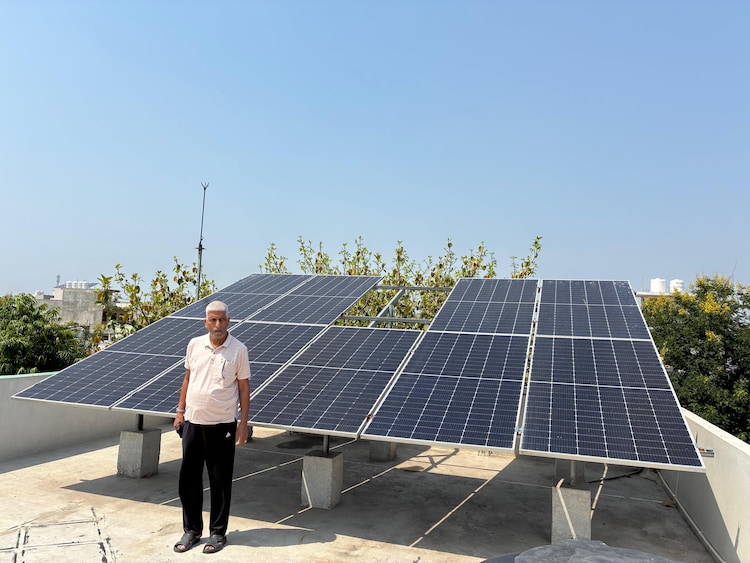
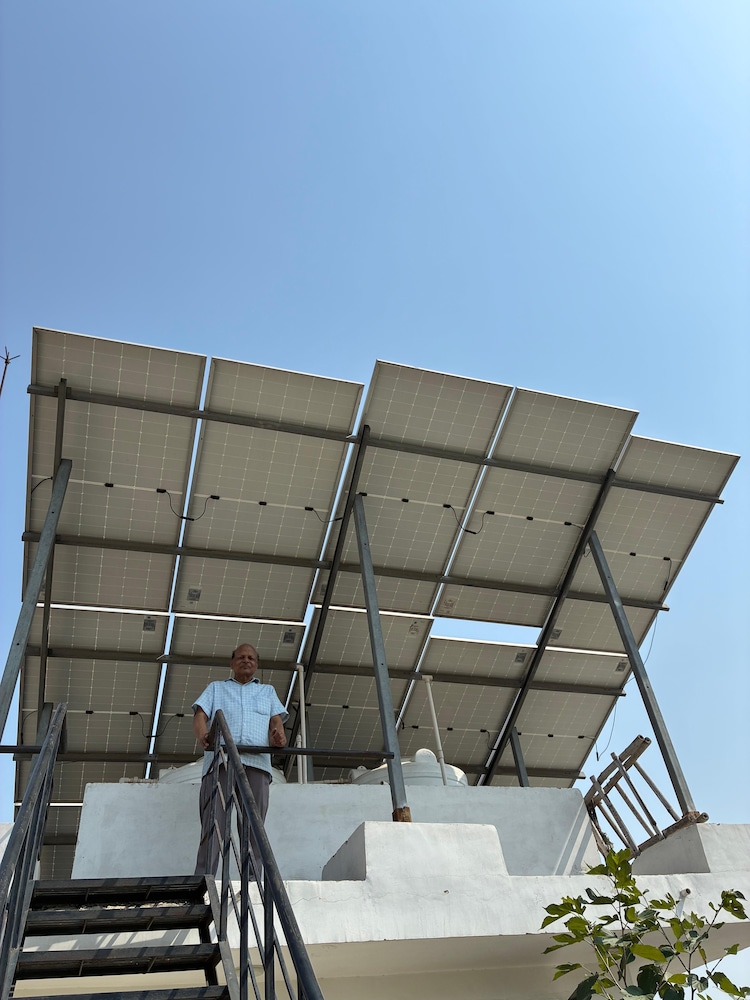
For Greater Noida resident Mukul Gupta, getting a solar panel for his home was a little challenging. His 8 kW rooftop solar system was installed in 2022, but it only became fully operational in July 2023 due to delays with his vendor.
The vendor was unaware that subsidies under the prevailing schemes were largely restricted to a few approved brands only, such as Adani Solar. Despite the hiccup, Gupta does not regret the decision. The system, which covers his entire roof, cost him around Rs 5 lakh, of which he recovered approximately Rs 1 lakh in combined central and state subsidies.
"In winters, my bill is just the basic amount," Gupta said, adding, "I have got a 10 kW load sanctioned from NPCL, so I pay only Rs 900–1,000 during the winter months."
Sanctioned load is the maximum electricity capacity (in kilowatts) that the power distribution company, in this case, NPCL, officially approves for a household connection. It determines how many high-power appliances can run simultaneously without overloading the system.
A higher sanctioned load, like Gupta's, allows heavy simultaneous usage, without triggering excess demand penalties, which can double the fixed charges for that month (based on sanctioned load or maximum demand recorded).
In winter, when solar generation is decent and overall consumption is lower, the solar system covers most needs, leaving Gupta to pay only the minimum fixed charges tied to his sanctioned load.
"In summers, however, our bill is Rs 3,000 to Rs 4,000. But that's not bad at all," he added. "We have six air conditioners, of which three to four are constantly running from March to June. Still, we end up saving around Rs 10,000 a month."
Today, solar panels are mushrooming from one terrace to another. In India, where energy needs are rising day by day with an expanding middle class, this form of generating electricity is a shock-proof solution. For the environment, and for the pocket.
- Ends