
AI slop is beginning to clog internet… and your mind
The world seems surprisingly eloquent and chatty nowadays. It is also, thanks to AI tools like ChatGPT and Claude, faker and more verbose than ever, fogging the internet and our brains.
Most of the AI content lacks vitality that human-generated content has.

New Delhi,UPDATED: May 9, 2026 10:52 IST
That long 600-word LinkedIn post you read earlier today from the CTO of a 100-core IT startup is most likely fake. It was not written by that CTO, despite its eloquence and its expert-like handling of subject as knotty as AI and jobs. Instead, it was written by ChatGPT.
But this is not the only AI-written post that you have read today. On X aka Twitter, those viral posts by one Mr Gupta and one Mr Perera have also been written by AI.
They are brilliantly written, by the way. It is possible that they are not written by ChatGPT or Gemini. Instead, they are written by Claude, the smart Aleck of the AI world. Because that would explain why Mr Gupta and Mr Perera are writing 30,000 words in lucid prose every week. Words that cover subjects as diverse as the female reproductive health and the wealth management of LeBron James. Words that make Mr Gupta, Mr Perera, and the likes come across as polymaths in the mold of Leonardo Da Vinci.
And that short video you saw on Instagram, the one full of pathos and moments so unbelievable that they shock senses? That too has been scripted and created using AI tools, no humans needed.
What about this article you are reading? Is it also written by AI? I am not going to answer because it doesn’t matter. You will, anyway, not believe it. Such is the world nowadays. But I can tell you this much: that Substack you read yesterday, that news analysis you loved so much that you shared it in the WhatsApp group of your condo, that funny news clip in which an elephant was frolicking in mud all were likely created using AI tools. In our world AI now touches everything.
There is a word for this AI content. AI slop. Merriam-Webster, the wisecracker supreme on X, deemed “slop” the word of the year this past December. Now in 2026 we are beginning to perceive the scale of it. AI slop is everywhere, from the code that is powering the software in your laptop on which you are reading this piece, to everything that you see on your screen. It is beginning to clog the internet, and consequently our minds.
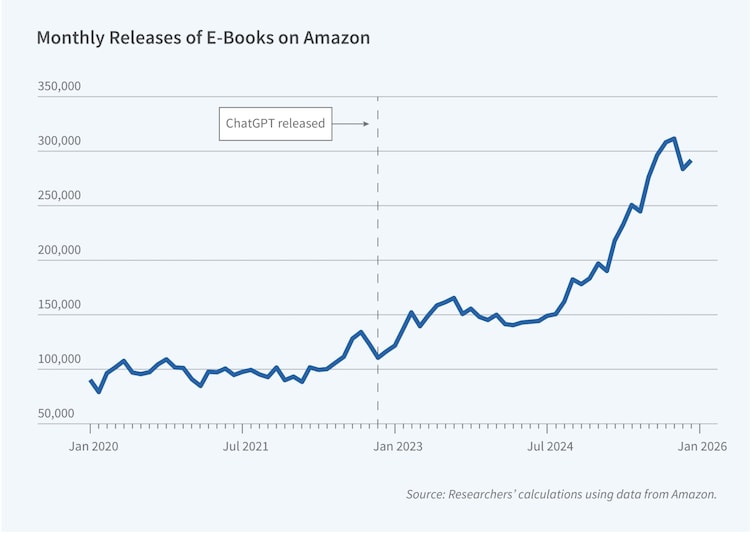
Earlier in the week a graph went viral on X. It comes from a paper published on the website of National Bureau of Economic Research, a think-tank in the US, and it shows the number of ebooks released on Amazon every month since January 2020. There is a big jump from July 2024 onwards, a couple of months after ChatGPT-4o was released. This was arguably the first AI model that was capable of sustained coherence, and it was extremely good with language. In fact, so good that its sycophancy and warmth in conversations are still craved by poor souls who lost their mind talking to it.
According to the graph, the first jump in the number of ebooks came in January 2023, when ChatGPT was starting to enter our conversations. The number went up from an average of 100,000 to 150,000. After July 2024, the number jumped from 150,000 to 250,000 in just one year. Now, it is over 300,000 a month.
Of course, these e-books, most of them self-published, are one small slice of the pie. Nowadays AI is in every piece of content. According to website originality.ai, which tracks AI writing on the web, in 2026 over 13 per cent hiking guides on Pinterest are work of AI. The same website notes that over 32 per cent medical diets on Pinterest, over 32 per cent books on the theme of pet loss, and over 77 per cent self-help guides on “success” have been written using AI. Even Podcasts are seeing AI slop. According to Podcast Index, almost 40 per cent of all podcasts nowadays are AI-generated using tools like NoteBook LLM.
None of this is to say that Gemini, ChatGPT and Claude write badly. Far from it. They are accomplished wordsmiths, which also seems to be a better term for them than writers. They arrange words cleverly to write stuff, whether it is a self-help ebook or an email. They write coherently, sometimes even logically. The writing can have a pleasing tone to it, with some pet-phrases that work great with masses. Such as “it is not just XXXX but also YYYY”.
That is when you are being lazy with AI tools. If you put in a bit of effort, you can achieve better results. For example, you can imitate styles. Such as the style of Hemingway with and, and, and, and some more and. Or you can ask AI to use the style that is extremely popular nowadays. With its frantic prose full of bursts of energy, which is kept in check by single-sentence breaks between paragraphs, it is a style created to go viral on social media.
I would be a fool to call AI writing bad. It is not bad. And that is precisely the problem. It is way too good for the good of the internet and our minds.
Good writing does not imply meaningful writing. Polished content does not automatically translate into meaning. At least for now meaning is something only humans can imbibe into something and ascribe to something. That is the reason why humans can find meaning in something that seems nonsensical, such as a painting by Jackson Pollock, or Finnegan’s Wake. The value of Number 17A doesn’t come from what it depicts. It comes from the meaning the viewer finds in it, and the meaning with which Pollock painted it. The same is true of, “riverrun, past Eve and Adam's, from swerve of shore to bend of bay, brings us by a commodius vicus of recirculation back to Howth Castle and Environs.”
AI cannot offer meaning because meaning is based on human experiences. AI can write a phrase as ludicrous as “riverrun” but it gets a meaning only when James Joyce writes it. At least for now AI has no “experiences”. It only has words. And concepts. All of them tucked inside its 01101101 01101001 01101110 01100100.
And because AI lacks the ability to ascribe meaning to what it creates, or what it sees and hears, its output has a certain hollowness to it. This lack of heft does not get reflected immediately. But probe a little and it gets apparent. The risk, however, is that most people do not probe. And the more they come across the AI slop, the more their brains and senses get acclimatised to it. The more they see those LinkedIn posts written with AI, the more their minds and eyes adjust to the new normal. In the process they start to lose the ability to reason and think deeply. The phenomenon has already started with researchers calling the mental decline brought about by AI “cognitive atrophy.”
Years ago, writer Umberto Eco made his controversial — and often repeated — statement about social media. He called the arrival of websites like Facebook and Twitter invasion of idiots. “Social media has given the right of speech to legions of idiots who used to only speak at the bar after a glass of wine, without harming the community,” he had said. “They were quickly silenced, but now they have the same right to speak as a Nobel Prize winner. It’s the invasion of the idiots.”
Over the years we have seen what social media has done to the world. Very little of it, on the whole, is good. Worse, it has addled our brains. From crippling anxieties to debilitating brain fog, social media has fuelled it all. The kind of AI slop that has started flooding the internet and our brains is this “invasion of idiots” on steroids. To borrow the words of Umberto, if social media gave idiots a right to speech, AI is giving them the right to eloquent speech. That may, on the whole, turn out to be even worse than what Instagram, YouTube, and Facebook have inflicted on the world and our brains.
- Ends