
X stops creators from making money off stolen viral videos
X is taking action against accounts reposting stolen viral content to earn money through its creator revenue-share program. The change targets revenue-sharing abuse while still allowing commentary through attribution tools.

X targets accounts reposting viral clips for monetised engagement.

New Delhi,UPDATED: May 25, 2026 08:07 IST
If you are a regular X user, you have probably come across the same viral video or meme being posted by multiple large accounts within minutes of each other. In many cases, the original creator barely gets noticed while repost accounts rack up millions of views and earn money from engagement.
Now, X appears to be cracking down on that system.
X is introducing new measures aimed at reducing what many users call the platform’s “copycat economy,” accounts that rapidly repost or recycle content from smaller creators to profit from it.
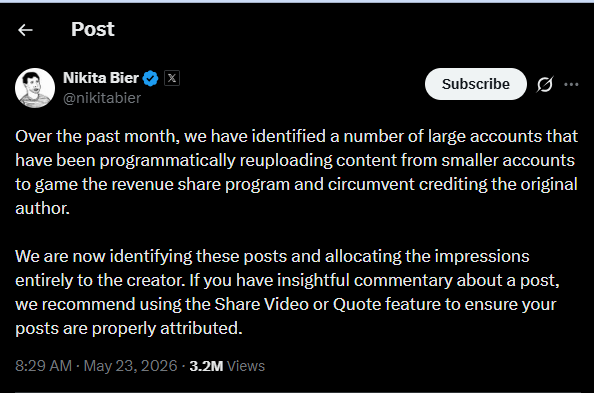
According to X’s Head of Product, Nikita Bier, the company has identified several large accounts that were “programmatically reuploading content from smaller accounts” to exploit X’s creator revenue-share program.
“Over the past month, we have identified a number of large accounts that have been programmatically reuploading content from smaller accounts to game the revenue share program and circumvent crediting the original author,” Bier wrote in a post on X.
X’s creator revenue-share program allows eligible creators to earn money based on engagement on the platform. But the system also created incentives for some users to quickly repost trending videos and viral content before the original creator could gain traction.
Original creators may now get the bulk of impressions
Bier said X is now changing how impressions are allocated on such reposted content.
“We are now identifying these posts and allocating the impressions entirely to the creator,” he said.
The move is designed to ensure that the original creator, not repost or aggregation accounts, receives most of the visibility and monetisation benefits.
At the same time, X says commentary and reactions are still welcome on the platform.
Commentary is allowed, but attribution matters
Bier encouraged users who want to add opinions or context to a viral clip to use X’s “Share Video” or “Quote” feature instead of downloading and reposting the content.
“If you have insightful commentary about a post, we recommend using the Share Video or Quote feature to ensure your posts are properly attributed,” he added.
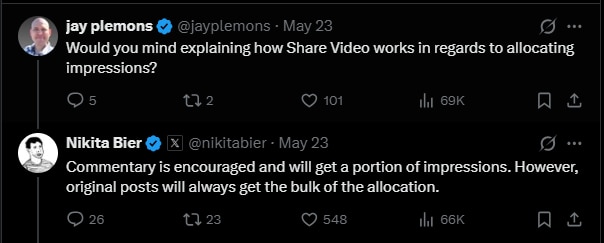
In response to a user asking how impressions would work when using the Share Video feature, Bier clarified that users adding meaningful commentary would still receive a share of impressions.
“Commentary is encouraged and will get a portion of impressions. However, original posts will always get the bulk of the allocation,” he explained.
X also acknowledged a bug in the Share Video feature
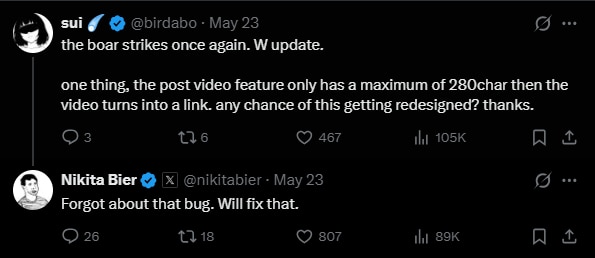
Some users also pointed out limitations in the Share Video tool, noting that after 280 characters, the shared video turns into a link instead of remaining embedded in the post.
Responding to the complaint, Bier said it was a bug and that it would be fixed.
The latest changes are part of a broader effort by X to reduce payouts to content aggregation accounts whose business models often depend on reposting other people’s work for monetisable engagement.
- Ends