
Pak's Fatah-2 missile flopped during Sindoor. Country just tested an upgrade
Pakistan has tested an upgraded Fatah-2 missile months after an earlier version was intercepted and destroyed by India during Operation Sindoor. The development highlights Pakistan's attempt to address gaps exposed by India.
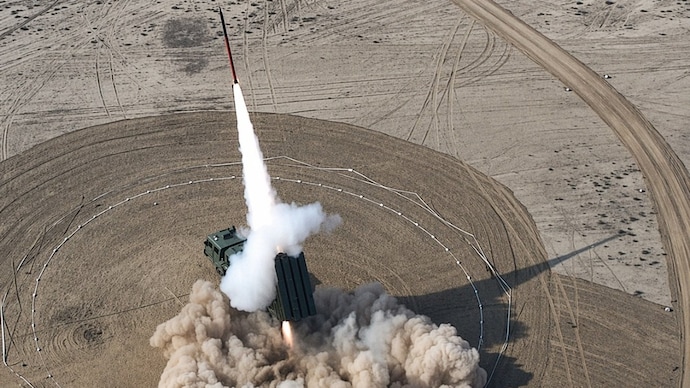

At the peak of last year's hostilities, Pakistan fired a ballistic missile, believed to be the Fatah-2, likely aimed at Delhi. However, it was intercepted and destroyed by an IAF unit in Haryana, exposing gaps in Pakistan's missile capabilities. On Tuesday, Islamabad tested an upgraded version of the Fatah-2, which has a maximum range of 400 km.
The upgraded Fatah-2 is equipped with "advanced avionics" and "state-of-the-art navigation aids", the media wing of Pakistan's military said. This suggests that Pakistan has improved the missile's electronic systems, including communication and navigation. This will help the missile reach targets more precisely.
Such advanced tech was found lacking in the previous version of the Fatah-2. It is why it came a cropper during Operation Sindoor.
WHAT IS THE FATAH-2 MISSILE TESTED BY PAKISTAN
However, Pakistan has claimed that several gaps have now been plugged. It has emphasised that the upgraded version is comparable to Russia's Tornado-S and China's PHL-191.
Before we go any further, here's a quick brief on the Fatah-2. A successor to the Fatah-1 (it had a maximum range of 150 km), Fatah-2 made its entry in 2024. It is basically a guided multiple-launch rocket system that can fire multiple rockets at once.
While Pakistan did not divulge many details, it said the launch was carried out for training purposes and to test the missile's "improved accuracy and enhanced survivability", The Dawn reported.
What is unique to the Fatah-2 is that it can change course mid-flight. Pakistan claims this capability can help it evade missile defence systems.
Its 400 km range makes several India cities near the Pakistan border within the missile's reach, including Chandigarh, Sirsa, Pathankot, Jalandhar, and Ludhiana. If fired from near the border, Delhi and nearby areas could also come under threat.
WHAT TEST OF MISSILE SUGGESTS
The test-firing of the Fatah-2 comes months after Pakistan scurried to set up an Army Rocket Force Command (ARFC). It came after India punched holes in Pakistan's long-range strike capabilities during Operation Sindoor.
For this, Pakistan reportedly received help from its all-weather friend China. The People's Liberation Army Rocket Force (PLARF), which controls both conventional and nuclear missiles, is a potent wing of the Chinese military.
Defence expert Sandeep Unnithan told indiatoday.tech that the test-launch of the Fatah-2 missile indicates Pakistan's desperation after what transpired during Operation Sindoor.
"India struck a dozen frontline Pakistani airbases using a barrage of Brahmos supersonic cruise missiles. Pakistan could not intercept any of these Brahmos missiles. The sole Fatah-2 ballistic missile, which it launched towards Delhi, was shot down by an IAF missile on May 10," Unnithan said.
Operation Sindoor was launched by India on May 7, 2025, in response to the Pahalgam terror attack, which left 26 dead.
Pakistan retaliated by launching a swarm of drones and missiles targeting Indian border areas. However, a Fatah series missile was likely aimed towards Delhi.
The missile was successfully intercepted and destroyed by an Indian Air Force unit based in Sirsa, Haryana. The Barak-8 surface-to-air missile system proved to be its undoing.
Apart from the Barak-8, India has a strong air defence network comprising the S-400 and Akash systems. Thus, it has the capabilities to neutralise even an upgraded version of the Fatah-2.