
The Pacifist state no more: Japan's historic break with post-war restraint
For nearly eight decades, Japan's renunciation of militarism was the cornerstone of Asia's post-war order. A single cabinet decision on the 21st of April has retired that architecture, and the pressures that produced it reveal as much about China's ambitions and America's unreliability as they do about Japan itself.
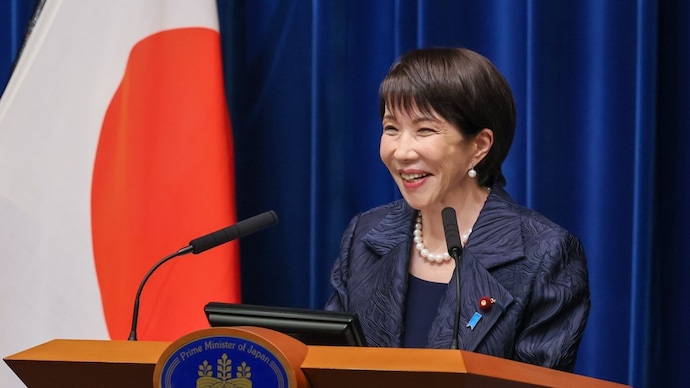

The cabinet meeting on the 21st of April lasted no longer than usual. Yet what Prime Minister Sanae Takaichi's government approved that morning was anything but routine. Japan formally scrapped its ban on the export of lethal weapons — fighter jets, guided missiles, warships, combat drones, the full arsenal — ending a prohibition that had held, in some form, since 1967. Eight decades of post-war restraint were retired in a single agenda item. "With this amendment," Takaichi declared, "transfers of all defence equipment will in principle become possible."
The announcement was framed as a practical necessity. It was, in fact, the conclusion of a decade-long strategic reckoning — one driven in equal measure by a neighbour that chose coercion and an ally that chose conditionality.
The architecture of restraint
Japan's arms export rules were never merely policy. They were self-definition. Introduced in 1967 and hardened into law by 1976, they were the practical expression of Article 9 — the constitutional clause renouncing war that the United States had effectively written for Japan after 1945. The country that had bombed Pearl Harbour and marched through Manchuria would remake itself as the region's most committed pacifist. For decades, that bargain held. Japan prospered under the American security umbrella, rebuilt its economy, and cultivated an international identity premised entirely on restraint and reconciliation.
The first crack appeared on the 1st of July 2014, when Prime Minister Shinzo Abe's cabinet reinterpreted Article 9 to permit collective self-defence — allowing Japanese forces to fight alongside allies under certain conditions. China objected loudly. Much of the Japanese public felt uneasy. In retrospect, it was the first domino. What followed over the next decade was a sustained campaign of pressure from Beijing that would do more to accelerate Japan's rearmament than any hawkish politician in Tokyo ever could.
The threat that built itself
What China chose, in lieu of outright confrontation, was something slower and considerably more calculated. Beginning around 2011, Chinese naval and coast guard vessels began pushing into the East China Sea with growing regularity, asserting territorial claims around the Senkaku Islands in ways carefully calibrated to remain just below the threshold of open conflict. In 2013, Beijing declared a unilateral Air Defence Identification Zone over contested airspace — a bureaucratic assertion of control that left Japan's air force scrambling. Meanwhile, the People's Liberation Army's defence budget kept climbing without interruption, reaching an estimated 1.78 trillion yuan — approximately 246 billion dollars — with a further 7.2 per cent increase announced in 2025.
The economic dimension of China's pressure ran in parallel. Japan had received an early warning in 2010, when Beijing cut off rare earth mineral exports over a fishing boat dispute near the Senkakus. The message was noted, filed, and not forgotten. It was delivered again, more formally and more deliberately, in February 2026, when China placed 20 Japanese companies on its Entity List — a move that signalled the end of improvised retaliation and the beginning of a structured framework of coercion. Renewed bans on Japanese seafood imports and tightened travel advisories followed, each chosen to maximise Japan's exposure whilst minimising Beijing's domestic costs.
Prime Minister Takaichi characterised the move plainly: economic coercion aimed at forcing other countries to submit to China's claims. According to the Czech-based analytical platform Sinopsis, Beijing has simultaneously deployed what it terms a cognitive warfare operation against Japan — a layered campaign combining state media amplification of Japanese militarism narratives, diplomatic pressure, and legal challenges at the United Nations invoking post-war enemy state clauses. The aim, as analysts at the RAND Corporation have assessed, is to weaken cohesion between Tokyo and Washington by making Japan a visible example of the costs Beijing will impose on American allies.
The miscalculation, from Beijing's perspective, was the outcome. Rather than compelling restraint, China's pressure campaign consolidated Japanese resolve. A Cabinet Office poll conducted in January 2026 found that 45 per cent of Japanese respondents believed the Self-Defence Forces should be strengthened. China's coercive tactics helped produce the Liberal Democratic Party landslide that returned Takaichi to office. The public that once harboured deep and genuine ambivalence about rearmament was now broadly, if uneasily, in favour of it.
The American doubt
China's pressure was one half of the equation. The other, equally consequential, was Washington's. During Donald Trump's first term, his administration publicly demanded that Japan and South Korea pay more for the nuclear umbrella that had sheltered both nations since the Cold War. The message delivered — crudely and repeatedly — was that American security guarantees were no longer unconditional goods but services subject to renegotiation. The alliance, Tokyo was being told, was a liability the United States was actively reassessing.
His second term reinforced the lesson with fresh examples. In April 2026, Trump publicly criticised Japan and South Korea for failing to contribute to American military operations in the Strait of Hormuz — the waterway through which both nations receive the vast majority of their energy supplies. He noted that both countries host approximately 75,000 American troops whilst, in his framing, remaining insufficiently grateful for the arrangement. The Trump administration has simultaneously called on Asian allies to raise defence spending to five per cent of GDP — a demand that, if taken seriously, would require Japan to nearly triple its current outlays.
The transactional logic cut deep. Japan purchases roughly 90 per cent of its weapons from the United States and has funded American military installations on its territory — including the bases at Futenma and Iwakuni — to an extraordinary degree. The alliance was never merely transactional on Japan's side. But Washington was now pricing it as though it were. Analysts at the Centre for Strategic and International Studies have further noted that Tokyo is wary of a scenario in which Trump pursues a bilateral accommodation with Beijing that effectively partitions regional influence, leaving Japan's security fundamentally exposed.
Tokyo drew the rational conclusion: a security guarantee whose terms could be renegotiated at the next American election was not a guarantee at all. Self-sufficiency, or something meaningfully closer to it, was the only durable answer.
The industrial logic
Japan's response has not been cautious. Its defence budget for fiscal 2026 reached approximately 10.6 trillion yen — around 66.5 billion dollars — marking the twelfth consecutive annual increase. Under Takaichi, the government achieved its two per cent of GDP spending target a full two years ahead of the original 2027 deadline, underpinned by a five-year, 43 trillion yen build-up programme initiated by the previous Kishida administration in 2022. Japan has formally embraced what its strategic documents describe as a denial competitive strategy — building stand-off strike capabilities, long-range missile systems, and cross-domain asymmetric advantages in space, cyber, and electronic warfare, with the explicit purpose of raising the cost to China of any attempt to alter the regional status quo by force.
The April export decision is the industrial expression of that strategy. Japan's defence sector — anchored by Mitsubishi Heavy Industries, Kawasaki Heavy Industries, and Mitsubishi Electric, all ranked among the world's top 100 arms companies — had been crippled for decades by the constraint of serving a single domestic customer. Small order volumes drove unit costs upward and pushed dozens of contractors out of the market entirely. Opening exports addresses both the strategic and the economic problem simultaneously: broader markets generate economies of scale, reduce per-unit costs, and preserve manufacturing capacity that Japan may require urgently in a prolonged contingency. Japan's top five defence firms recorded a combined 13.3 billion dollars in arms sales revenue in 2024 — a 40 per cent year-on-year increase, according to data from the Stockholm International Peace Research Institute.
The deals already done
The consequences have extended beyond Japan's borders with remarkable speed. Days before the cabinet vote, Tokyo formalised a 6.5 billion dollar agreement for Mitsubishi Heavy Industries to deliver three next-generation Mogami-class frigates to the Royal Australian Navy, with eight further vessels to be jointly constructed in Australian shipyards. It is Japan's largest arms deal in history. Australian Defence Minister Richard Marles welcomed the new export policy as essential to building a seamless bilateral defence industrial base. New Zealand, the Philippines, and Indonesia are among the countries actively exploring procurement from Tokyo.
Separately, Japan is co-developing a sixth-generation combat aircraft with Britain and Italy under the Global Combat Air Programme, with operational deployment targeted for the mid-2030s. A decade ago, Japan building advanced fighter jets for allied air forces would have been unthinkable. Today it is a scheduled programme with a delivery date, a budget, and a growing list of interested observers. All exports of lethal systems require National Security Council approval and are restricted to the 17 nations that have signed defence equipment and technology transfer agreements with Japan — though the new guidelines retain flexibility for exceptions when deemed necessary for national security.
What has actually ended
China's response has been predictable. Beijing's Foreign Ministry described the April decision as the revival of Japanese militarism — a charge that carries genuine historical resonance across the region and will find audiences willing to receive it. Whether it will alter the procurement calculations of any of the governments now in active dialogue with Tokyo is a different matter entirely.
The deeper significance of the April decision lies not in the weapons it permits to be sold but in the argument it has permanently retired. Japan was not simply a pacifist state in the post-war order. It was the pacifist state — the reference point for every serious contention that the most destructive forms of militarism could be genuinely and durably set aside. That argument is now, in any meaningful sense, concluded.
If Japan — facing a rising China and an unreliable America, having spent eight decades honouring a restraint its neighbours never fully reciprocated — has concluded that the current security environment requires this transformation, the case for restraint elsewhere becomes correspondingly harder to sustain. Rearmament conversations already underway in Germany, Poland, South Korea, and across Southeast Asia now proceed with a powerful and historically weighted new reference point.
The post-war security order in Asia was constructed upon three assumptions: that American guarantees were unconditional, that Japanese restraint was permanent, and that Chinese ambitions could be managed through engagement. All three have been tested, found wanting, and quietly set aside. What Tokyo decided on the 21st of April did not cause that collapse. But it marks, as clearly as any single event can, the moment it became official.