
Three scenarios as US's Hormuz blockade risks huge global fallout
The US's move to control the Strait of Hormuz risks bringing in major powers and disrupting the fragile balance of energy flows.
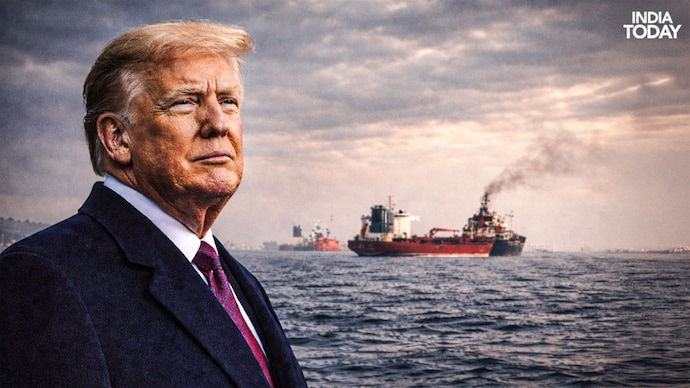
Donald Trump has pledged to block all shipments passing through the Strait of Hormuz.

The collapse of high-stakes negotiations in Islamabad has propelled an already volatile West Asia conflict into dangerous new territory, with US President Donald Trump announcing a sweeping naval blockade across the Strait of Hormuz. By pledging to enforce restrictions on vessels of all nations, Washington has effectively widened the standoff far beyond Tehran, heightening the risk of a broader geopolitical crisis, one that could draw major powers, particularly China and Europe, ever closer to the centre of the confrontation.
The Strait of Hormuz, a narrow maritime chokepoint at the mouth of the Persian Gulf, has already been under strain, with Iran allowing passage to Tehran's friends while restricting vessels linked to US and Israeli allies. What could unfold further as the US’s blockade risks widening a regional standoff into a potential global confrontation?
CHINA IN THE CROSSHAIRS
Among the most consequential questions is how the blockade will impact China, Iran’s closest economic and strategic partner.
Beijing has so far enjoyed relatively uninterrupted access through the strait, aided by Tehran’s preferential treatment. But with the US now seeking to control all maritime movement, a critical question emerges: Will American forces attempt to stop Chinese-flagged vessels entering or exiting the Gulf?
China has now issued a direct response, signalling it may not accept any such move.
Chinese Defence Minister Dong Jun said, “We have trade and energy agreements with Iran; we expect others not to interfere in our affairs. The Strait of Hormuz is open to us.”
The remarks are being seen as a warning to Washington, indicating Beijing’s intent to protect its economic lifelines and resist any attempt to restrict its access.
Such a position could force China into more direct involvement in a conflict that is already intensifying tensions between Washington and Beijing.
The Trump administration has already issued stark warnings. US officials said China could face sweeping trade penalties if it is found supplying weapons to Iran — one of the clearest signals yet of Washington’s willingness to escalate beyond the battlefield.
Reports that Beijing may be preparing to send advanced missile systems and air defence equipment to Iran have further inflamed tensions.
“If China does that, China is going to have big problems,” Trump warned.
TRADE WAR RISKS AND ‘GREY ZONE’ RETALIATION
While China is unlikely to engage in a direct naval confrontation with the US Fifth Fleet in the Persian Gulf, analysts say Beijing has a wide arsenal of “grey zone” economic tools at its disposal.
One immediate option is curbing exports of critical materials, including rare earth elements and key semiconductor components – sectors where China holds significant global leverage. Recent trade disputes have shown how such measures can disrupt Western industries, triggering production slowdowns and supply chain shocks.
At a time when global markets are already grappling with energy volatility, a renewed US-China trade war could deliver a severe double blow to the world economy.
Some analysts believe the crisis could embolden China to ramp up military pressure in other theatres, particularly around Taiwan or in the South China Sea, with Beijing may view the moment as an opportunity to test regional dynamics.
CHINA’S DEEP ENERGY DEPENDENCE
No country apparently has more at stake in the Strait of Hormuz than China. Beijing accounts for over 80 per cent of Iran’s oil exports, importing an estimated 1.5 to 1.6 million barrels per day through complex sanctions-evasion networks. This represents roughly 15-16 per cent of China’s total crude imports, making Iran one of its most critical energy suppliers.
Beyond Iran, China is also heavily reliant on Gulf producers such as Saudi Arabia, the United Arab Emirates, and Kuwait, meaning the crisis extends far beyond bilateral tensions and into the heart of global energy security.
A SECOND CHOKEPOINT THREAT: BAB EL-MANDEB
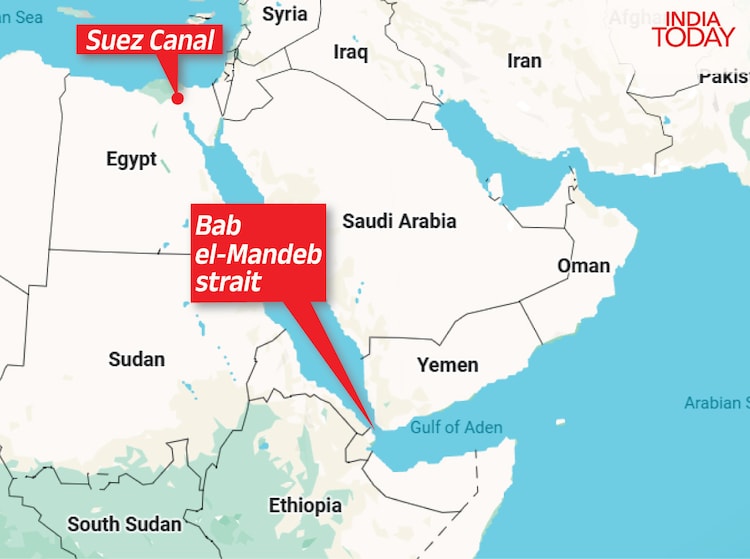
The risks are not confined to Hormuz. Another dangerous scenario involves Yemen’s Iran-backed Houthi rebels expanding the conflict by targeting the Bab el-Mandeb Strait, a vital gateway linking the Red Sea to the Arabian Sea and onwards to the Suez Canal.
This corridor handles around 12 per cent of global seaborne oil trade and serves as a crucial artery for goods moving between Europe, Asia, and the Middle East, with an estimated USD 1 trillion worth of cargo passing through annually. Any disruption here would deliver a fresh shock to global energy markets, with European economies likely to bear the brunt.
HEADACHE FOR EUROPE
The Bab el-Mandeb Strait holds critical strategic importance for Europe as the primary maritime link connecting the oil-rich Persian Gulf to European markets via the Suez Canal.
With the Strait of Hormuz effectively closed due to regional conflict, Bab el-Mandeb has emerged as the last artery for Middle Eastern oil supplies bound for Europe. For instance, Saudi Arabia extracts crude in its Eastern Province and, to bypass Hormuz, transports roughly 7 million barrels per day through the East-West Pipeline to the Red Sea port of Yanbu. From there, tankers sail south through the Bab el-Mandeb, between Yemen and Djibouti, before entering the Gulf of Aden and the Indian Ocean.
Similarly, oil from countries such as Iraq and the UAE that reaches the Red Sea from the south must pass through Bab el-Mandeb to access the Suez Canal or Egypt’s Sumed pipeline, both of which funnel supplies into the Mediterranean for European refineries.
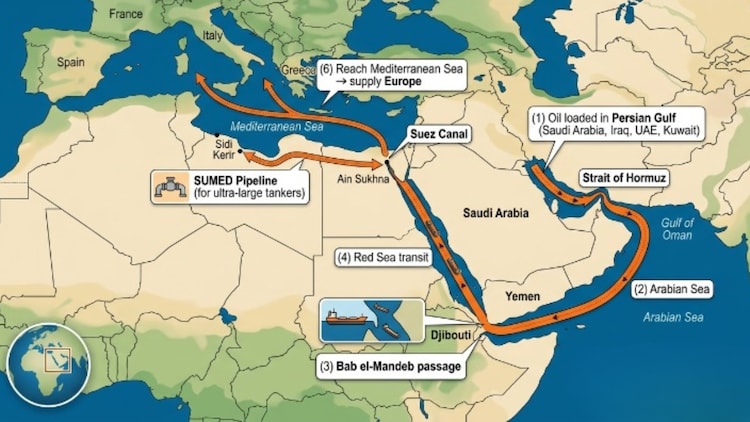
Beyond oil, nearly 10 per cent of global trade transits through the Bab el-Mandeb, including container shipments from China, India and other Asian economies to Europe.
Any blockade of the strait could pull European nations more directly into the crisis, as they seek to secure vital trade routes and stabilise energy supplies. Sustained disruptions would force vessels to reroute around the Cape of Good Hope, significantly increasing transit times, freight costs and insurance premiums. The knock-on effects would likely include higher energy prices, rising inflation and further strain on already fragile supply chains.
Europe’s ability to quickly diversify oil sources remains limited, particularly for refineries in Mediterranean countries such as Italy, Greece and Spain, which are calibrated to process specific Middle Eastern crude grades.
Such a scenario could also bolster Donald Trump’s push for allied naval deployments, potentially widening the conflict into a broader multinational military presence across key maritime corridors.
With tensions escalating across multiple fronts, from the Persian Gulf to the Red Sea and potentially into the Indo-Pacific, the Hormuz blockade risks becoming more than a tactical manoeuvre. Instead, it may mark the opening phase of a wider geopolitical confrontation, with China, global trade networks, and energy security all caught in the crossfire.
- Ends