- Tamilakam’s Travels: Part 1
- Cosmos, Continent, Country: Part 2
- Tamilakam drew its own map: Part 4
- Name Games: Part 5
- Empires, Elites & Europeans: Part 6
- Dravida to Dravidian: Part 7
- The Caldwell Conundrum: Part 8
- Pundit's Paradoxical Passion: Part 9
- Gods, Kings & Grammar: Part 10
- Tolkappiyar: Part 11
- Valluvar: Part 12
- T’rupparam-Kundram: Part 13
- Epic Clash of Faiths: Part 14
- Tamilakam's Epic Counter: Part 15
- Vaishnavism: Part 16
- Tamil and Sanskrit: Part 17
- Anti-Brahminism: Part 18
- Rise & Rifts Part 19
- Bearded Beginning Part 20
- Alliances & Animosities Part 21
- The Thundering Thandhai Part 22
- Shadows and Succession Part 23
- Anna Arch Part 24
- Agitation Alchemy Part 25
- Anna’s CM Crown Part 26
- The Tricolour Twilight: Part 27
- Karunanidhi’s Coronation: Part 28
- Era of Scams & Defiance: Part 29
- Maximum Guarantee Ramachandran: Part 30
- MGR's 'Thottam' Theatre: Part 31
- The Second Show: Part 32
- Accord, Acrimony, Assaults: Part 33
- DMK’s Tiger-Riding: Part 34
- Jayalalithaa’s Crown: Part 35
- The JJ Juggernaut: Part 36
- Karunanidhi Springs: Part 37
- Role Reversal: Part 38
- Mercury Rises in Poes: Part 39
- Amma’s Comeback: Part 40
- An Arresting Personality: Part 41
- Sandalwood Sunset: Part 42
- Back to Future: Part 43
- Thirumangalam: Part 44
- Sangam, Spectrum: Part 45
- The Lady’s Challenge: Part 46
- Jayalalithaa’s Arc: Part 47
- Kalaignar’s Tryst with Tomb: Part 48
- Dravidian Defiance: Part 49
- Tamil Nadu Through Time: Part 50
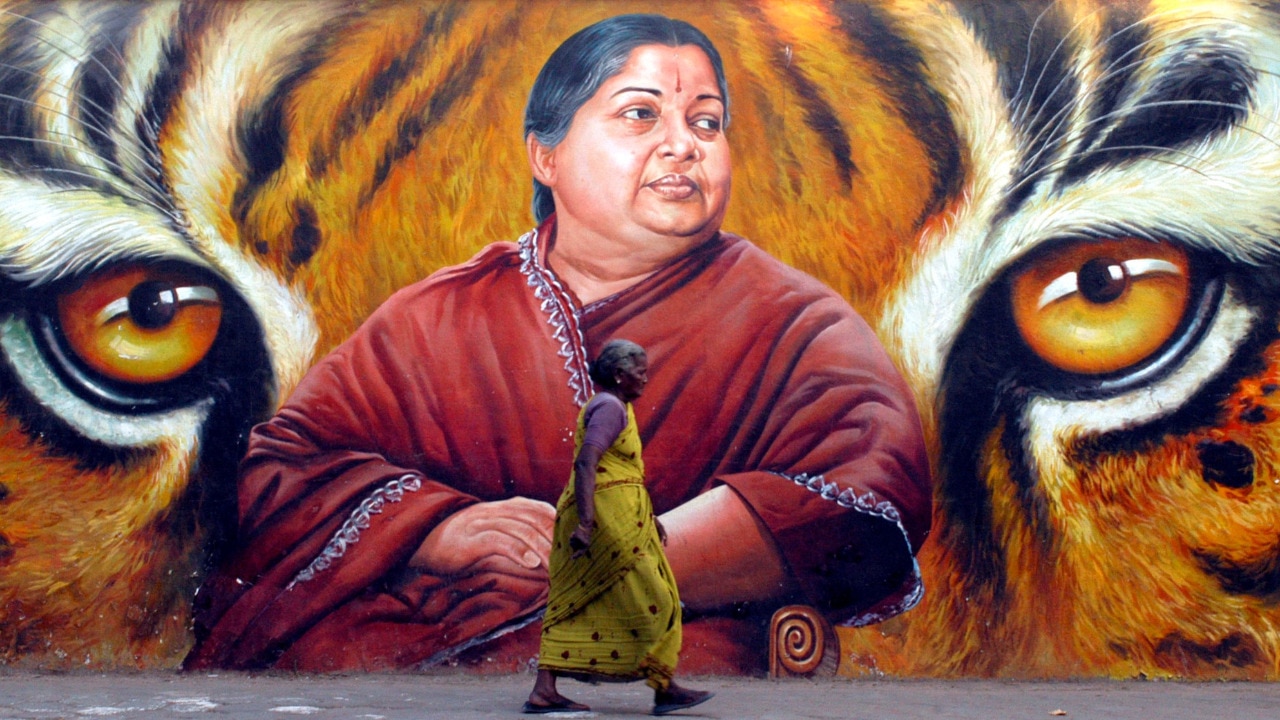
An Arresting Personality: As Jayalalithaa Reigned and Raged
She had not been allowed to contest, but she had been allowed to rule. That was the paradox with which Tamil Nadu entered the summer of 2001. The oath had been taken, the flowers had been showered, and the crowd had moved on. But the argument had only begun. What followed over the next two and a half years was not merely a government. It was a performance of authority: bruising, audacious, often excessive, yet impossible to ignore.
The Oath on Law's Edge
When Jayalalithaa was sworn in as chief minister in May 2001 despite being disqualified from contesting, Tamil Nadu did not so much begin a new regime as step into a constitutional dare. The electorate had handed the AIADMK alliance a thunderous mandate. Jayalalithaa read that verdict in the simplest possible way: if the people wanted her, the law could wait its turn.

That was always her instinct — to treat legitimacy as something more muscular than legality. She did not see herself as a technical offender against a procedural clause. She saw herself as the unquestioned centre of political gravity in a state that had voted not merely for a party but for her personal return. Governor Fathima Beevi, by administering the oath, converted that political claim into a constitutional provocation.
Thus began one of the most dramatic stretches in Tamil Nadu’s public life: a government born not on settled ground, but on contested soil. Jayalalithaa had returned in defiance, and from the very first day, one sensed that she did not intend to govern apologetically. She had come back not to explain herself, but to impose herself.
Midnight Knock, National Shock
The first great demonstration of that instinct came with brutal speed.
In the early hours of June 30, 2001, the police descended on the residence of Karunanidhi, then seventy-seven, and arrested him in a manner so visually violent that it altered the political atmosphere overnight. Tamil Nadu had seen vendetta before. Tamil Nadu had seen drama before. But this was something else: raw, televised, unforgettable.
The images did damage that the FIR could not control. A frail former chief minister in veshti and vest, resisting, shouting, being tugged and hauled in the dark, while family members and party men cried out around him, instantly transformed what may have been intended as legal retaliation into political overreach. It was supposed to be an assertion of state authority. It became, instead, a spectacle of state fury.
The alleged case related to the construction of flyovers in Chennai during the previous DMK regime. On paper, the arrest could be dressed as anti-corruption enforcement. On screen, it looked like vengeance in uniform. That difference mattered more than any charge sheet.
What made matters even worse for Jayalalithaa’s government was that the episode did not stop with Karunanidhi. Union ministers Murasoli Maran and T.R. Baalu, who intervened, were themselves roughed up in scenes that instantly nationalised the controversy. This was no longer Chennai’s revenge theatre. It was now Delhi’s problem too.
And thus, almost perversely, Jayalalithaa’s first great act of power in her second coming gifted her rival something he had not possessed since defeat: sympathy. Karunanidhi, routed only weeks earlier, was suddenly recast as the elderly victim of excessive state force. Jayalalithaa, who had meant to show that she was back in command, instead revealed the peril of command unsoftened by restraint.
This was the first great contradiction of her return. She was severe, yes. But she was also doing, in a manner far more frontal than most governments would hazard, what many administrations privately fantasise about: demonstrating that the state could still frighten. The problem was not that she lacked nerve. It was that her nerve often arrived without cushioning, and spectacle outran strategy.
Press Under Pressure

Jayalalithaa’s relationship with the media, never exactly warm enough for tea and biscuits, remained as frosty as ever. If the press in a democracy is meant to function as a watchdog, under her it was often expected to behave more like a well-trained lapdog — obedient, house-broken and preferably silent unless spoken to.
State advertisements were used as velvet leverage, criminal defamation as a standing weapon, and the assembly’s privilege motion as a kind of antique bludgeon revived for modern intimidation. The message was unmistakable: criticism could be tolerated only if it was sufficiently toothless.
The warning signs had come early. In late June 2001, after the detention of a television reporter, journalists in Chennai attempted a protest march to the Secretariat. They did not get very far. The police blocked the procession, broke it up, and bundled away more than 150 journalists, including senior editors and veterans of the profession, who were detained for hours at the Vepery police station.
It was an extraordinary sight even by Tamil Nadu standards — the Fourth Estate reduced, if only for a day, to a police diary entry. And the timing was almost prophetic. This happened a day before the infamous midnight arrest of Karunanidhi, as though the state had thoughtfully decided to rehearse its handling of inconvenient witnesses before the main show began.
When that arrest unfolded, the script only grew darker. Media personnel were not merely kept away from the scene; many were effectively herded and held in the DGP’s office for hours, preventing real-time coverage of one of the most dramatic arrests in Tamil Nadu’s political history. It was not enough to seize the opponent. The government also wanted to seize the camera angle.
The hostility did not stop there. Much later, in November 2003, after a privilege resolution passed by the assembly, the police descended on the office of one of India’s most prestigious newspapers in what remains one of the most brazen attempts by any elected government to bully the press into obedience.
The sweep was not content with targeting a single byline. It sought, in almost comic overreach, to net the entire publishing food chain — publisher, printer, editor, news editor, bureau chief, reporter — as though journalism itself were a criminal conspiracy. It was so excessive that it almost invited satire, had it not been so deeply unsettling.
This was the paradox of Jayalalithaa and the press. She understood media power intimately, feared it instinctively, used it strategically and distrusted it completely. Under her, a free press was never abolished; it was simply made to feel that freedom could at any time be converted into a police matter.
POTA and the Politics of Severity

The ‘arresting personality’s’ instincts reached one of its most controversial peaks with the arrest of Vaiko in July 2002 under the Prevention of Terrorism Act (POTA).
Vaiko, founder of the MDMK, had by then fashioned himself as a fiery Tamil nationalist voice, often blending oratory, grievance and Eelam-inflected political symbolism. His remarks sympathetic to the LTTE provided Jayalalithaa’s government with the opening it wanted. She used POTA to arrest him and keep him behind bars for an extended period.
The move was legally severe and politically electric. It signalled several things at once. First, that Jayalalithaa had no intention of appearing soft on militancy or separatist rhetoric. Second, that she was willing to use the hardest available instrument of the Indian state even against a Tamil political figure with emotional resonance among sections of the electorate. And third, that she was not going to let anyone else monopolise the rhetoric of Tamil assertiveness.
The symbolism was powerful. Here was a state once accused, in different eras, of being too indulgent toward Eelam sentiment, now jailing a Tamil nationalist leader under anti-terror legislation. It was as severe as political punctuation.
Critics saw overreach. Supporters saw nerves. Jayalalithaa, characteristically, seemed untroubled by the distinction.
Delhi Winced, Chennai Watched
And Delhi saw dread. The Vajpayee government, which was still trying to project coalition stability and institutional sobriety, was appalled by the optics. The Centre had already known that Jayalalithaa could be combustible. It had now been reminded that she could also be uncontainable.
The arrest episodes sharply worsened relations between the Tamil Nadu government and the NDA leadership. Questions arose not merely about law and order, but about gubernatorial propriety, federal restraint and political excess. Governor Fathima Beevi, already under criticism for swearing in a disqualified leader, came under even greater pressure in the aftermath. Before long, her continuance itself became untenable.
The message was plain. Jayalalithaa remained and reigned supreme in Chennai. But beyond it, she had become difficult even for those inclined to work with her. The old pattern had returned: she could dominate the state’s imagination with ease, but she struggled to make that dominance travel gracefully into wider acceptability.
Law Interrupts, Power Waits
In between was the constitutional correction. In September 2001, the Supreme Court held that Jayalalithaa’s appointment as chief minister was invalid. The logic was devastatingly simple. A person disqualified from contesting because of conviction could not be installed through the side door and then allowed six months to regularise the arrangement. Popularity could not disinfect disqualification.
It was one of those rare moments in Indian politics when the law, instead of hovering around power, walked directly into its centre and switched off the lights.
The judgment did not merely inconvenience Jayalalithaa. It publicly embarrassed a regime that had begun by treating the mandate as a sufficient answer to a legal objection. Tamil Nadu had installed her. The Constitution had removed her. And for all her political magnetism, there was no plausible way to stare down a five-judge bench with the same confidence with which one could stare down an opposition bench in the assembly.
Yet even in retreat, she did not appear diminished. She appeared interrupted. That distinction would prove crucial.
Proxy Chair, Permanent Command

Her replacement was O. Panneerselvam, a loyalist so deferential that his elevation instantly entered Tamil Nadu’s political folklore as one of the purest expressions of proxy power in modern Indian politics. Here was a chief minister in office, with files and seals and formal authority, who seemed visibly conscious that he was merely warming the chair.
Everything about that interlude announced its temporary nature. The office had shifted. Power had not. The seat at Fort St George had a new occupant, but the centre of command remained firmly in Poes Garden.
And yet, it would be unfair to treat this merely as theatre. The arrangement also revealed something deeper about Jayalalithaa’s hold over her party and government. AIADMK under her was not a broad church. It was a command structure. Loyalty was not ornamental; it was operational. Ministers, MLAs, officers, functionaries — all understood that the source of authority had not changed merely because the nameplate on the desk and door had.
This was not doctrinaire Dravidianism in the old movement sense. Jayalalithaa’s state was something else: diktat-driven pragmatism with occasional civilisational overtones, social conservatism and executive certainty. It was less about ideological sermons than about unmistakable hierarchy. The system did not need to be persuaded every day. It needed to obey.
The Return Through Andipatti
Jayalalithaa, meanwhile, did what she did best in adversity: she waited without appearing to wait. Legal relief arrived with notable speed. The Madras High Court, and later the Supreme Court, removed the obstacles created by the TANSI and Pleasant Stay convictions that had earlier barred her path.
Once the legal door opened, the political script resumed almost mechanically. She contested the Andipatti by-election, won comfortably in February 2002, and was sworn in again as chief minister in March 2002.
If the first oath of 2001 had been constitutionally provocative, this second return carried the opposite quality: vindication through route correction – the same destination with a tweaked GPS. She had been pushed out by law and brought back through the law’s own openings. It was, in a way, a classic Jayalalithaa recovery cycle — setback converted into pause, pause converted into comeback, comeback converted into fresh authority.
The message to Tamil Nadu was unmistakable. She was not a passing inconvenience in the state’s political life. She was once again the central weather system.
Rule by Shock and Nerve
Once back in office properly, Jayalalithaa governed in the only manner she truly believed in: full control, minimal softness.
Her administration in 2002–03 was combative, centralised and frequently startling in its willingness to take politically costly decisions without much apology. If her earlier 1991–96 regime had often become trapped in excess and personality, this phase had a different texture. It was harsher, leaner, more administrative in tone, and at times almost austerely authoritarian.
The bureaucracy fell in line quickly. One did not get the impression of a government uncertain of itself. Files moved with fear and speed. Orders carried edge. The political class, the permanent executive, trade unions and even sections of civil society began to understand that the new Amma regime was not interested in conversational governance. It intended to rule, not negotiate every comma.
And here lies the difficulty of writing this period honestly. It would be easy to caricature it as mere arbitrariness. That would be lazy. The truth is more interesting. Jayalalithaa was often severe, sometimes to the point of excess, but she was also doing what many governments privately wished to do and lacked the nerve to attempt: willing to wound, scared to strike. In a political culture used to drift, accommodation and endless calibration, Jayalalithaa offered something unnervingly rare: hard, cold decisions.
Many disliked the style. Many quietly admired the steel.
The Iron Hand Test
Nothing captured that more vividly than her confrontation with government employees in 2003.
By then, discontent had been building over service conditions, benefits and state policy. When government employees and teachers escalated their agitation into a strike, Jayalalithaa did not respond with the traditional choreography of Tamil Nadu politics — committee, compromise, consultation, collective bargaining, that trade unions are used to. Instead, she responded like a ruler irritated by insubordination.
Invoking emergency-style legal powers, her government cracked down hard. Tens of thousands of employees were dismissed or suspended in one of the most sweeping disciplinary actions ever seen in the state, nay, nation. The message was not merely administrative; it was moral and political. Government service, in her telling, was not a hereditary entitlement to disruption. The state could not be held hostage by its own payroll.
The move shocked Tamil Nadu. It also split opinion in a revealing way. Organised employees saw cruelty, vindictiveness and over-centralised punishment. But a large number of ordinary citizens, especially those who had long suffered bureaucratic indifference and union-era inertia, saw something else: a government finally willing to confront a protected class.
This was classic Jayalalithaa territory. She took the politically dangerous side of an issue and bet that public resentment against entrenched privilege would carry her through. It was a risky wager. But it reinforced the image she prized: a ruler willing to do what weaker governments feared.
She was not trying to be loved at that moment. She was trying to be obeyed.
Conversion, Sacrifice and Command Morality
This same impulse surfaced in other decisions that startled even those accustomed to Tamil Nadu’s improvisational politics.
Her government enacted the Tamil Nadu Prohibition of Forcible Conversion of Religion Act in 2002, a law that immediately triggered debate over minority rights, religious freedom and the state’s changing ideological posture. The Dravidian movement had historically presented itself as rationalist, anti-clerical and anti-Brahminical. Jayalalithaa’s move suggested a different sensibility — one that was less interested in ideological purity than in command, symbolism and moral order. It is said she even turned down appeals from the Vatican to repeal the law.
Around the same period, her government also moved against certain ritual practices, including animal sacrifice in temples, producing yet another unusual spectacle: a Dravidian state under a leader with film-world roots and a cult political following acting, at moments, like a stern social conservator.
What unified these moves was not theological coherence. It was executive temperament. Jayalalithaa’s state was not animated by a single doctrine. It was animated by her belief that the state must occasionally intervene sharply in domains where others hesitate. Whether one agreed with the decisions or not, one could not accuse them of timidity.
She governed not as a hesitant inheritor of Dravidian convention, but as a ruler prepared to reorder it when it suited her.
Law, Order & Fear of Disorder
Beyond the headline controversies, there was a wider mood to the administration. It projected order. Or, at the very least, it projected the fear of disorder being punished.
This matters because public memory is not made only by landmark cases or election speeches. It is also made by atmospherics — whether people feel the state is present, absent, permissive or watchful. Jayalalithaa’s government cultivated watchfulness. Officials feared transfers. Party men feared displeasure. Critics feared retaliation. Supporters admired the discipline. Detractors called it suffocation. But almost nobody called it lax.
And that, in Tamil Nadu’s political culture, has often counted for something. The state has never been immune to the appeal of a ruler who appears to govern with a steel ruler in hand. Jayalalithaa understood that instinctively. She may have overreached often, but she rarely looked unsure.
The Opposition Learns to Wait
If Jayalalithaa dominated the state’s surface during 2001–03, the opposition spent the same period learning a quieter art: patience.
The DMK, badly beaten in 2001, initially looked shaken and exposed. But the arrest of Karunanidhi had unexpectedly given it a new emotional register. The party could now speak not only as a defeated formation, but as a wronged one.
Karunanidhi himself, for all the physical indignity of June 2001, remained what he had always been at his most dangerous: a patient political recycler of injury. He did not need immediate recovery. He needed accumulation — of resentment against Jayalalithaa’s severity, of disquiet among government employees, of discomfort among minorities, of anxiety among allies, of small bruises gathering into a larger anti-incumbent mood.
The DMK therefore did not spend these years in heroic frontal assaults. It spent them in watchful repositioning. It knew that Jayalalithaa’s greatest strengths — command and decisiveness — could also become liabilities if she pushed them too far. And she often did.
Delhi Distance, Chennai Memory
At the national level too, the DMK’s position during this period carried a certain irony. It remained part of the NDA under Vajpayee, even though state-level politics in Tamil Nadu had turned sharply hostile and Jayalalithaa herself was once again out of that frame.
This arrangement was useful, but increasingly awkward. The DMK got relevance and access in Delhi. The BJP got a southern ally with parliamentary utility. But the ideological and emotional chemistry was never especially organic, and after Gujarat in 2002, the distance between the DMK’s preferred self-image and the BJP’s expanding national profile became harder to ignore.
Still, politics often lives longer than chemistry. The relationship continued because it remained useful. But one could already sense that the arrangement was being held together more by arithmetic than warmth.
That undercurrent would matter greatly later. For now, however, it remained background music rather than headline noise.
Maran, Memory & the Delhi Bridge

If one man embodied the DMK’s sophistication in coalition-era Delhi, it was Murasoli Maran. He was more than Karunanidhi’s nephew, more than a union minister, more than a party intellectual. He was the DMK’s most polished bridge between Tamil Nadu’s Dravidian instincts and Delhi’s power circuits. He could speak coalition arithmetic in one room, economic policy in another, and party strategy in a third. He made the DMK legible to the capital in a way few others could.
His illness, therefore, was not merely a personal tragedy to Karunanidhi. It was political depletion. As his health declined, the DMK was not just watching a senior leader suffer; it was slowly losing one of its most effective interpreters of national power.
So, when Murasoli Maran died in November 2003, it marked the end of a distinct chapter in Dravidian coalition politics.
A Tribute and a Brewing Shift
Prime Minister Atal Bihari Vajpayee’s tribute to Maran, after flying into Chennai, carried genuine warmth and respect. It was one of those rare moments in Indian politics when the formal gestures of condolence also conveyed the residue of real political regard. Vajpayee understood utility, but he also recognised calibre, and Maran had been one of the more capable coalition minds of that age.
Yet politics has a way of making even heartfelt tributes look ironic in hindsight. For while Delhi mourned and Chennai reflected, something was already beginning to stir beneath the surface. The equations that had held through convenience and necessity were beginning to loosen. The tea in Delhi still looked warm. But in the Tamil kitchen, another brew had already been set on the boil.
At the start of another year, decade, century and millennium, Jayalalithaa remained where she most preferred to be — at the centre of the state’s imagination, feared, debated, obeyed, admired and opposed in equal measure. She had governed in fury, overreached in spectacle, ruled in command, and yet stayed formidable enough to define the political weather.
But beneath that formidable facade, the undercurrents had begun to move. The opposition had learnt to wait. Old allies had begun to look elsewhere. New resentments had quietly gathered. And the next turn would show that in Tamil Nadu, even the most arresting personality cannot indefinitely arrest the motion of politics.
Next | Somersaults, Sacred Shocks, Sandalwood Sunset and a State at Sea
About
Tamil Nadu is the graveyard of national political parties. It buried the Congress at its peak then in 1967. The BJP, also at its peak now, has been pregnant with possibilities but has failed to deliver. Never a serious player in the state before the dawn of the Modi-era, the BJP has been humbled in every election since his arrival in 2014 (2019, 2021 and 2024).
Pundits and laypersons, Tamil Nadu confounds everybody alike. What makes it the strongest citadel of regionalism in contemporary politics that is now soaked in nationalism? Why is it a unique entity even among its culturally similar southern states? All these states are also fiercely proud of their cultural moorings, but none practices antagonism to national parties as a principle of state policy, so to say. What makes it stand out and stand apart? Is it true that a monolithic national narrative suppresses or seeks to suppress the state's distinct Tamilakam (Tamil Nadu of yore) identity and ancient glory? Or, do the state's Dravidian parties deliberately stoke the sense of cultivated alienation and grievance to perpetuate their careers? What has Dravidian politics delivered that the state does not want a taste of any other model? What is the collective angst of the Tamils? Is it justified? Why can't the rest of India fathom it? As another grand electoral spectacle looms in 2026, these are some of the myriad questions that need to be addressed. Not to predict winners and losers, but just to understand why Tamil Nadu is the way it is.
In this new series, that is what Chennai-based senior journalist, TR Jawahar, will attempt to do. He will dig deep into history and heritage, arts and archaeology, language and literature, cinema and culture, kingdoms and conquests, castes and communities, religion and race and, of course, politics and pelf, to paint a picture of the state that might help you understand whatever happens when it happens.