- Tamilakam’s Travels: Part 1
- Cosmos, Continent, Country: Part 2
- Tamilakam drew its own map: Part 4
- Name Games: Part 5
- Empires, Elites & Europeans: Part 6
- Dravida to Dravidian: Part 7
- The Caldwell Conundrum: Part 8
- Pundit's Paradoxical Passion: Part 9
- Gods, Kings & Grammar: Part 10
- Tolkappiyar: Part 11
- Valluvar: Part 12
- T’rupparam-Kundram: Part 13
- Epic Clash of Faiths: Part 14
- Tamilakam's Epic Counter: Part 15
- Vaishnavism: Part 16
- Tamil and Sanskrit: Part 17
- Anti-Brahminism: Part 18
- Rise & Rifts Part 19
- Bearded Beginning Part 20
- Alliances & Animosities Part 21
- The Thundering Thandhai Part 22
- Shadows and Succession Part 23
- Anna Arch Part 24
- Agitation Alchemy Part 25
- Anna’s CM Crown Part 26
- The Tricolour Twilight: Part 27
- Karunanidhi’s Coronation: Part 28
- Era of Scams & Defiance: Part 29
- Maximum Guarantee Ramachandran: Part 30
- MGR's 'Thottam' Theatre: Part 31
- The Second Show: Part 32
- Accord, Acrimony, Assaults: Part 33
- DMK’s Tiger-Riding: Part 34
- Jayalalithaa’s Crown: Part 35
- The JJ Juggernaut: Part 36
- Karunanidhi Springs: Part 37
- Role Reversal: Part 38
- Mercury Rises in Poes: Part 39
- Amma’s Comeback: Part 40
- An Arresting Personality: Part 41
- Sandalwood Sunset: Part 42
- Back to Future: Part 43
- Thirumangalam: Part 44
- Sangam, Spectrum: Part 45
- The Lady’s Challenge: Part 46
- Jayalalithaa’s Arc: Part 47
- Kalaignar’s Tryst with Tomb: Part 48
- Dravidian Defiance: Part 49
- Tamil Nadu Through Time: Part 50
Coalition Politics in India: Tamil Nadu's Influence in the 1990s
If Tamil Nadu politics before the nineties often resembled a game of snakes and ladders played under Delhi’s shadow, the decade after 1991 altered the board itself. Article 356, once the Centre’s favourite constitutional crowbar, had been sharply restrained by the Supreme Court’s Bommai judgment of March 1994, clipping Delhi’s old habit of toppling elected state governments at whim.
The axe that had felled ministries in the state for decades was no longer free to swing. And that constitutional correction produced one of Indian politics’ finer ironies: the old question had once been whether Delhi would allow Tamil Nadu to govern itself. The new question was whether Delhi could govern itself without Tamil Nadu.
That role reversal would define the late nineties. Tamil Nadu, long accustomed to resisting central overreach, was now discovering that its own parties could help make and unmake governments in the capital. The state that had spent decades fearing Delhi’s hand was beginning, at last, to hold a few fingers of its own around the national neck.
When 356 Axe Lost its Edge
For Tamil Nadu, the fear of arbitrary dismissal was never an abstract constitutional concern but a recurring historical wound. The state had seen elected governments cut short often enough — four times in fifteen years — to treat the Centre’s “constitutional satisfaction” with justified suspicion. Article 356 had functioned less like an emergency valve than a political axe. Governments could be shown the door first and asked legal questions later.
The Bommai ruling did not abolish the Article, but it civilised its use. The Supreme Court insisted that legislative majorities must ordinarily be tested on the assembly floor, not guessed at in Raj Bhavans or engineered in Delhi drawing rooms. It was a jurisprudential slap on the old habit of treating states as inconvenient subsidiaries.
Its political consequences were not instantly visible, but they were profound. In Tamil Nadu, it helped create a new expectation: that an elected government, however disliked, would likely get its full five years unless it collapsed from within. This did not make governments gentler or wiser; it merely made them harder to evict. Stability was no longer guaranteed by affection or lack of it, but by law.
That legal assurance would quietly become one of the invisible foundations of the state’s modern duopoly. Once dismissal from above became less likely, politics at home hardened into a different kind of certainty.
The Same Cliff, Every Five Years
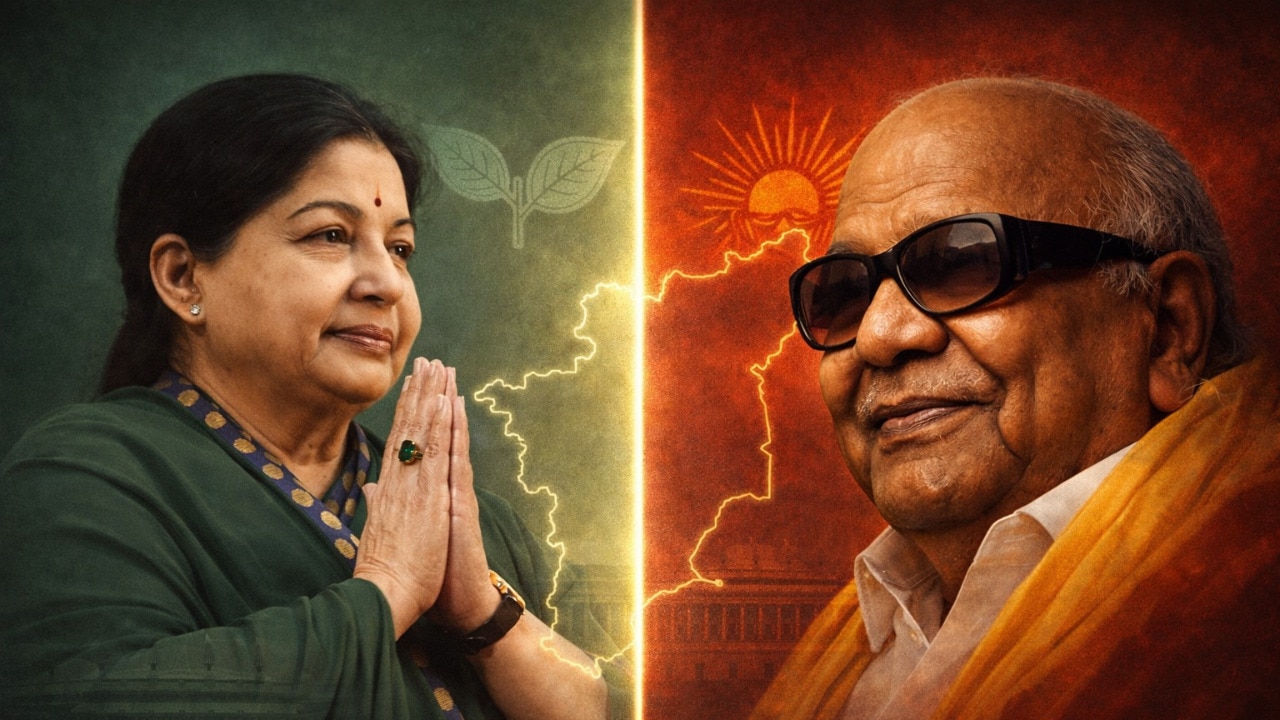
And yet, for all the constitutional novelty and coalition complexity, one political fact hardened at home with almost comic stubbornness: from 1991 onward, Tamil Nadu’s voters would keep leaping every five years from the same cliff — from Jayalalithaa to Karunanidhi, from AIADMK to DMK, and back again, as though duopoly itself had become democracy’s favourite exercise.
Once the threat of central dismissal receded, the battlefield narrowed. Voters increasingly saw the Assembly election not as a test of whether a government would survive, but as a five-year handover between the only two machines they believed capable of running the state. The cliff had two sides, but the leap was always familiar.
By the mid-nineties and to date, Tamil Nadu had settled into a peculiar political rhythm: highly dramatic, yet structurally repetitive. Elections looked volcanic, but their outcomes increasingly resembled pendulum swings between the same two poles. The Congress had been reduced to memory, the Left totally left out, and the smaller regional outfits to bargaining chips or rhetorical irritants. The real contest had narrowed to a duel between two Dravidian formations whose founders had once emerged from the same ideological womb and whose successors now treated each other as hereditary enemies.
This was not a collapse of democracy, but it was certainly a concentration of it. Tamil Nadu’s electorate remained alert, punitive and highly participatory. Yet its anger and favour were being channelled through the same twin pipelines. One cycle would make Jayalalithaa look sovereign and unassailable; the next would reduce her to rubble. One would cast Karunanidhi as a seasoned administrator and national tactician; the next would make him appear tired, compromised or over-familial.
The voters were not fools. They knew they were jumping from the same cliff. But they also knew the alternatives were either too weak, too fragmented, or too dependent on one of the two giants to matter independently. In that sense, Tamil Nadu had evolved a paradoxical political maturity: it had rejected one-party permanence, but not duopoly itself. Its ballot had become both a weapon of punishment and a ritual of repetition.
TN Fort Safe, Delhi’s Blocks Wobbly
The 1996 verdict mattered for reasons deeper than its scale. Karunanidhi returned to Fort St George with a mandate that was not merely victorious but vindicatory. The humiliation of Jayalalithaa’s first regime had been translated not only into state power but into parliamentary weight.
That was the visible triumph. The deeper significance lay elsewhere. This was the first clear post-Bommai phase in which Tamil Nadu’s elected government began its term with relatively little fear of Delhi’s dismissal of power. The old uncertainty had shifted upward. It was now the Centre, not the state, that looked provisional. And Delhi soon proved exactly that.

The 1996 general election produced one of the most unstable phases in Indian politics. Congress had weakened, the BJP had risen without yet consolidating, and majority rule had dissolved into arithmetic. Vajpayee’s first government lasted just thirteen days before numbers undid rhetoric. The United Front then took office with Congress support, elevating ‘humble farmer’ H.D. Deve Gowda through the now-familiar logic of coalition compromise.
For Tamil Nadu, this was no sideshow. The DMK and its allies were not decorative passengers in the new arrangement; they were part of the axle. Their presence in Delhi converted regional strength into cabinet relevance and federal leverage. The old Dravidian complaint had been that Delhi neither listened nor understood. Now Delhi had no option but to count them — and count on them.
This was the period’s deepest inversion: while Fort St George looked safer than ever from arbitrary central intervention, Delhi itself had become a revolving foyer, and Tamil Nadu’s parties had begun learning how to hold the door.
Karunanidhi’s Early Reset
The early months of the 1996 DMK regime were marked by a deliberate attempt to restore the grammar of government after the excesses of the previous dispensation. Karunanidhi returned with the old Dravidian promise of administrative sobriety, institutional process and a more breathable political atmosphere.
He moved quickly to project order. Files began to act with less theatrical anxiety, bureaucrats sensed that government was once again being conducted through departments rather than durbars, and the assembly regained a semblance of argumentative normalcy. The tone was not revolutionary, but restorative.
At the same time, the regime quietly reinforced the state’s urban, infrastructural and industrial direction. Chennai’s civic and transport pressures were increasingly treated as structural concerns, while policy continuity and bureaucratic signalling helped sustain Tamil Nadu’s reputation as an investment-friendly destination. The message was clear: the state was open for business again — and without wedding chandeliers.
Fronts, Affronts & Footnotes
If state politics now looked stable, national politics looked like a parade of fronts forever in search of a backstage. The late nineties were an era in which “front” became both a noun and a nuisance. There was the United Front, the anti-Congress reflex, the anti-BJP impulse, the Congress-supported anti-BJP, anti-Congress arrangement, and enough ideological acrobatics to keep political cartoonists employed.

What had once been a politics of keeping the Congress out had, by the mid-nineties, morphed into a politics of figuring out how to keep the BJP out — or use it without admitting so. This was not hypocrisy alone; it was coalition India’s peculiar moral weather. Parties that had once spoken in grand ideological paragraphs were now writing their politics in footnotes and caveats.
By April 1997, the Congress, under the ‘old man in a hurry’, namely Sitaram Kesari, had pulled the plug on Deve Gowda, and the polished diplomat I. K. Gujral became the consensus PM.
Tamil Nadu excelled in this climate because its parties had long practised a politics of rhetorical absolutism and practical elasticity. The Dravidian movement could thunder against Delhi in the morning and negotiate with it by afternoon without losing its instinctive sense of theatre. Principles were not always abandoned; they were often rearranged.
The Jain Jolt

A ghost from the past has now landed. The assassination of Rajiv Gandhi on May 21, 1991, at Sriperumbudur had never really ceased to haunt Tamil Nadu, even when politics elsewhere tried to move on. The killing itself was immediate, spectacular and devastating. But its political afterlife was slower, deeper and, in many ways, more corrosive.
The criminal investigation moved with unusual intensity. The Special Investigation Team pieced together the conspiracy through forensic evidence, intercepted trails, witness testimony, hideouts and the now-iconic photographs recovered from the camera of Haribabu, who died in the blast. The key LTTE-linked operative Sivarasan, the one-eyed mastermind associated with the execution of the plot, became the face of the manhunt. By August 1991, he and others were cornered in Konanakunte near Bengaluru, where the fugitive trail ended in gunfire, cyanide and closure of one kind — but not of all kinds.
The legal case proceeded through the designated court process, and the prosecution sought to establish not merely the chain of execution but the architecture of conspiracy. Yet alongside the judicial track ran a more politically combustible question: what had been the climate, network and permissive environment in which the LTTE had once operated in Tamil Nadu? That was never merely a legal query. It was also a moral accusation, an ideological contest and, when convenient, an electoral weapon.
This was the context in which the Jain Commission acquired such force. In November 1997, strangely, its initial findings were first ‘tabled’ in the media before being ‘leaked’ to Parliament. Tasked with examining the broader conspiracy surrounding Rajiv Gandhi’s assassination, the commission brought back to centre-stage the uncomfortable overlap between Tamil sentiment for Sri Lankan Tamils, the LTTE’s once-expansive footprint in the state, and the political burden of proximity.
For the DMK, which had long argued that support for Sri Lankan Tamils and complicity in assassination was neither identical nor interchangeable, the commission’s shadow was dangerous even where its conclusions were politically stretched. In Delhi, perception often outruns precision, and old smoke is enough to trigger fresh alarm.
The real circus, however, lay in Congress’s own shifting posture and somersaults. In 1991, the party had not hesitated to cast a long shadow on the DMK, helping justify the dismissal of its government. In 1996, when coalition arithmetic demanded flexibility, it had no qualms in supporting a central arrangement in which the DMK was an important constituent. Then, in 1997, once the Jain Commission findings and their political reading gathered traction, Congress rediscovered ethical outrage and demanded that the DMK be shown the door.
This was not just inconsistency. It was a practised elasticity in which grief, convenience and arithmetic took turns wearing the mask of moral principle.
Gujral: Going, Going, Gone
Prime Minister I.K. Gujral, who carried himself with a diplomat’s softness and a coalition manager’s caution, now found himself facing a test that was less about one party than about the very logic of coalition government. Congress wanted the DMK removed from the ruling arrangement. Gujral refused.
This was not an act of romantic loyalty but one of structural sense. If a supporting party could insist on the retrospective political purification of a coalition by expelling one of its constituents, then the government would no longer be a coalition at all. It would be a hostage camp with cabinet portfolios.
Congress did what Congress, in such moods, often does best. It withdrew support while draping itself in the language of conscience. Gujral’s government fell. And thus Delhi found itself collapsing under a Tamil Nadu-linked cloud.
For the state, this was a profound inversion of the older order. Tamil Nadu had spent decades fearing the central axe. It now found itself at the centre of the arithmetic and emotion that could bring down governments in the capital. The Centre was no longer the unquestioned disciplinarian. It had become, in many ways, a nervous landlord living at the mercy of quarrelling tenants.
Year end, India was headed back to the polls. Three PMs had risen and fallen in 18 months.
Jaya’s Revival
If Karunanidhi’s return had been a restoration, 1997 for Jayalalithaa was something more difficult and, in many ways, more revealing: it was a year of endurance.
She had been arrested in December 1996, incarcerated in Chennai Central Jail, and publicly exhibited as the fallen emblem of corruption-era excess. In the political morality play of that moment, she was meant to serve as a cautionary spectacle — the once-commanding ruler reduced to political debris, a warning to others on the perils of overreach.
But Jayalalithaa was never built for quiet exits.
Her release in the first week of January 1997 did not restore office or erase disgrace, but it revived something more fundamental — motion. The year was not one of immediate electoral recovery, but of hard political reconstitution. The law haunted and hunted her relentlessly. The disproportionate assets case, among others, continued to weigh on her heavily. Courtrooms, petitions, procedural battles, anticipatory strategies, appeals and legal positioning became part of her daily political weather. She was no longer functioning as a conventional opposition leader so much as a political defendant under permanent glare and siege.
And yet, if the law was trying to reduce her to an accused, she was trying just as hard to reassemble herself as a wronged protagonist.
That effort required not merely legal stamina, but emotional theatre of a very high order. Jayalalithaa understood something that many of her critics underestimated: in Tamil Nadu, humiliation is not always terminal. If the protagonist survives it with enough steel, public shame can be re-scripted as persecution, and defeat can become the first act of return. She knew that political disgrace, if sufficiently dramatic, could be made recyclable.
That was the real labour of 1997. Jayalalithaa was not simply fighting cases; she was rebuilding psychological authority. Cadres who had watched their leader move from power to prison had to be reminded that in Tamil Nadu politics, burial is often only incubation with a legal file attached.
Her rhetoric and posture gradually shifted. She was no longer projecting invincibility in the old style. Instead, she was inviting the state to see her as a leader subjected not merely to justice, but to its excess — excessive prosecution, excessive humiliation, excessive triumphalism by her opponents. It was a subtle but crucial gambit. She was converting disgrace into grievance, grievance into resolve, and resolve into political fuel.
The Puratchi Thalaivi, a staunch believer in astrology, the Almighty and, above all, her own might, bided her time. This, in retrospect, was the beginning of her comeback.
The BJP Staircase

That comeback needed a route, and the route lay not first through Fort St George, but through Delhi. Jayalalithaa’s decision to align with the BJP ahead of the 1998 Lok Sabha election was one of the most consequential tactical moves of the period. It was not ideologically seamless, nor did it pretend to be. But coalition India had already made ideological neatness look like a museum piece. Arithmetic, timing and leverage mattered more.
The BJP needed a strong regional ally in Tamil Nadu, where it lacked organic and organisational depth. Jayalalithaa needed national relevance, parliamentary heft and a northern bridge to secure protective central power. Each had what the other lacked.
The alliance that emerged was not merely a two-party arrangement but a broader anti-DMK front, bringing together the AIADMK, the BJP, the PMK, the MDMK and others in varying combinations and local calculations. The saffron party, in a state where it could not yet gain a footing on its own, accepted the practical wisdom of junior status in the South. Jayalalithaa, in turn, accepted that a northern staircase was worth climbing even if the décor and demeanour were distinctly unfamiliar.
The alliance was, in essence, a transaction between need and opportunity. But in politics, those are often the most durable materials — at least for the election season.
Kovai Fire

Then came Coimbatore. On 14 February 1998, the city was ripped apart by a series of coordinated bomb blasts. The explosions, linked to Islamist extremist networks and timed around the anticipated visit of L.K. Advani, killed scores and injured many more.
Coimbatore, one of Tamil Nadu’s most industrious and self-confident urban centres, was suddenly transformed into a national symbol of vulnerability. The blasts did not emerge from nowhere. The city had already been carrying rising communal tension through the nineties, sharpened by earlier violence, retaliatory anger, police action, local radicalisation and the growth of both Islamist and Hindu mobilisation.
But the scale and timing of the attack altered the electoral climate immediately. What had been shaping up as a contest defined by coalition instability, the Jain Commission and anti-incumbency math was now infused with a sharper and more combustible question: Who had failed to read the gathering danger?
For the DMK government, the timing was disastrous. Already signed by the Jain Commission controversy in Delhi, it now faced the charge that it had failed to anticipate or contain an escalating extremist threat on its own soil. Karunanidhi was not politically demolished by Coimbatore, but the moral weather around his regime changed. Security and governance now entered the campaign not as abstract talking points, but as bloodied facts.
Jayalalithaa moved with characteristic speed. She did what seasoned opposition leaders do in moments of state failure: she converted tragedy into political accusation. Coimbatore became, in her telling, not only a terror attack but an indictment of the ruling regime’s judgment and vigilance. The BJP, as her ally, gained immediate resonance from the security narrative. The emotional centre of the election shifted.
Tamil Nadu, which had long prided itself on being relatively insulated from the more combustible communal patterns seen elsewhere in India, was now confronting the reality that exceptionalism is no firewall.
Junior Partner, Senior Pain
When the votes were counted, the shift was unmistakable. The AIADMK-led alliance won 30 of Tamil Nadu’s 39 Lok Sabha seats, while the DMK-led front was reduced to 9. It was one of those familiar but still astonishing Tamil Nadu reversals: a state that had routed Jayalalithaa in 1996 had, within two years, restored her to national relevance with emphatic force.
This was not, strictly speaking, a full moral absolution. The legal cases had not vanished. The memory of 1996 had not dissolved into sentimentality. But elections do not function as courtroom ledgers. They are shaped by momentum, fear, fatigue, anger, security, tactical alliances and the perpetual Tamil Nadu habit of changing the script without changing the principal cast.
Jayalalithaa had not merely survived. She had re-entered the main frame. At the national level, the results allowed Atal Bihari Vajpayee to return to office at the head of a coalition that would come to be known more firmly as the NDA. But the real story, at least from the Tamil Nadu angle, was not the formation of the government. It was the terms of its fragility.
On paper, Jayalalithaa was a junior partner in the new arrangement. In practice, she was something much more delicate and dangerous: an ally with arithmetic value and an appetite for leverage. Her numbers mattered. Her mood mattered. Her timing mattered. And she made sure Delhi understood that support was not to be confused with surrender.
One of the earliest signs came in the matter of the letter of support to Vajpayee. She did not rush to hand over compliance wrapped in courtesy. The delay was not merely procedural. It was political signalling. It conveyed, even before the coalition had properly settled into office, that this would not be a relationship of quiet gratitude. It would be a deal of calibrated pressure. The PM-in-waiting had to endure a painful 10-day cup-and-lip syndrome before finally taking oath, more in relief than celebration.
That was the beginning of a tumultuous equation. Jayalalithaa had entered the Union arrangement not as a decorative ornament, but as a vicious variable. She had not climbed the northern stairs simply to admire the architecture. She had mounted it to test the railings.
Beginning of End
And thus, by March 1998, the transformation was complete. Tamil Nadu’s government, under Bommai’s protective afterlife, had become legally harder to dislodge. Delhi’s regimes, under coalition arithmetic, had become structurally easier to dismantle. The state that had once feared the central axe was now learning to hold the handle.
The cliff-jumping voter had done it again — not by abandoning the familiar duel, but by rearranging its results.
Karunanidhi remained in Fort St George, but no longer under the unclouded sky of 1996. Jayalalithaa, written off as a cautionary tale barely a year earlier, was once again within touching distance of national consequence. Congress had proved, yet again, that its moral outrage is always installment-based. And Vajpayee, for all his grace and stature, had inherited a chair whose legs extended awkwardly into Poes Garden.
The stage was now set for more turbulent times — with the Delhi throne beginning to rock precariously at Puratchi Thalaivi's whim.
Next | Mercury Rise in Poes: Delhi Heatwave, Teacup Storms & Tectonic Shifts
About
Tamil Nadu is the graveyard of national political parties. It buried the Congress at its peak then in 1967. The BJP, also at its peak now, has been pregnant with possibilities but has failed to deliver. Never a serious player in the state before the dawn of the Modi-era, the BJP has been humbled in every election since his arrival in 2014 (2019, 2021 and 2024).
Pundits and laypersons, Tamil Nadu confounds everybody alike. What makes it the strongest citadel of regionalism in contemporary politics that is now soaked in nationalism? Why is it a unique entity even among its culturally similar southern states? All these states are also fiercely proud of their cultural moorings, but none practices antagonism to national parties as a principle of state policy, so to say. What makes it stand out and stand apart? Is it true that a monolithic national narrative suppresses or seeks to suppress the state's distinct Tamilakam (Tamil Nadu of yore) identity and ancient glory? Or, do the state's Dravidian parties deliberately stoke the sense of cultivated alienation and grievance to perpetuate their careers? What has Dravidian politics delivered that the state does not want a taste of any other model? What is the collective angst of the Tamils? Is it justified? Why can't the rest of India fathom it? As another grand electoral spectacle looms in 2026, these are some of the myriad questions that need to be addressed. Not to predict winners and losers, but just to understand why Tamil Nadu is the way it is.
In this new series, that is what Chennai-based senior journalist, TR Jawahar, will attempt to do. He will dig deep into history and heritage, arts and archaeology, language and literature, cinema and culture, kingdoms and conquests, castes and communities, religion and race and, of course, politics and pelf, to paint a picture of the state that might help you understand whatever happens when it happens.