
How Delhi's vintage cars vanished quietly, taking their heritage along
Older cars once gave Delhi's streets a sense of history and identity, but strict age-based regulations over the past decade have quietly pushed this living automotive heritage out of public view.
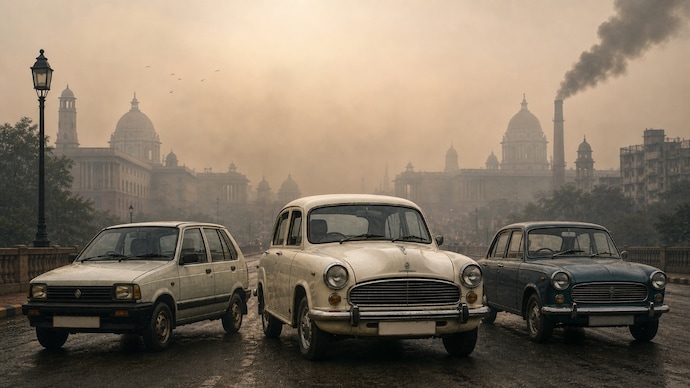

There was a time when the streets of Delhi told stories, not just of movement, but of memory. A drive through Lutyens’ boulevards or the older lanes of South Delhi would occasionally reveal a lovingly preserved Hindustan Ambassador, a stately Premier Padmini, or even a rare classic maintained with pride across generations. These cars weren’t just machines they were heirlooms, carrying family histories within their metal and chrome.
Step outside Delhi and the contrast becomes hard to ignore. In parts of southern India, it is still possible to spot well-kept classics weaving through everyday traffic. A neatly preserved Mercedes-Benz W124, an ageing but enduring Maruti 800 or even the occasional Premier Padmini continue to exist not as museum pieces, but as living parts of the automotive landscape. These cars survive because regulations are less absolute, allowing enthusiasts to maintain and occasionally use them. In Delhi, however, that organic presence has all but vanished. What remains is not a gradual fading, but an abrupt absence, where heritage hasn’t aged out naturally, but has been legislated out of sight.
But over the past decade, much of that rolling heritage has quietly disappeared.
The shift began when environmental concerns took centre stage. Acting on the growing air pollution crisis, directives backed by the National Green Tribunal and reinforced by the Supreme Court of India led to a sweeping regulation: diesel vehicles older than 10 years and petrol vehicles older than 15 years would no longer be permitted on Delhi’s roads. The policy was designed as a decisive intervention to curb vehicular emissions in one of the world’s most polluted capitals.
What the rule did not account for, however, was nuance. It made no distinction between a high-mileage, poorly maintained daily commuter and a carefully preserved classic driven sparingly. Overnight, heritage vehicles many of which contributed negligibly to pollution were treated the same as end-of-life cars. Owners found themselves cornered into difficult choices: deregister their vehicles, move them out of Delhi, or simply keep them locked away. In effect, a policy aimed at cleaning the air also ended up silencing a part of the city’s cultural expression.
The impact has been gradual but unmistakable. The casual sightings of vintage cars that once added character to Delhi’s streets have all but disappeared. Enthusiast circles have shrunk, weekend drives have reduced, and the sense of community around classic car ownership has weakened. Unlike global hubs where automotive heritage is celebrated through events such as the Pebble Beach Concours d'Elegance, Delhi’s vintage car culture has retreated into private garages and closed compounds, largely out of necessity rather than choice. Forget classic cars, even a sighting of a Maruti 800 feels like walking down the memory lane.
There is, of course, a valid argument on the other side. Older vehicles typically lack modern emission control systems, and phasing them out does contribute to cleaner air. Delhi’s pollution crisis demanded bold measures, and the age-based ban was one of the most visible steps in that direction. Yet, critics continue to point out that heritage vehicles form a minuscule fraction of the total vehicular population and are rarely used for daily commuting. In many global cities, such vehicles are granted limited-use exemptions, acknowledging their cultural value while still maintaining environmental safeguards.
Beyond the cars themselves, an entire ecosystem has been affected. Workshops that once specialised in restoration have seen demand shrink. Skilled mechanics familiar with carburettors and older engineering are becoming rare. Spare parts networks have thinned out, and the informal knowledge that sustained this niche community is gradually disappearing. What was once a living, breathing subculture is now at risk of becoming a static memory.
The air quality battle is ongoing. Even after this regulation, Delhi remains among the most polluted cities in the world, raising a pressing question: has the ban truly delivered on its promise, or has it largely ended up erasing automotive heritage without meaningfully solving the problem it set out to fix?
And with it, a small but meaningful part of Delhi’s identity has slipped out of sight.
There are workable middle paths. Countries like United Kingdom and Germany offer structured exemptions for historic vehicles. In the UK, cars over 40 years old can qualify for "historic vehicle" status, often exempt from certain taxes and allowed limited use, provided they meet basic roadworthiness standards. Germany’s well-known "H-plate" system grants classic cars special registration, recognising their cultural value while still enforcing periodic inspections. Similar frameworks exist in parts of the United States, where vintage plates come with usage restrictions—typically for shows, events or occasional drives.
A Delhi-specific solution could follow a similar template: a clearly defined vintage or heritage classification, strict fitness and emission checks, capped annual mileage, and usage limited to weekends, events or designated zones. Digital permits and tracking could ensure compliance without adding enforcement burden. Such a system would allow the city to retain its environmental focus while bringing its automotive history back into the public eye—controlled, accountable, and visible, rather than locked away.
Subscribe to Auto Today Magazine