
Five people die daily from lightning strikes in India
India recorded 1,456 lightning-related deaths from January to September 2025.
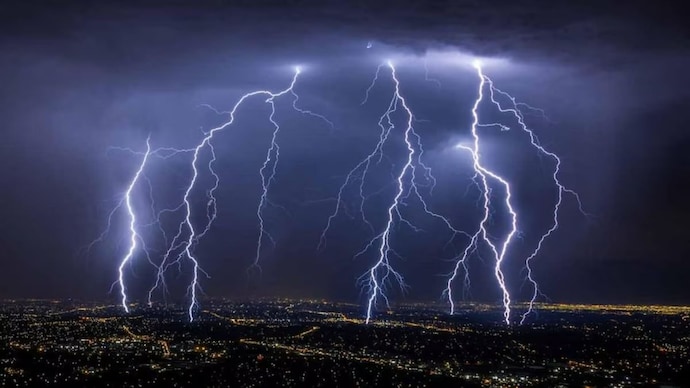


In May, lightning strikes claimed at least seven lives across Uttar Pradesh and Bihar. On May 13, lightning killed three people in UP’s Bhauthari village, Deoria, and Neruari village. On May 8, four people died in separate lightning incidents in Bihar’s Bhojpur, Patna, Samastipur, and East Champaran districts.
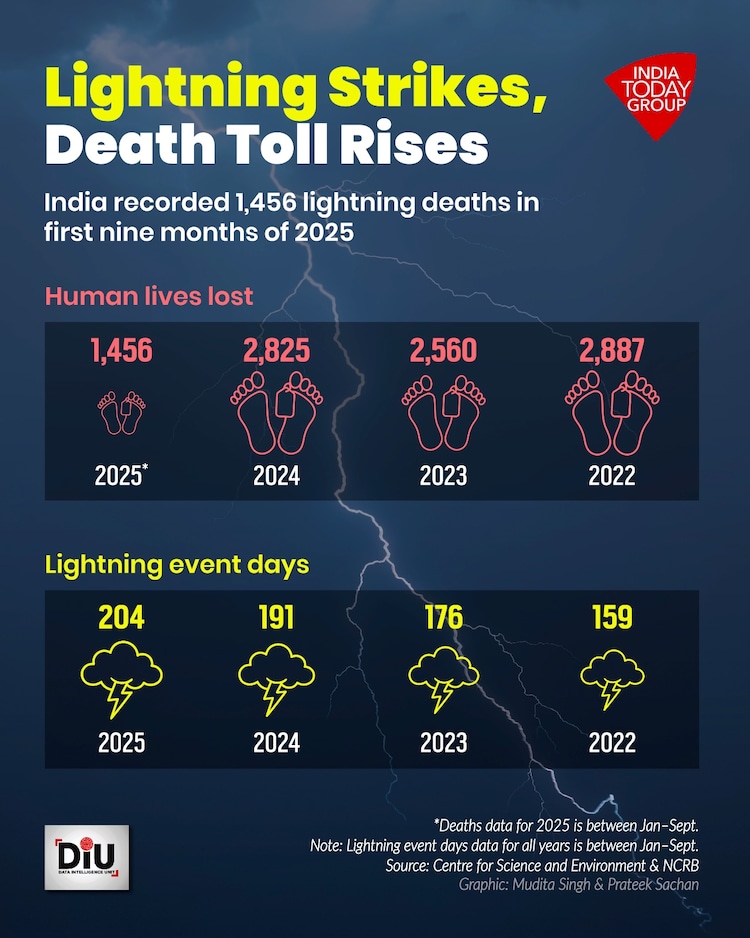
India recorded 1,456 lightning-related deaths in January–September 2025, according to data from the non-profit Centre for Science and Environment. That’s about five deaths every day.
Data from the National Crime Records Bureau also show that lightning deaths have remained consistently high in recent years. India reported 2,887 lightning deaths in 2022. The number fell to 2,560 in 2023, a decline of around 11.3 per cent, before rising again to 2,825 in 2024.
Before 2000, India recorded around 1,800 lightning deaths each year. Today, the annual toll has risen to about 2,800–3,000.
Uttar Pradesh tops the list
According to the Centre for Science and Environment, Uttar Pradesh recorded the highest number of lightning deaths in 2025, with 284 fatalities. Jharkhand followed with 222 deaths, Andhra Pradesh reported 192 deaths, and Madhya Pradesh 183. Bihar, which has witnessed several recent lightning incidents, recorded 146 deaths during the same period.
Lightning activity has also become more frequent in recent years. India recorded 159 lightning event days between January and September 2022, which increased to 176 days in 2023 and 191 days in 2024. By September 2025, the country had already witnessed 204 lightning event days that year, the highest for the period in the last four years.
According to the United Nations Office for Disaster Risk Reduction, states like Odisha, Madhya Pradesh, and Maharashtra reported more lightning deaths for several reasons.
One reason is population size. Large states have more people, and many of them work outdoors in farming, construction, and other occupations. This increases their exposure to lightning.
Odisha also reports a high number of deaths because it has better record-keeping systems. It was among the first states to provide compensation to families of lightning victims. Once compensation became available, more deaths began to be officially reported.
Rising temperatures create more intense thunderstorms, which can lead to more lightning strikes. Human activities such as deforestation and air pollution also affect weather patterns and contribute to increased lightning activity.