
How Bengal erected BJP fence after Jamaat's rise along Bangladesh border
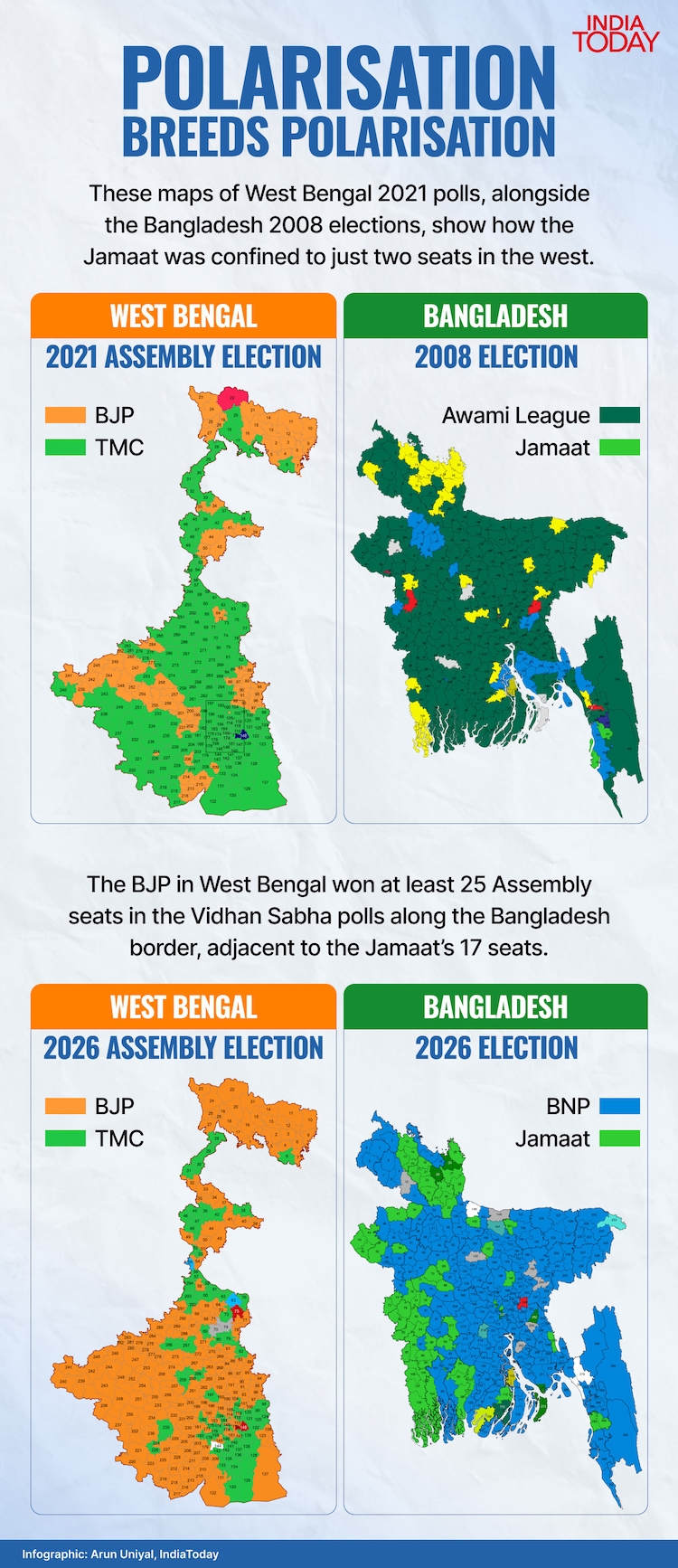
The Jamaat-e-Islami saw a surge in Bangladesh in the February election, particularly along the border with West Bengal. The rise of the Islamist party seems to have resulted in voter consolidation for the BJP across the border. The West Bengal Assembly election results show that the BJP won several seats in pockets directly adjacent to the seats won by the Jamaat.


In the 1990s, towns along the US-Mexico border like San Diego and Tijuana, and Laredo and Nuevo Laredo developed "Spanglish" (or Tex-Mex Spanish). TV, migration and interactions influenced the language people spoke on either side of the border. Now, thousands of kilometres away, and decades later, there's a story of cross-border influence along the India-Bangladesh border. But it's different and is of a reactionary influence and appears to have unfolded differently, reveals the results of the West Bengal Assembly elections.
Did polarisation breed polarisation across the border? Data seems to suggest so.
Illegal immigration and religious polarisation have been key factors in the Bengal Assembly election. The BJP said that illegal immigrants from Bangladesh, mostly Muslims, had altered the state's demography. It blamed the Trinamool Congress and its chief, Mamata Banerjee, for ignoring the menace because it benefited her electorally.
Home Minister Amit Shah, while congratulating BJP leader Suvendu Adhikari, on Friday, touched upon the issue. "The BJP's victory in Bengal is not an expansion of our organisation or validation of ideology but about national security," Shah said on Friday, referring to the influx of Bangladeshi illegal immigrants.
While the residents were being alerted about the changes in West Bengal, they warily noticed the developments in Bangladesh, just across the border.
They saw how Hindus were being hounded after Bangladesh PM Sheikh Hasina's ouster, temples were targeted and people lynched by Islamists over blasphemy.
Months before the Bengal polls, the Islamist Bangladesh Jamaat-e-Islami won several seats along India's West Bengal border in the February 2026 parliamentary election in the neighbouring country. The victories of the Islamist party in at least 17 border seats in West Bengal, seem to have resulted in voter consolidation for the BJP across India's West Bengal.
The West Bengal Assembly election results show that the BJP won at least 26 seats in some of the stretches along the Bangladesh border, which are directly adjacent to the 17 seats won by the Jamaat-e-Islami in the 2026 Parliamentary polls.
The Shafiqur Rahman-led Jamaat-e-Islami, which was banned by now-ousted Bangladesh Prime Minister Sheikh Hasina, was unbanned after the Muhammad Yunus-led interim administration took power in August 2025. The Yunus regime, backed by Islamists of anti-Hasina protests, wasted not time in lifting the ban on Jamaat.
YUNUS LIFTED BAN ON JAMAAT, ISLAMIST PARTY WON SEATS BORDERING WEST BENGAL
In the Bangladesh February 2026 elections, with Hasina's Aawami League banned, the Jamaat-e-Islami emerged as the Bangladesh Nationalist Party (BNP)'s main contender. The Jamaat, contrary to what some believed, gave the BNP a tough fight in the polls. While the Tarique Rahman-led BNP won the election with 209 seats, the Jamaat's 11-party alliance, which also included the students-led National Citizen's Party (NCP), won 77 seats. This was the Jamaat's best-ever show.
Out of the 77 seats the Jamaat alliance won in Bangladesh, 17 seats came from the border districts of Rangpur, Nimphamari, Kurigram, Joypurhat, Naogaon, Meherpur, Chuadanga, Bagdah, Jhenaidah, Jessore, and Satkhira. A big chunk of the seats came from Bangladesh's northeastern Rangpur division, which is adjacent to the Siliguri Corridor. The seats the Jamaat won were earlier won by the Awami League and the Jatiyo Party.
In Rangpur division, adjacent to the Siliguri Corridor, the Jamaat saw a massive surge. The Siliguri Corridor is also known as the Chicken's Neck, because of its size, and is crucial for India's security and connectivity with the northeast states.
The last time the Jamaat won seats in the Bangladeshi parliament was in 2008-09 polls, which was also what experts say was Bangladesh's last truly free and fair election. In the 2008-09 polls, the Jamaat won two seats, that too far from the border areas in Chittagong division.
The Jamaat was banned from operating and contesting in the 2024, 2018, 2014 general elections of Bangladesh. Between 2009 and 2024, several leaders of the Jamaat-e-Islami were prosecuted for war crimes of the 1971 Liberation War, where the Islamist outfit sided with the occupying Pakistani forces and were involved in the rape and murder of multiple pro-independence Bengalis.
After the ban on Jamaat was lifted by the Yunus regime, the party contested the polls as part of an 11-party alliance led by it. Even as the Jamaat claimed the election results were "looted" by the BNP, its alliance won 77 seats, of which the Islamist party secured 68 of them.
The Jamaat alliance won 18 seats out of the 32 seats of the Rangpur divisions' districts like, Rangpur and Nimphamari, which is right adjacent to the Siliguri Corridor.
ATTACKS ON HINDUS IN BANGLADESH MADE BJP HIT BENGAL STREETS; INFILTRATION BIG POLL ISSUE
At the same time in West Bengal, since Sheikh Hasina arrived in India and the interim regime led by Muhammad Yunus, backed by Islamist forces, took charge in Bangladesh, anti-India and Islamist elements across the border repeatedly targeted India with hostile rhetoric.
Some leaders linked to the Islamist-backed 2024 student protests even raised slogans attacking India's territorial sovereignty and integrity. Reports of attacks on Hindus in Bangladesh kept surfacing, with Hindu homes, businesses and temples vandalised and set ablaze.
Several Hindus were killed, including Dipu Chandra Das, who was lynched over alleged blasphemy. Even as the Indian government urged the Yunus-led interim setup to ensure minority protection, Yunus dismissed reports of atrocities on Hindus as "exaggerated propaganda".
At the same time, in West Bengal, political parties and civil society groups repeatedly raised the issue of attacks on Hindus in Bangladesh. The BJP, then in the Opposition in West Bengal, hit the streets multiple times over the issue. Suvendu Adhikari, the then Leader of the Opposition, consistently raked up the issue through protests and demonstrations.
In December 2025, Adhikari visited the Indo-Bangladesh border at Petrapole to condemn atrocities against Hindu minorities in Bangladesh. Days later, he led a major protest rally against attacks on Hindus and temples, and against the arrest of Hindu monk Chinmoy Krishna Das in Bangladesh.
Following the killing of Dipu Chandra Das, Adhikari also led a protest outside the Bangladesh Deputy High Commission in Kolkata. He warned that he would not allow the mission to function smoothly unless he was granted a meeting with officials over the attacks on minorities in Bangladesh.
The BJP in Bengal, with Suvendu in the lead, also raised the issue of illegal infiltration from Bangladesh into India. These narratives continued to gain traction in the run-up to the Assembly polls in West Bengal.
BJP WON 26 SEATS ADJOINING CONSTITUENCIES WON BY BANGLADESH'S JAMAAT
While it cannot be said definitively and conclusively that the Jamaat's rise in Bangladesh's border seats directly resulted in BJP gains in the adjacent constituencies across the border in West Bengal, that is what is the pattern appears to be.
Did the polarisation in Bangladesh influence the people in West Bengal? One can only wonder. But, data suggests so. A BJP fence has been erected on the Bangladesh border after the Jamaat's rise.
While the BJP in the 2026 Bengal polls made significant gains in several regions, like the Presidency, the Jungle Mahal, the southern Bengal and the Doars, the striking detail is in the comparison of the seat-map of the 2021 and the 2026 polls.
The BJP's 26 seats on the India-Bangladesh border, adjacent to Bangladesh's Jamaat seats, came from nine districts like (north to south)
Starting from the southern Sundarbans belt in South 24 Parganas districts, the BJP won seats like Bagdah (SC), Bangaon Uttar (SC) and Hingalganj (SC), which sit right opposite Bangladesh's Satkhira-1 to Satkhira-4 seats that the Jamaat had won in February.
Moving slightly north in the Muslim-dominated Malda district, the BJP secured English Bazar and Baisnabnagar seats, again facing Bangladesh's Jamaat-won constituencies across the border.
HOW BJP WON SEATS NEAR SILIGURI CORRIDOR ADJOINING JAMAAT SEATS
Further up in Dakshin Dinajpur, the BJP won Kushmandi (SC), Balurghat, Tapan (ST), Gangarampur (SC) and Habibpur (ST), directly across from seats like Joypurhat, Naogaon and Meherpur, where the Jamaat had won in February 2026.
In Uttar Dinajpur, another Muslim-majority district, the BJP won Karandighi, Hemtabad (SC) and Haripada seats, across from Chuadanga and Jessore's Jamaat seats in Bangladesh.
As one moves towards the Siliguri Corridor, the BJP's Siliguri and Phansidewa (ST) seats sit opposite Nilphamari-1 across the border.
In Jalpaiguri district, the BJP won Maynaguri and Jalpaiguri (SC), again directly bordering Bangladesh constituencies that the Jamaat won.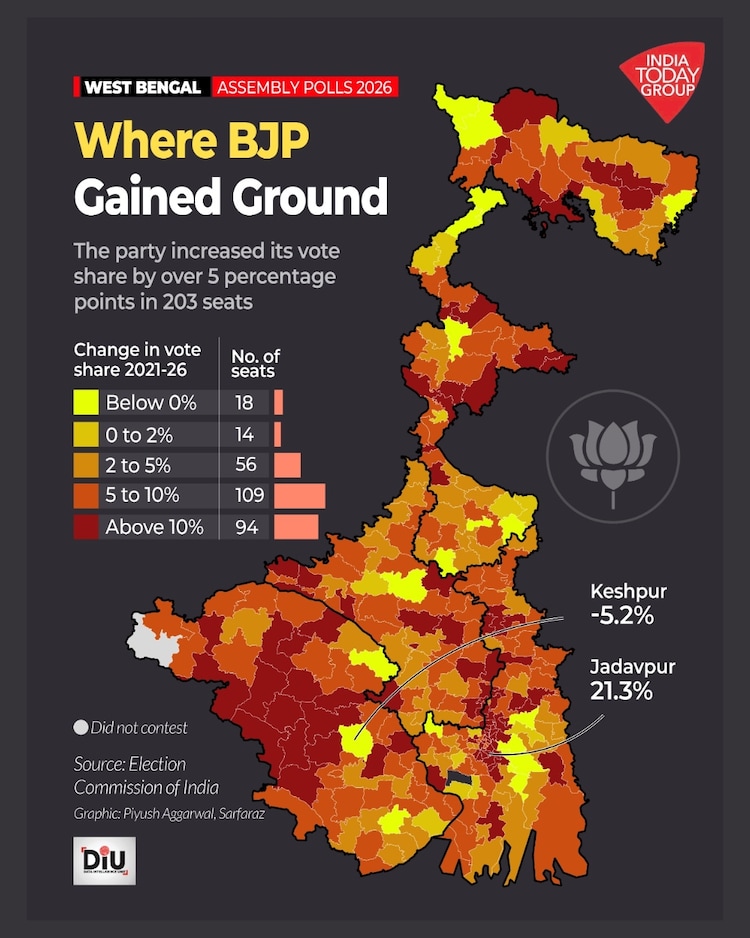
Finally, in the Dooars, in the Cooch Behar district, the BJP secured Sitai (SC), Sitalkuchi (SC) and Mekliganj (SC), which lie just across from Bangladesh's Kurigram district, where Jamaat and its allies won four seats in the February polls.
While the electoral maps of Bangladesh and West Bengal polls show a symmetrical build-up, there is no comparison between the BJP, a nationalist party, and the Jamaat, an Islamist party. The voters in West Bengal might have put their faith in the BJP to curb illegal immigration that they have witnessed on the ground.
The electoral results in the border areas could be a result of religious and political developments in the two countries, anxieties around identities, and the narratives around migration and security. And these factors seemed to have blended into voter behaviour in West Bengal, as the Bengalis saw what they saw, across the border fence unfolding in Bangladesh.