
As TVK struggles to form government, a look at 5 other elections with hung verdicts
Article 164(1) of the Indian Constitution gives the power to the Governor to appoint the Chief Minister. In the case of a hung assembly, the Constitution also gives the Governor discretion to decide the right candidate for the Chief Minister's chair. Historically, in several states, the Governors invited the leader of the single largest party to form a minority government.
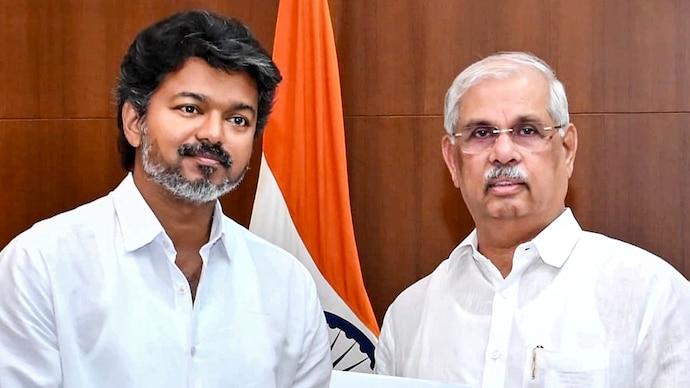

Political uncertainty continues to grip Tamil Nadu after actor-politician Vijay failed to stake a claim to form the government for a second consecutive day. On Wednesday, Vijay held his first meeting with Governor Rajendra Arlekar, presenting signatures from 112 MLAs—comprising 107 from his own party and five from the Congress.
However, the Governor advised him to return only after securing the support of the 118 MLAs required for a majority. Despite a follow-up visit on the second day, Vijay remains short of the mandate needed to break the deadlock.
Article 164(1) of the Indian Constitution gives the power to the Governor to appoint the Chief Minister. In the case of a hung assembly, the Constitution also gives the Governor discretion to decide the right candidate for the Chief Minister's chair. Historically, in several states, the Governors invited the leader of the single largest party to form a minority government.
Let us look at some of the states where respective governors administered formations of minority governments.
MAHARASHTRA: 2019
The 34-day-long political drama in Maharashtra over the formation of the government and post-poll alliances still lives afresh in the minds of the people and pundits. Following the breakdown of the pre-poll alliance between the BJP and the undivided Shiv Sena in the aftermath of the 2019 assembly polls, Governor Bhagat Singh Koshyari administered the oath to Devendra Fadnavis as the Chief Minister and Ajit Pawar (NCP) as the Deputy CM during the early hours of November 23.
However, that government lasted for barely 80 hours after Ajit Pawar tendered his resignation, citing personal reasons, and went back to the Maha Vikas Aghadi (MVA), a coalition of the Congress party, the undivided Shiv Sena, and the Nationalist Congress Party (NCP).
KARNATAKA: 2018
After the 2018 assembly election, the BJP emerged as the single largest party with 104 seats, falling short of the majority mark of 113 seats. The Congress, which secured 80 seats, extended its support to Janata Dal (Secular), which had 37.
However, Governor Vajubhai Vala invited BS Yediyurappa to form a minority government. The government lasted only for three days as the Supreme Court ordered an immediate floor test. Since the BJP did not have numbers, it felt before facing the trust vote.
GOA: 2017
In the 40-member state assembly, Congress secured 17 seats against the BJP’s 13. It was expected that Governor Mridula Sinha would invite the Congress to form the government as the single largest party. However, providing a major shock, Sinha invited Manohar Parrikar to form the government.
The BJP survived the floor test as it quickly cobbled an alliance with the help of the Goa Forward Party and the Maharashtrawadi Gomantak Party, and three independent candidates. The government lasted for two years and three days.
MANIPUR: 2017
Like Goa, a hung assembly was formed in Manipur after the 2017 assembly election. Congress won 28 seats, while the BJP won 22. The BJP soon formed a coalition with the National People's Party and the Naga People's Front. Both parties had 4 MLAs each.
The coalition was further supported by a Lok Janashakti Party (LJP) MLA, a Trinamool Congress (TMC) MLA, and an independent MLA.
The combined force was invited by Governor Najma Heptullah to form the government. N Biren Singh was sworn in as the Chief Minister and ran a 5-year-long government.
DELHI: 2013
Following the 2013 Delhi Legislative Assembly elections, the political landscape reached a stalemate as no single party secured a clear mandate. The BJP emerged as the single largest party with 31 seats, finishing just five short of the 36-seat majority in the 70-member house.
Despite their leading position, the BJP declined to form a government, citing their lack of numbers.
Consequently, the Governor invited the Aam Aadmi Party, which had secured 28 seats, to bridge the gap. Under the leadership of Arvind Kejriwal, the AAP agreed to form a minority government bolstered by external support from the Congress party's 8 MLAs. This unconventional alliance, however, proved short-lived. The tenure lasted only 49 days, concluding on 14 February 2014 when Kejriwal resigned from the chief minister's post.
His resignation followed a heated assembly session where the government failed to introduce the Jan Lokpal Bill, leading to the collapse of the administration and the beginning of a period of political transition for the capital.