
Mamata Banerjee faces intense BJP fight on Bhabanipur turf. What does that reveal?
The BJP has transformed Mamata Banerjee's safest constituency into West Bengal's most-watched contest in the 2026 West Bengal Assembly election. With Suvendu Adhikari as the challenger, caste surveys and door-to-door campaign, the Trinamool Congress chief faces the most serious test on her turf yet.
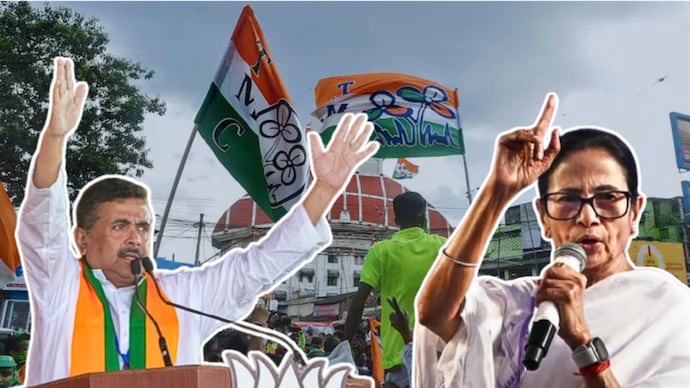

In a city as diverse as Kolkata, the small constituency of Bhabanipur stands out. Often described as a "mini-Bharat", the seat comprises eight Kolkata Municipal Corporation (KMC) wards with a vibrant mix of Bengali Hindus, Muslims, and migrants from Rajasthan, Gujarat, Bihar, Jharkhand, and Odisha. Since 2011, this seat has been a Trinamool Congress (TMC) citadel, held by the party's matriarch-in-chief, Mamata Banerjee. In the 2026 West Bengal Assembly election, however, what was once a safe seat for Mamata has become a fierce battleground. The BJP, under Suvendu Adhikari’s leadership, has launched an all-out campaign to breach the fortress, the likes of which the constituency has rarely seen.
Bhabanipur has hitherto served as a reliable political sanctuary for Chief Minister Mamata Banerjee. In the 2011 Assembly elections, the seat was won by TMC parliamentarian Subrata Bakshi, who later vacated it for Mamata, who was then the Union Railway Minister. She won the subsequent by-election by a margin of 54,213 votes. In 2016, defeating a united Left-Congress opposition, the Chief Minister retained the seat by 25,301 votes.
In both the elections, the BJP candidate wasn't a heavyweight.
However, the ground has shifted noticeably since 2021. With the rapid decline of the Left Front, the BJP has emerged as the principal challenger to the TMC. The defection of Suvendu Adhikari, once a close associate of Mamata during the 2011 Nandigram movement, proved to be a major turning point. Their bitter rivalry peaked in Nandigram in 2021, where Mamata lost to Adhikari by a narrow margin of under 2,000 votes. It was Bhabanipur that sent her to the Assembly with a bye-election, and helped her retain the CM's post.
In 2026, Bhabanipur is no longer the quiet refuge Mamata could reliably fall back on. The BJP under Adhikari's leadership has thrown its full weight behind a high-stakes campaign to repeat its Nandigram success.
"Jodi paren, vote ta amay deben... amake meeting ta porjonto korte dicche na (If you can, do cast your vote for me. They aren't allowing me to even hold this meeting," Mamata said as she walked off the stage at an election rally on Sunday. She alleged that her speech was being disrupted by a BJP rally nearby. The "if you can" in her appeal and leaving the stage raised the curiosity of several people. Is Mamata no longer confident about the seat or is she trying to project herself as a victim and gain sympathy?
For the TMC supremo, this is the seat where she found her political footing in the Assembly, and the BJP is determined to make her feel the heat if not snatch it outright.
WHAT MAKES THE BHABANIPUR ASSEMBLY SEAT SO UNIQUE?
The Bhabanipur Assembly constituency comprises eight KMC wards (63, 70, 71, 72, 73, 74, 77 and 82), all currently represented by Trinamool councillors.
Often called a "mini Bharat", it is not a typical Kolkata seat, as evident by its demography. Around 40% of its voters belong to non-Bengali communities, mainly Gujarati, Marwari, Punjabi, and Odia. According to news agency PTI, the electorate comprises roughly 42% of Bengali Hindus, 34% of non-Bengali Hindus, and nearly 24% of Muslims, along with migrants from Bihar, Odisha, and Jharkhand.
This diverse mix has traditionally favoured Mamata Banerjee and the TMC. However, the BJP sees a clear opening among the non-Bengali business community, many of whom appear alienated by the TMC's "outsider" rhetoric. Earlier, the business community had, however, sided with the TMC.
The recent Special Intensive Revision (SIR) of electoral rolls has added a new dimension. Over 47,000 names were deleted in Bhabanipur, with The Telegraph reporting that more than 40% of them were Muslims — a core TMC support base. Another 14,000 names remain under scrutiny.
HOW BJP IS RAMPING UP PRESSURE ON MAMATA IN BHABANIPUR
Until 2026, Bhabanipur had been a relatively safe seat for Mamata Banerjee. In the 2021 Assembly elections, while she battled her bete noire Suvendu Adhikari in Nandigram, TMC's Sovandeb Chattopadhyay comfortably defeated the BJP's debutant, actor Rudranil Ghosh, who had defected from the Trinamool.
When Mamata returned to Bhabanipur via a by-election after her narrow loss in Nandigram, she defeated BJP youth leader Priyanka Tibrewal (who had earlier lost from Entally) by a massive margin of over 58,000 votes.
This time it's different. Instead of fielding actors or celebrities or political lightweights, the BJP has turned to its heavy artillery, fielding none other than Suvendu Adhikari, the winner of Nandigram, who has promised to breach the TMC's citadel and make Mamata "former chief minister by a margin of 20,000 votes".
The saffron camp's strategy rests on booth-level caste arithmetic, consolidation of Hindu votes across Bengali and non-Bengali communities, and turning Bhabanipur into a psychological contest through Adhikari's candidature.
"The battle here cannot be fought with one slogan. It has to be fought booth by booth, community by community. The state now wants Ram Rajya. People are tired of appeasement politics," BJP leader Debjit Sarkar was quoted as saying by The Telegraph.
The BJP is executing a highly organised, booth-level campaign. According to a report in The Telegraph, party workers are focusing on increasing voter turnout in their traditional strongholds such as Chakraberia, Allenby Road and Bakulbagan.
Cadres are reportedly going from door to door in housing complexes, urging voters who typically skip Assembly polls (but participated in the Lok Sabha election) to come out on April 29. In some cases, they are even promising logistical help like wheelchairs for elderly or ailing supporters.
WHY BJP SEES A PROMISE IN BHABANIPUR ASSEMBLY SEAT
For context, in the 2019 general election, BJP candidate Tathagata Roy had temporarily edged past Trinamool Congress nominee Subrata Bakshi by a narrow margin of 176 votes in the contest for the Kolkata Dakshin seat, with most of the BJP's votes coming from Bhabanipur. Similarly, the Trinamool’s lead margin in the Bhabanipur Assembly segment in the same seat came down to 8,297 votes in the 2024 General Elections.
The party has also stepped up efforts to woo fence-sitting voters. This aggressive approach was evident when the BJP organised a rally on Sunday barely 100 meters from Mamata Banerjee's own public meeting. The high-decibel event allegedly disrupted her speech, forcing Mamata to cut short her address and leave the stage abruptly, triggering a tense confrontation between supporters from both sides.
Furthermore, the BJP has also set its eyes on a section of the Bengali-speaking Hindus and non-Bengali Hindus, especially Gujarati and Marwari traders, traditionally soft towards the saffron party, who form a significant section of the Bhabanipur's electorate.
According to a report in The Telegraph, for over a year, the BJP carried out a survey in Bhabanipur to break down the caste and community arithmetic, and craft appropriate strategies.
"We have a fair idea where the Bengali-speaking voters are dominant, the areas where Muslims have the edge and where the non-Bengali traders hold sway," one BJP insider told The Telegraph. "We have tweaked the campaign strategy for each of these zones accordingly."
TMC USES FAMILIAR 'GHORER MEYE' PLAYBOOK IN BHABANIPUR
For the TMC and Mamata Banerjee, Bhabanipur is one seat that must be held at any cost.
Since 2011, it has always been a safe refugee for the Chief Minister. Her Kalighat residence lies within the constituency, and long before it became her Assembly fortress, its lanes and community clubs were central to her rise from MP of Kolkata Dakshin to the state's most dominant politician who toppled the 34-year reign of the Left Front.
"This is not just another seat. People here have repeatedly stood by Mamata Banerjee's politics of development and inclusiveness," Kolkata Mayor and senior TMC leader Firhad Hakim said on Bhabanipur.
For the 2026 Assembly polls, the TMC is once again relying on the emotional "Ghorer Meye" (daughter of the house) narrative. The campaign portrays Mamata not as a distant Chief Minister but as Bhabanipur's own "Didi", a familiar, caring local figure deeply connected to the area's diverse communities.
Facing Suvendu Adhikari's high-voltage challenge, TMC has intensified personal outreach. A TMC local councillor, who has been part of the Bhabanipur campaign, told The Telegraph, "We are trying to visit every home three times. It can be different teams calling them on. We are also trying to organise meetings with residents of housing complexes where many are coming to meet us". Welfare schemes such as Lakshmir Bhandar, Kanyashree, and Swasthya Sathi remain the backbone of the messaging, with special emphasis on benefits received by women and families.
The party has also been trying to offset the BJP's advantage within the seat's Gujrati and Marwari communities, with senior TMC leaders, including Firad Hakim, meeting community leaders ahead of the elections.
But perhaps most tellingly, Mamata Banerjee herself has led multiple rallies in Bhabanipur and padyatras, including one on April 25 from Sambhunath Pandit Street to Kalighat Road Crossing and another on April 26 covering a one-km stretch from Lansdown Crossing to Kalighat Fire Services Station, accompanied by thousands of supporters.
In any case, one thing is clear. The loss of Nandigram, the cradle of Mamata Banerjee's politics, delivered by a former aide was a big jolt to the TMC despite it retaining the state in 2021. Bhabanipur is an even more important seat, especially for Mamata. It's her home, and the nursery that nurtured her political acumen through the decades. After dominating Bengal politics for 15 years, Mamata's position as the state's most powerful leader may ultimately rest on whether she can hold this seat. The stage is set for the most-watched battle of the West Bengal Assembly election. The results will be out on May 4.