
How a Congress minister's public revolt deepens party fault lines in Jharkhand
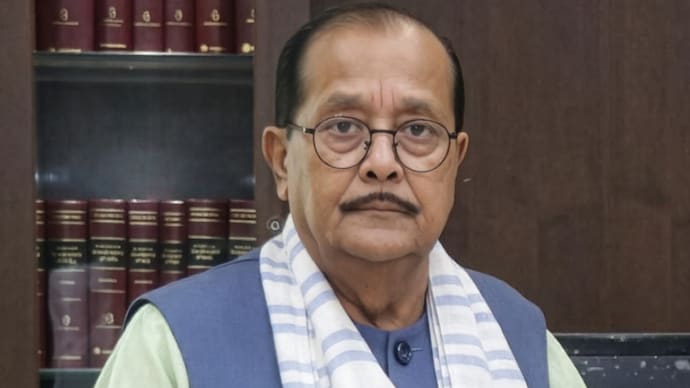
Finance minister Radha Krishna Kishore's remarks against the state Congress chief have not only unsettled the party but also sections of the ruling alliance


That Kishore then posted the letter on social media platform X makes one thing clear: his move was a calculated political step taken with full awareness of the fallout.
The latest turmoil in the Jharkhand Congress has exposed far more than an ordinary factional dispute. What began as dissatisfaction over a newly formed state committee has turned into a wider political confrontation involving loyalty, entitlement, organisational authority and the future balance of power within the party.
At the centre of the storm is Kishore, a veteran leader whose latest public attack on the state Congress leadership has unsettled not only the organisation but also sections of the ruling alliance. The immediate trigger was the announcement of the new 314-member Jharkhand Pradesh Congress Committee. Intended as an exercise in organisational expansion, the move sparked sharp resentment. There are reports suggesting that Kishore’s son, Prashant Kishore, was given a relatively modest role in the new structure, which might have displeased the minister.
The situation quickly escalated. The minister launched a public attack on state Congress president Keshav Mahto Kamlesh. In letters to K. Raju and in comments shared publicly, he questioned the utility of the ‘oversized’ committee, criticised the leadership for staying silent on key issues and suggested that changing the state leadership itself could solve many of the organisation’s problems.
For the Congress, the importance of this episode lies in the fact that Kishore is not a fringe dissenter or a backbench MLA. He holds the finance portfolio in the Hemant Soren government, one of the most politically significant ministries allotted to the Congress quota. The fact that a serving minister is openly weakening his own state leadership has naturally deepened concerns about party discipline and internal unity.
Yet the present crisis is rooted in a deeper, older resentment within the Jharkhand Congress. According to party sources, sections of the organisation have long been uneasy about Kishore’s rapid rise despite his shifting political affiliations over the years. Before returning to the Congress ahead of the assembly elections in late 2024, Kishore had moved through several parties, including the JD(U), BJP and RJD. For many long-serving Congress workers who stayed with the party through difficult years, his elevation to the finance portfolio reflected the growing dominance of political expediency over organisational loyalty.
That unease had already surfaced earlier this year when disgruntled Congress MLAs from Jharkhand reportedly approached the central leadership, seeking a review of ministerial allocations and the performance of certain ministers. Although no name was officially singled out, party insiders widely read it as dissatisfaction with ministers who were seen as politically disconnected from the organisation.
Against that backdrop, Kishore’s latest confrontation has taken on significance far beyond a dispute over committee appointments. His critics inside the Congress argue that the minister’s public intervention appears too carefully planned to be dismissed as a momentary outburst. His letters do not merely raise personal grievances or object to organisational appointments. Instead, Kishore has framed his criticism around socially resonant issues—caste representation, Dalit concerns, women’s reservation, linguistic identity and regional neglect.
Kishore accused the state leadership of failing to strongly oppose the exclusion of Bhojpuri and Magahi from the Junior Teachers’ Eligibility Test. He also criticised the organisation for not mobilising politically on issues such as women’s reservation and Scheduled Caste representation.
These are not random talking points but issues that can resonate well beyond internal Congress politics. That is precisely why many within the party are viewing the episode with caution. Even though Kishore has continued to campaign for the Congress outside Jharkhand as well, his decision to mount such a sustained attack on the state leadership suggests a carefully thought-out political strategy rather than an emotional reaction.
Adding to the discomfort within sections of the Congress are longstanding perceptions about Kishore’s proximity to political circles outside the party. Congress insiders privately point to speculation that he may be considering a future beyond the Congress. Such links are not unusual in Indian politics, but in the middle of an open organisational clash they become politically sensitive.
The irony of the situation is hard to miss. According to party insiders, it was Keshav Mahto Kamlesh himself who played a major role in bringing Kishore back into the Congress before the assembly elections. Senior leaders say Kamlesh strongly backed Kishore’s candidature and later supported his entry into the state cabinet despite resistance from parts of the party. That partnership has now turned into open confrontation.
For the Congress high command, the challenge is delicate. Taking strong action against Kishore could disturb internal caste equations and deepen factional tensions within the state unit. Ignoring the confrontation, however, would weaken the authority of the state leadership and encourage a culture of public defiance.
The episode also exposes a larger structural contradiction within the Congress in Jharkhand. The party increasingly depends on influential political entrants who can deliver electoral arithmetic and regional reach, even as long-serving organisational workers feel sidelined.
Kishore, in many ways, represents that contradiction. He is experienced, electorally relevant and politically seasoned. Yet he also reflects the Congress’s growing dependence on leaders whose relationship with the organisation is often transactional rather than ideological.
At a time when the Congress is trying to stabilise its organisation nationally and strengthen state units before future electoral battles, the public nature of the Jharkhand infighting has been especially damaging. More importantly, it has reinforced a familiar concern within the party: internal rivalries are now increasingly being fought through public messaging. And because this confrontation involves the state’s finance minister, many within the Jharkhand Congress believe this episode may not end with a committee dispute alone.
Subscribe to India Today Magazine