
A mukbang influencer's Mounjaro journey reveals the cost of eating for Internet
For Madhuri Lahiri aka MaddyEats mukbang is her world. However, that also led to her complicated relationship with her weight. Then, entered Mounjaro.
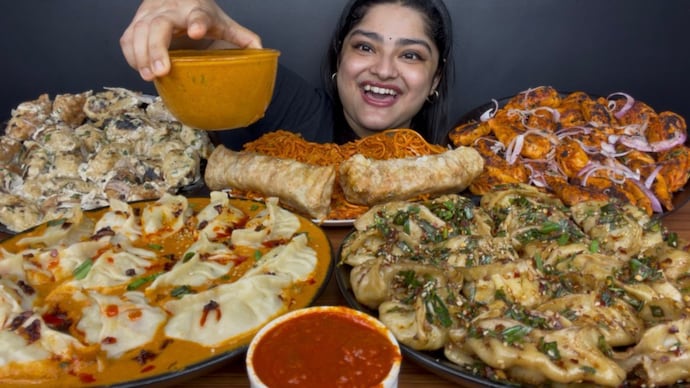
A glimpse from MaddyEats' mukbang video.

New Delhi,UPDATED: Jun 6, 2026 09:14 IST
For seven years, food was not just a source of comfort for Madhuri Lahiri. It was her career.
Every month, several times in fact, she would sit down in front of the camera and eat huge quantities of food. You name it — burgers, biryanis, fried chicken, desserts, home-cooked meals, and food ordered from outside. Madhuri did everything that is a staple of the internet's mukbang culture. The videos brought views, followers, and eventually an income.
She is Madhuri Lahiri, aka MaddyEats. She has over 6 million followers on YouTube and several more across Facebook and Instagram. And like any mukbang influencer, you might have seen her take on enormous quantities of food, sometimes with ease and sometimes while visibly struggling through it.
She has a love-hate relationship with food because while it has given her fame, income, and popularity, it has also complicated her relationship with her body.
"I was always a chubby kid. I was never thin," she says. "But I could manage my weight. I would go to the gym, I would diet, and my body would respond."
Until it stopped.
Despite dieting and exercising, her weight refused to drop below 65 kg. The scale remained stubbornly fixed. This was affecting her mental health too.
Multiple tests revealed no major health issues. There was no PCOD. No obvious hormonal condition. The only significant finding was severe vitamin D deficiency.
"The weight was increasing and not decreasing. It was affecting me mentally," she says.
Eventually, with a BMI of 32, she consulted a doctor at a reputed Mumbai hospital. The recommendation surprised her.
Mounjaro.
The same drug (tirzepatide) that has become one of the most talked-about medications in the global weight-loss conversation.
The hidden pressure of eating for the internet
Mukbang began in South Korea and has since become a global internet phenomenon. At its simplest, it involves creators consuming large quantities of food on camera while interacting with viewers. Over the years, it has evolved into a lucrative content category that thrives on spectacle. In India, it saw its peak around 2021.
For creators, however, the reality can be far less glamorous than the thumbnails suggest. We have seen this in the case of Nikocado Avocado, who is often regarded as the "King of Mukbangs."
Madhuri does not blame mukbang entirely for her weight struggles. Seven years is a long time. Age changes bodies. Metabolisms shift. But she acknowledges that her profession likely played a role. A typical person may have one cheat meal a week. Her job required something closer to eight cheat days a month.
"The bigger problem wasn't just the mukbang day," she says. "The cravings would continue the next day. I would want to eat more."
That cycle is something researchers have long been interested in. Studies examining mukbang culture have found complex links between these videos and eating behaviours, with some viewers and creators reporting increased food cravings, binge-eating tendencies, and conflicted relationships with food.
Health experts have also raised concerns that extreme eating content can normalise overeating and distort perceptions of what constitutes a normal meal. For creators, the challenge is even more direct: the content itself revolves around consumption.
The Mounjaro effect
The biggest change, Madhuri says, wasn't dramatic weight loss. It was the disappearance of the hunger pangs. More specifically, it was the disappearance of what many GLP-1 users describe as "food noise" — the constant mental chatter about food, cravings, and the urge to eat.
"I don't get those cravings anymore," she says.
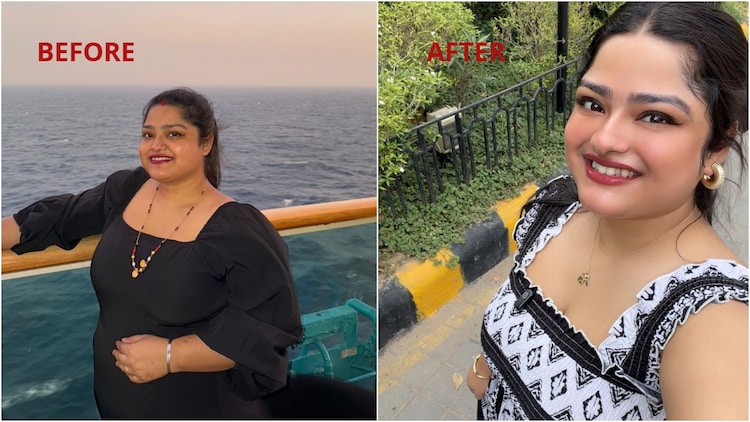
She has now been on Mounjaro for around two and a half months. Unlike some of the viral before-and-after transformations flooding social media, her results have been gradual. She has lost around 6 kg, going from 70 kg to 64 kg.
In the age of Ozempic and Mounjaro success stories, where social media is filled with stories of people dropping 15 or 20 kg, that figure may sound modest. But her doctor had prepared her for that possibility. Not everyone responds to these medications in the same way.
Recent research suggests that biological and even genetic factors may influence how strongly people respond to GLP-1 drugs, helping explain why some people see dramatic changes while others lose weight more gradually.
"I think I'm a slow responder," she says.
Yet she considers the medication one of the best decisions she has made. Not because it magically made her thin, but because it helped her stick to the things she was already struggling to maintain — a calorie deficit, regular exercise, and dietary discipline.
The uncomfortable reality of doing mukbangs on Mounjaro
Madhuri may be on Mounjaro, but that hasn't stopped her from making mukbang videos. She continues to upload content every week because, quite simply, that's her bread and butter.
What has changed, however, is that the very drug designed to suppress appetite has made her job harder.
Before Mounjaro, she could complete an entire mukbang in one sitting. Now, she needs breaks. The medication makes her feel full much faster.
"Earlier, I would finish everything in one go. Now I have to stop, take a break, and continue," she says.
It highlights a tension that few people talk about. While influencers often present either a weight-loss journey or a food-content career, Madhuri is attempting to balance both at the same time.
She cannot stop making mukbang videos because they are a major part of her livelihood. But she also recognises that the very content helping pay her bills may be slowing down her progress.
When asked whether her twice-weekly mukbangs could be affecting her weight loss, she doesn't hesitate.
"One hundred per cent," she says. "But it's part of my income."
The side effects nobody posts about
Online discussions around GLP-1 drugs often focus on dramatic transformations. The reality is usually more mundane.
For Madhuri, the most noticeable side effects have been constipation, mild dizziness, and occasional nausea after her weekly injection.
She typically takes the shot on Wednesday nights and feels the effects most strongly the following day.
Fortunately, she says the symptoms have remained manageable.
Those experiences mirror the commonly reported side effects of tirzepatide, the active ingredient in Mounjaro. Nausea, constipation, digestive discomfort, and reduced appetite are among the most frequently reported issues.
The mental health shift
The biggest difference, however, may not be physical.
Before starting treatment, she describes feeling mentally exhausted. Years of trying to lose weight and failing had left her discouraged.
Today, what she talks about most is hope.
"I feel lighter," she says. "I feel like if I keep working at it for another six months, I'll get there."
That optimism comes with a caveat. She is quick to push back against the idea that Mounjaro is a miracle drug. "You can't take Mounjaro, eat junk food, and expect to become thin," she says. "You still have to exercise. You still have to diet."
The pregnancy question
Weight loss was not the only reason she sought treatment. She and her husband have been thinking about pregnancy, and that added another layer to her concerns.
She worried about entering pregnancy at 70 kg and gaining substantial additional weight during the process. Her doctor advised that if she plans to conceive, she would need to discontinue Mounjaro several months beforehand.
For now, that remains a future decision.
The immediate goal is simpler: get healthier, lose more weight, and reach a place where food no longer controls every thought. For someone whose profession revolves around eating on camera, that may be the most significant transformation of all.
- Ends