
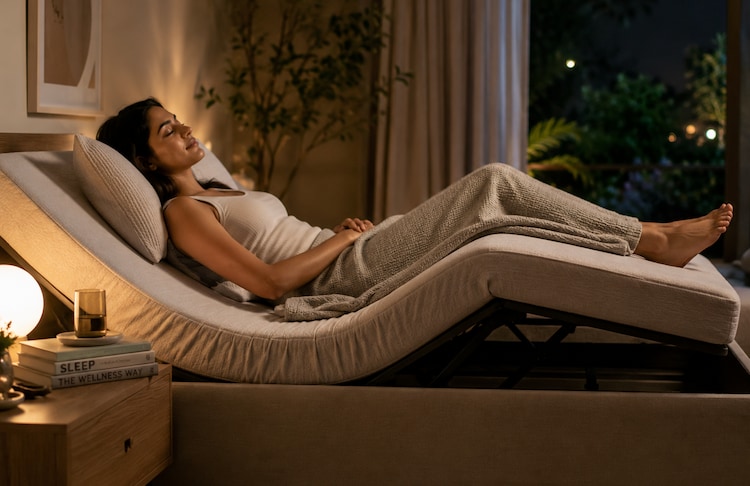
Can sleeping like an astronaut improve your sleep?
The world is in it's sleep deprived era and looking for the next best thing to hack their way to having a good night's sleep. The 'zero gravity sleep' position might just help.

Zero gravity sleep position helps the spine to relax (Photo: Pexels)

How do you sleep? Curled up like a cocoon, sprawled on your side, flat on your back (rare species), or face-down clutching a pillow for emotional support? Everyone has a sleeping position that feels comforting.
But it may not always be the right one.
In an era where people are sleepmaxxing their way through life, one thing is often not talked about enough: the position their body settles into for seven or eight hours every night.
And this is where we look up to astronauts (pun intended), for the ‘zero gravity sleeping.’
The zero-gravity sleep position traces its origins back to NASA, where it was designed to help astronauts cope with the physical strain of living in microgravity.
What is zero gravity sleeping?
Zero gravity sleep is a type of sleeping position that was initially researched by NASA and is also referred to as the "neutral body position." It's how astronauts might sleep like in space.
By slightly elevating the upper body and legs, the posture helps distribute pressure more evenly across the body, reducing strain on the spine and joints, mimicking weightlessness.
“Zero-gravity sleep is essentially a slightly reclined way of lying down, where the upper body and legs are both gently elevated. Think of it as taking the pressure off your lower back and letting the body ‘settle’ rather than lie completely flat. The knees are a little bent, the legs are raised just a bit, and the upper body is propped up enough to keep the spine more relaxed,” Dr Nalini Nagalla, HOD, pulmonology and sleep disorders, Arete Hospitals, tells India Today.
A lot of people don’t realise this, but even small changes in angle can make a noticeable difference to how the body feels through the night.
“The position used in zero gravity is similar to what astronauts use in space to allow redistribution of the G-force that they experience. It minimises musculoskeletal stress and aligns the spine in microgravity,” Dr Lancelot Mark Pinto, consultant pulmonologist and epidemiologist, P.D. Hinduja Hospital and MRC Centre, Khar, explains.
The use of this position in daily life occurs when the head and knees are elevated approximately two-three inches above the level of the heart while forming an approximate 120-degree angle between the hips, adds Dr Pinto.
Over time, researchers and sleep experts found that this posture could offer benefits far beyond space travel.
The perks
Before diving into the perks, experts caution that while there's a lack of strong long-term evidence suggesting everyone should sleep this way, the logic behind it is fairly sound, and it may help certain groups of people.
People with lower back discomfort often find the zero-gravity position noticeably relieving. Raising the upper body can also help with nighttime acidity, snoring, and mild sleep apnea by keeping the airways more open.
With the legs slightly raised, circulation gets a boost, which may help reduce swelling. The position is often beneficial for people dealing with GERD, sciatica, and varicose veins, while many pregnant women also turn to it for gentler back support.

“Those with backache are likely to benefit from it, but again, this is a difficult position to sleep in through the night. Predominant side sleepers will find it difficult to adjust,” Dr Mihir Gangakhedkar, consultant - pulmonology, Fortis Hospital Mulund, Mumbai, cautions.
While, in theory, it sounds a little too good to be true, the practicality is still a debate.
Is it practical?
If you are willing to put in the money and effort.
According to Dr Gangakhedkar, adjustable beds (which can be expensive) obviously make achieving this unusual posture easier. While a makeshift arrangement with pillows can be made, it is likely to be difficult to maintain.
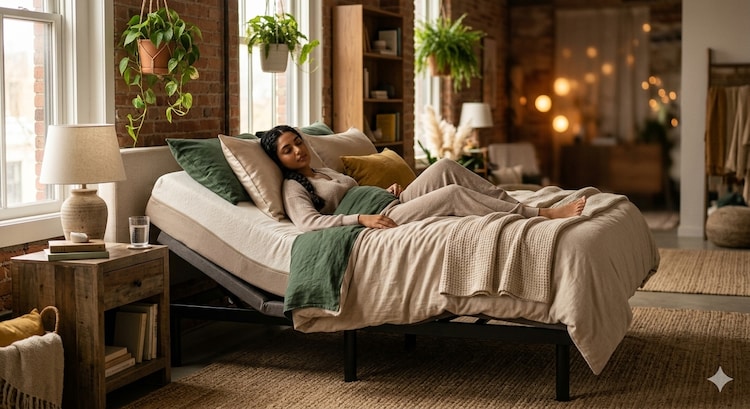
Tempted to give it a shot? Dr Pinto explains how:
“If one were to sleep with their upper body raised at an angle between thirty and forty-five degrees (by using a firm wedge), one could then place a bolster pillow or several stacked ordinary pillows under their knees so that they are slightly elevated above their heart.”
The only catch? Pillows shift and flatten through the night, making the position hard to maintain till morning.
So, what’s the ideal sleep position?
Nothing that fits everyone.
Sleep in the real world is hardly graceful. People toss and turn, move side to side, and maybe even wake up with the blanket missing.
According to experts, side sleeping is often easier on breathing, and certain positions help specific conditions.
“If there’s no stiffness, no disturbed sleep, and no worsening of symptoms, that position is doing its job. Sleep isn’t something that needs to be over-engineered,” says Dr Nagalla.
She further divulges that good sleep is not just about posture. Stress, screen time, light exposure, and sleep schedules play an equally big role.
“In India, where people sleep on everything from firm coir mattresses to plush foam beds — and sometimes even the floor — comfort is personal. The real trick is simply listening to what your body needs and making small adjustments that actually feel sustainable.”
The sleep crisis the world is slowly lulling itself into is no jaw-dropping revelation. Sleep gummies, magnesium mocktails, smart rings, cooling mattresses, and white-noise machines — an entire industry has emerged around the desperate pursuit of better rest.
Maybe it's just about giving your body permission to rest the right way. And we all know the drill.
- Ends