
Global first, desi later: Ramayana's bold, big-screen bet beyond Indian box office
The Ramayana teaser signals a bold global-first rollout, with the makers positioning the epic for international audiences from the outset. Here's why this ambitious approach, backed by scale and storytelling, could redefine how Indian epics travel worldwide.
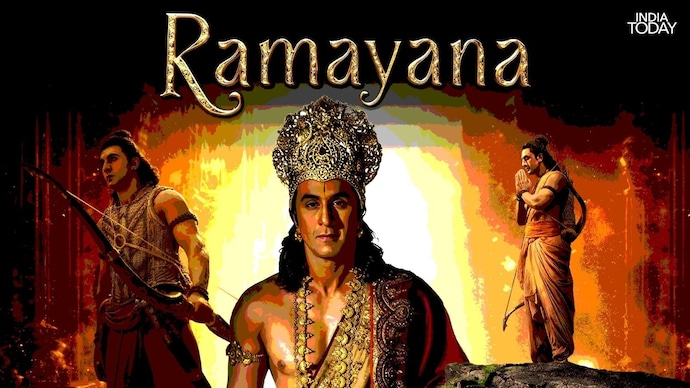

The Ramayana teaser, released on Thursday, makes one thing clear: this is not a routine big-budget film. It is a carefully planned, high-stakes project - emotionally, financially, and cinematically. And projects of this scale are rarely built for one market alone.
Directed by Nitesh Tiwari and produced by Namit Malhotra, the two-part Ramayana is being positioned with a global outlook from the very beginning. It would not be unfair to describe its approach as "global first, desi later" - an Indian story, but pitched to the world in a language it understands.
That intent is visible in the way the film has been introduced. Before the teaser reached Indian audiences, it was first showcased in Los Angeles to a select group of viewers and media. Social media buzz followed almost immediately, with attendees calling it a rare cinematic experience. By the time the teaser dropped in India a few days later, the conversation had already crossed borders.
For some, the delay felt unusual. But it also signalled a shift. This is not a film waiting to be validated at home before stepping out. It is stepping out first, with confidence, knowing fully well that it's already validated back home.
The scale of that ambition is backed by the film's making. The casting of Ranbir Kapoor as Rama and Yash as Ravana is designed to balance familiarity with freshness. The involvement of global VFX company DNEG, with multiple Academy Awards to its credit, adds another layer. This is not just about telling a story; it is about presenting it in a way that travels.
And there is a practical reason behind this approach. A film mounted at this scale, reportedly with a budget running into approximately Rs 4,000 crore, cannot depend on one territory. The economics demand a wider audience. But beyond numbers, there is also a cultural argument: Ramayana is not confined to India.
In fact, it never was.
Scholar AK Ramanujan, in his well-known essay 'Three Hundred Ramayanas: Five Examples and Three Thoughts on Translation', traced how the story has been told and retold across regions for over two millennia. From Southeast Asia to parts of East Asia, the narrative has taken different forms - sometimes changing characters, sometimes shifting perspectives, but always retaining its core.
In Thailand, the Ramakien reimagines the epic within its own cultural context. In Indonesia, the story lives through dance and shadow puppetry. In Cambodia and Laos, it appears in temple art and oral traditions. Even within India, there is no single, fixed version. Valmiki's telling is only one among many.
What binds these versions is not uniformity, but familiarity. The themes remain recognisable: duty, exile, loyalty, love, the cost of power, the pull between right and wrong. These are not ideas tied to one geography. They travel because they are human.
That is what the film seems to be leaning into.
The teaser does not overwhelm with information. It offers glimpses - Rama's stillness, Ravana's towering presence, a world in formation. It suggests a story rooted in faith, but told with an awareness that the audience may not share that context. The aim appears to be clarity, not complexity.
There is also a subtle shift in how the story is being framed. For many viewers in India, Ramayana is mythology. For others, it is a moral text, even a cultural memory. The film appears to position it as something broader: an account of values and choices, of a man trying to live by an ideal, and the forces that challenge that ideal. The teaser describes it as "our truth, our history."
That framing makes it easier to cross borders. You don't need to know every detail of the epic to understand a son honouring his father's word, a woman asserting her dignity, or a ruler consumed by ambition. These are entry points that work anywhere.
The idea of "global first" is not about dilution. It is about translation - of scale, of storytelling and emotion.
If anything, the film is building on a journey that began centuries ago. The Ramayana has already travelled through languages, performances, and retellings. This is simply its next medium.
And if the early glimpse is any indication, the makers are not holding back. They are not asking whether the world is ready for this story. They are presenting it as something the world already, in some form, knows. This time, it is arriving on a larger canvas - with the intent of staying.