
Real story behind Ravana's Pushpak Vimana: Ramayana teaser's biggest moment
The Ramayana teaser introduces a grand cinematic world, but it's the brief glimpse of the Pushpak Vimana that truly stands out. Here's why this iconic flying chariot adds intrigue, depth, and a deeper mythological layer to the film's vision.
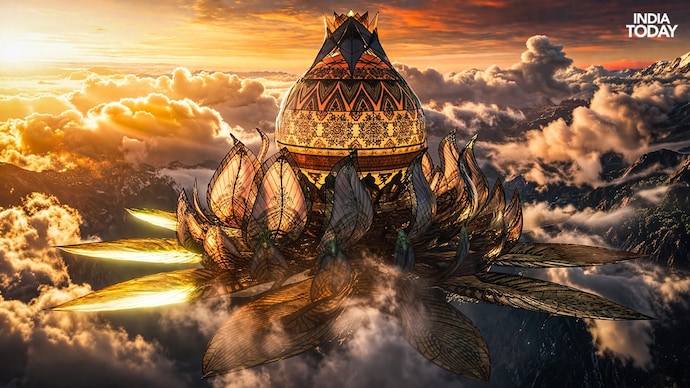

The Ramayana teaser, unveiled on Thursday, makes an immediate impression. It offers the first look at Ranbir Kapoor as Lord Rama and opens the doors to the colourful, immersive world of Nitesh Tiwari's two-part film series. But beyond the brief tease of Yash as Ravana, one moment stays: the grand reveal of the Pushpak Vimana in the closing frames.
The Pushpak Vimana, often described as a flower-shaped chariot in Ramayan attributed to sage Valmiki, is no ordinary vehicle. In mythology, it is a celestial aircraft once owned by the demon king Ravana - both a symbol of power and an object of fascination. Today, many theorists and mythological experts consider the Pushpak Vimana to be the world’s first aircraft, one said to possess technology we have yet to fully understand.
The teaser leans heavily on grandeur - Rama in his composed, almost divine stillness - but it is the fleeting image of the Vimana that shifts the mood. It adds intrigue and gives the visuals a sense of depth that goes beyond scale. For a brief moment, the teaser feels less like a CGI-heavy montage and more like a world with its own internal logic.
That image arrives alongside Ravana's introduction: a towering figure dressed in black and gold, moving with authority, as though the world - and its secrets - already belong to him. The pairing is not accidental. The Vimana, in that instant, becomes an extension of Ravana's presence. It grounds the grandeur, gives it texture, and leaves behind a sense of curiosity.
All about Pushpak Vimana as per Hindu texts
In mythological accounts, the Pushpak Vimana is often described as a divine creation. It is said to have been designed by Vishwakarma, regarded as the God of architecture in Hinduism, for Brahma, one of the trinity Gods, later passed on to Kubera, the king of wealth, and eventually taken by Ravana, the demon king. Over time, it came to represent not just mobility, but authority - whoever possessed it held power.
What makes the Vimana especially intriguing is how it is described in ancient texts and later interpretations. It is not just a chariot that flies. It is imagined as something far more advanced:
- It could change its size depending on the number of passengers. It always had more space for more people.
- It could move at the speed of thought, travelling vast distances instantly - the thought-controlled technology.
- It could fly freely, unrestricted by terrain or time.
These descriptions have often invited modern comparisons, ideas of adaptive structures, advanced propulsion, even thought-responsive systems like AI (artificial intelligence). Whether taken literally or symbolically, they point to a long-standing fascination with technology, imagination, and the unknown.
The teaser seems aware of that legacy. It doesn't explain the Vimana. It simply presents it: glowing, intricate, almost alive. And the idea is well conveyed: instead of overwhelming the viewer, it leaves space for interpretation.
For a film built on scale, this is a smart choice. The Pushpak Vimana helps shape the magnificence of the world of Ramayana.
It's early days for Ramayana, but this brief moment already hints at the film's intent. The world is being built piece by piece, and if this glimpse is anything to go by, the makers are aiming for more than just visual sweep.