
Dialogues, plots, MGR mentions: Vijay's films were trailers to political rise
Vijay's films repeatedly hinted at his political ambition from before Tamilaga Vettri Kazhagam (TVK) was even registered as a party or in the picture. His filmography over the years has been a running prelude to power.
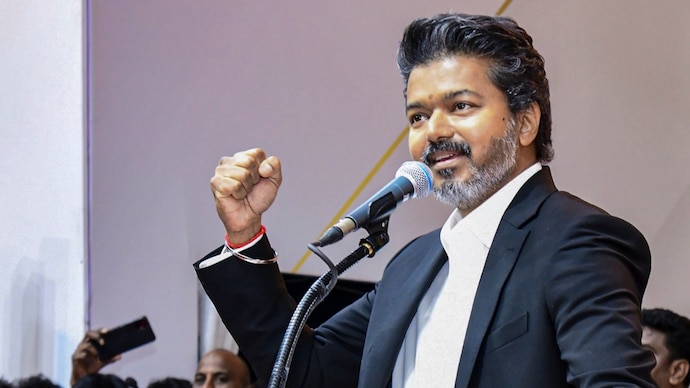
Vijay had been rehearsing his political entry for the past 25 years through his films. (Photo credit: PTI)

Chennai,UPDATED: May 11, 2026 08:39 IST
On May 10, 2026, when Vijay took oath as Chief Minister of Tamil Nadu after his party, Tamilaga Vettri Kazhagam (TVK), swept the state's assembly elections, the reaction from many long-time watchers was less surprise than recognition. They had seen this coming. Not from press conferences or political statements, but from his films – from speeches delivered at audio launches to film dialogues about GST, farmer suicides and voter fraud that had caused real political controversies long before Vijay even entered politics or registered a party.
With Rajinikanth and Kamal Haasan having tried their hand at politics and failed to create a dent, all eyes were on Vijay. And those who had been watching closely knew that his political aspirations had been hiding in plain sight — in message-loaded punchlines, MGR references, and film narratives that screamed politics long before he confirmed any of it.
Looking back at his filmography now, the trajectory is unmistakable. It was always there — first as a whisper, then as a steady drumbeat, and finally, by the time Jana Nayagan was announced, as something even his opponents could not ignore.
Here is how he dropped hints about his political aspirations, film by film.
Thamizhan (2002)
Most people locate Vijay's political pivot in the 2010s. But the seeds were sown much earlier. Thamizhan, released on April 12, 2002, and directed by Abdul Majith, cast Vijay as Surya — a carefree young man who transforms into a principled lawyer after corruption destroys his family. The film's central ambition was unusual for a commercial Tamil entertainer: Surya's mission is not revenge in the conventional sense, but making Indian law accessible to ordinary people, publishing a free book of legal rights for the common citizen.
The film featured Priyanka Chopra in her acting debut — her only Tamil film to date — and was notable enough that its patriotic tone. A Madras High Court case was filed seeking to ban the film for portraying lawyers negatively, which only underlined how seriously its themes were taken.
Thamizhan was not explicitly political, but it established something that would define Vijay's screen identity for the next two decades: the hero as a citizen fighting a system, using institutional means rather than brute force to deliver justice to those the system had failed.
Vaseegara (2003)
Vaseegara is primarily remembered as a romantic entertainer — but it contains one moment that, in retrospect, reads as an early statement of intent. In a particular scene, Vijay's character performs an aarti before a portrait of MGR drawn on a wall.
It was probably the first visible invocation of MGR's image in a Vijay film. It wasn't the last.
Thuppakki (2012)
Directed by AR Murugadoss — who would become Vijay's most politically attuned collaborator — Thuppakki follows a military officer uncovering terrorist sleeper cells in India. While not electoral politics in any conventional sense, it carries a strong nationalist and anti-terror narrative, positioning the hero as someone who identifies and corrects systemic lapses that the state has missed. It established the Vijay-Murugadoss combination as one capable of handling serious, socially charged material on a commercial canvas.
Thalaivaa (2013): Time to Lead
By 2013, the signalling had become impossible to miss. Thalaivaa — meaning Leader — was caught in controversy with the explicit tagline "Time to Lead." The film follows Vishwa (Vijay), an Australia-based dancer who returns to India and inherits his father's role as a reluctant community leader, navigating gang politics and public responsibility.
The tagline alone was enough to trigger political alarm. The then AIADMK government in Tamil Nadu perceived the film's themes as a provocation, and its release was delayed by 11 days. There were bomb threats. Vijay eventually sought Jayalalithaa's personal intervention to get the film released.
Kaththi (2014)
If Thalaivaa was the moment Tamil Nadu's political class took notice, Kaththi was the moment they could no longer look away.
Directed again by AR Murugadoss, the film cast Vijay in a dual role as Kathiresan, a petty criminal, and Jeevanandham, a social activist fighting a multinational corporation exploiting a village's groundwater while farmers commit suicide. The character Jeevanandham was reportedly inspired by a real-life activist.
Kaththi addressed farmer suicides, land acquisition, corporate exploitation, water rights, the plight of senior citizens, and media sensationalism — all in one film. It became the second highest-grossing Tamil film of 2014, earning Rs 128 crore against a budget of Rs 50 crore. The film is now routinely cited in academic and journalistic discussions on cinema-inspired political awareness in Tamil Nadu.
There was, however, a notable irony that critics quickly pointed out: Vijay had previously endorsed Coca-Cola in advertising campaigns, while Kaththi's narrative explicitly attacked soft drink manufacturers for stealing irrigation water from farmers. The contradiction was noted loudly. Vijay never endorsed another product that could be used against him so easily.
Mersal (2017)
By 2017, Vijay's films had acquired a quality that most commercial entertainers never develop: He was being watched by politicians as closely as by his fans. The film's success prompted the release of a postal stamp with Vijay's image by members of Vijay Makkal Iyakkam in the UAE.
Mersal, directed by Atlee, told the story of two brothers avenging medical corruption, with Vijay in triple roles. It featured a scene that became one of the most politically explosive moments in recent Tamil cinema: a monologue in which Vijay's character compared India's GST on medicines with Singapore's lower rate, noting that Singapore provided free medical care despite its lower taxation.
The scene also referenced the Gorakhpur tragedy, in which children died in a government hospital due to a reported oxygen shortage. One of the important scenes in the film featured MGR's song Unnai Arindhaal from Vettaikaaran — "If you know yourself, you can fight the world" — with MGR's photograph in a frame on screen.
Tamil Nadu BJP's state president Tamilisai Soundararajan demanded cuts in Mersal, calling the information "factually incorrect." The BJP's H. Raja publicly identified Vijay by his Christian name, suggesting the film reflected anti-Hindu bias. The controversy cemented Vijay's image as a star unafraid to question authority — and significantly blurred the line between cinema and real political debate.
The producers offered to cut scenes if required. But the controversy had by then become free advertising. Mersal earned over Rs 70 crore in its first two days.
Tamilisai's parting observation was the most revealing: She said the scenes had been written deliberately "because of Vijay's political ambitions." In 2017, Vijay had confirmed no such ambitions. But everyone, apparently, already knew.
Sarkar (2018)
If one film can be said to have predicted Vijay's actual political trajectory most precisely, it is Sarkar.
Directed by AR Murugadoss, the film follows Sundar Ramaswamy (Vijay), a powerful NRI businessman who returns to Tamil Nadu to vote, discovers that someone has already cast a vote in his name, and unearths an elaborate electoral fraud conspiracy. He then does something no previous Vijay character had done on screen: he contests an election directly, fights a legacy political family through democratic means, mobilises citizens and wins.
At the audio launch, Vijay told the audience: "I am not playing a Chief Minister in Sarkar, but I will not act like one if I become the Chief Minister. I meant I will be honest." It was the clearest statement of political intent he had made to date — delivered at a film event, in front of cameras, with full awareness of what he was saying. Years later, as Vijay's party surged in Tamil Nadu, parallels between Sarkar and reality became a recurring media talking point.
Bigil (2019)
Bigil, directed by Atlee, addressed gender inequality in sport — and featured the by-now unmistakable MGR references that had become Vijay's political calling card.
During a key fight sequence, Vijay's character Rayappan breaks spontaneously into the MGR song Ennathaan Nadakkum Nadakattume (Whatever happens, let it happen) — used here as a statement of political inevitability. MGR's photograph appears in a frame on screen.
Much before Mersal and Bigil, Vijay had already borrowed a title from MGR's filmography. In 2009, he used the title of MGR's 1964 blockbuster Vettaikaaran — a film that had run for 25 weeks in theatres — for one of his own productions.
MGR was a politician revered for his on and off-screen persona. Many have tried to be like him and failed. With Vijay commanding a massive fan base, these MGR references brought him closer to MGR's devotees — and signalled, to anyone paying attention, exactly what he was building toward.
Master (2021) and Leo (2023)
Master highlighted the failures of the juvenile justice system and the need for rehabilitation over punishment, exploring how young offenders are manipulated by powerful criminals — a critique of systemic failure in reform institutions.
Leo, while less overtly political, exposed drug culture, engaged with law enforcement and systemic crime structures, reinforcing Vijay's consistent screen identity as a morally complex, system-challenging figure.
Jana Nayagan (2026)
Which brings us to Jana Nayagan — "People's Hero" — Vijay's 69th and final film, still unreleased.
Directed by H. Vinoth, the film stars Vijay as a character whose name is a deliberate acronym: Thalapathy Vettri Kondan, or TVK — his own party's initials.
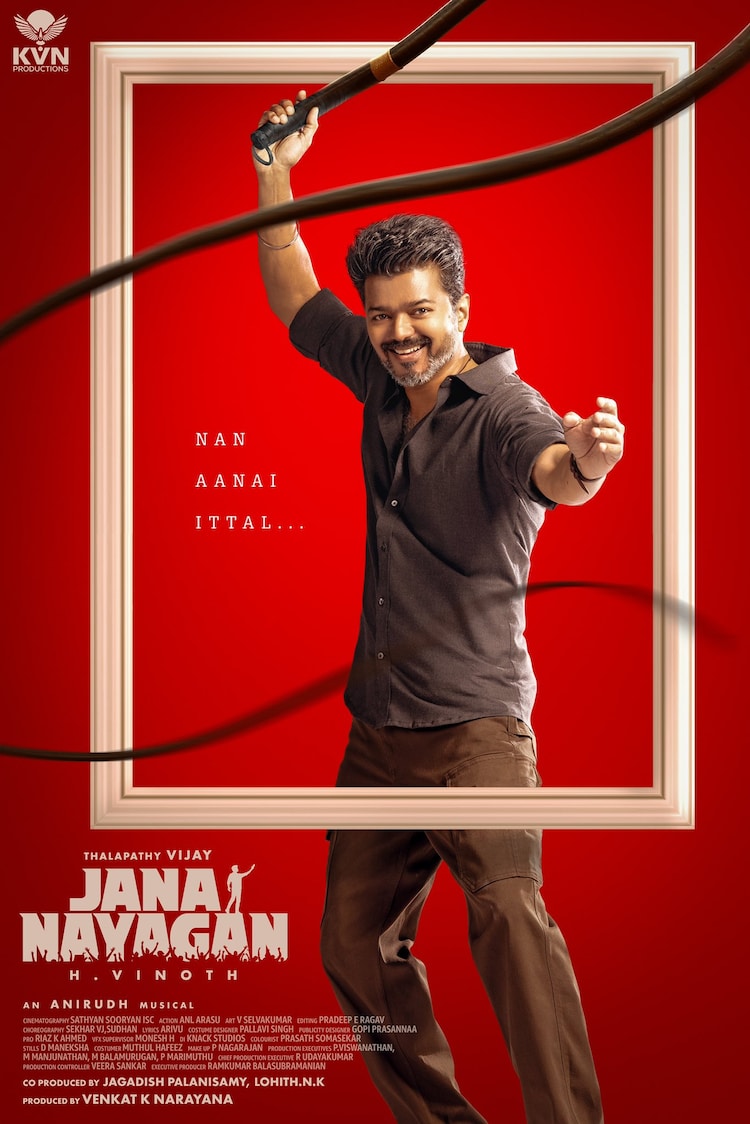
Jana Nayagan's promotional poster showed Vijay flicking a whip stamped with the words Naan Aanai Ittal — "If I order" — a direct echo of MGR's Enga Veettu Pillai (1965) and its famous song promising justice for the poor.
The censor board flagged certain dialogues for their potential political impact and public sentiments and held up the release, which had been planned for January 2026, three months before polling day. Actor Kasthuri Shankar, after watching leaked clips of Jana Nayagan, called it a "three-hour propaganda film for TVK."
On May 4, Tamil Nadu delivered its verdict. The jury that had been watching Vijay's films for two decades had finally been asked to vote.
They remembered every line. They voted. And made Vijay their Chief Minister.
- Ends