
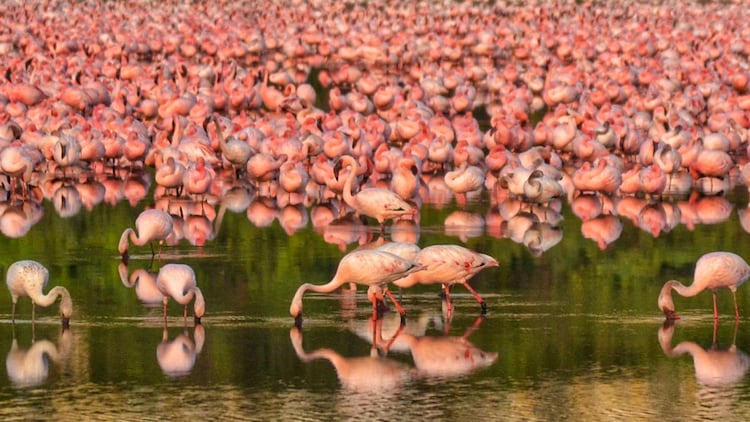
Why are flamingos in love with Mumbai? There is science behind it
Every winter, hundreds of thousands of flamingos descend on Mumbai's coastal wetlands, and the reason is rooted in biology. Here is the science that explains one of urban India's most spectacular natural phenomena.
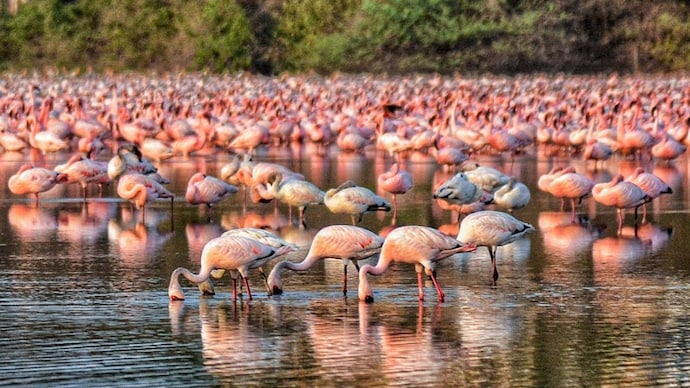
Hundreds of flamingos wade through the shallow waters of the Talawe wetlands behind Nerul's NRI Complex in Navi Mumbai, their pink plumage a direct result of the carotenoid-rich algae they feed on in Mumbai's tidal mudflats. (Photo: PTI)

New Delhi,UPDATED: May 17, 2026 15:43 IST
Every winter, something extraordinary happens along Mumbai's coastline.
Hundreds of thousands of flamingos descend upon the city's shallow tidal wetlands, turning the grey mudflats a vivid, improbable pink.
In May 2026, videos of a massive flock of flamingoes at the Talawe wetlands behind Nerul's NRI Complex in Navi Mumbai flooded the internet.
The birds were wading, feeding, preening, occasionally lifting off in short, spectacular bursts of flight.
It looked like a nature documentary. It felt like magic. But the real explanation is something far more interesting.
Mumbai accidentally built them a five-star buffet.
THE BIRDS AND THEIR BRILLIANT BILLS
Two species arrive each winter. Lesser Flamingos (Phoeniconaias minor), smaller and deeper pink, and Greater Flamingos (Phoenicopterus roseus), taller and paler, with a broader diet.
Both are filter feeders, which means they eat by straining food directly from water and mud rather than hunting or pecking.
Their bills are uniquely curved and lined with comb-like structures called lamellae, which work like a natural sieve.
The bird submerges its head upside-down, pumps water in and out using its tongue as a piston, and traps food inside.
Lesser Flamingos have finer lamellae for microscopic algae. Greater Flamingos have coarser ones for small crustaceans and invertebrates. The two species can feed in the same lake without competing.
The birds' famous pink colour is entirely diet-driven. It comes from carotenoids, the same family of pigments that makes carrots orange and tomatoes red, found in the blue-green algae and brine shrimp they consume.
Birds often arrive pale grey-white and turn a vivid pink over weeks of feeding. Their colour is, in a sense, a measure of how well they have eaten.
WHAT MUMBAI ACCIDENTALLY GOT RIGHT
Mumbai's coastal wetlands, particularly Thane Creek and its satellite wetlands in Navi Mumbai, offer exactly the conditions flamingoes need: shallow water for wading, vast mudflats for filter feeding, and mangrove shelter for roosting.
But what makes Mumbai truly exceptional is food abundance, and here the city's own growth is the unlikely reason.
For decades, large volumes of untreated domestic sewage have flowed into Thane Creek, degrading the wetland and contaminating groundwater in ways that concern environmentalists deeply.
But within this pollution crisis, flamingos have found an unlikely advantage: the nitrogen and phosphorus carried by that waste trigger explosive blooms of blue-green algae, and the birds have evolved to feast on exactly that.
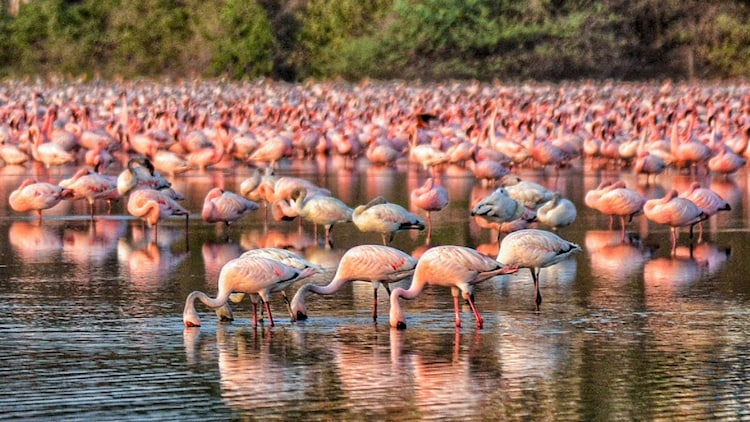
The nutrient surge triggers explosive blooms of blue-green algae, specifically a cyanobacterium called Arthrospira, popularly known as spirulina, which thrives in warm, alkaline, saline conditions.
Post-monsoon temperatures and reduced dilution create precisely those conditions each autumn.
Lesser Flamingos feed almost exclusively on this algae. The city's pollution, inadvertently, created one of the richest flamingo feeding grounds outside Africa.
Flamingos were rare visitors to Mumbai before the 1990s. Counts have since risen from roughly 10,000 in 2007 to over 1,30,000 in recent years, a thirteen-fold increase that tracks the growth of the city itself.
THE FRAGILE BALANCE
Mumbai also offers what ornithologists call a double habitat system. At low tide, the birds fan across Thane Creek's 26-kilometre-long intertidal mudflats to feed.
When high tide submerges those flats, the birds lift off and move to shallower inland wetlands, such as the NRI Complex lake and DPS Flamingo Lake in Navi Mumbai, to rest and continue feeding until the tide recedes.
This movement is clockwork, governed entirely by tidal rhythm.

But the balance is fragile. Recent water samples from Nerul's wetlands have shown total dissolved solids between 17,360 mg/L and 22,920 mg/L, far above normal benchmarks, with pH levels exceeding 9, indicating severe alkaline stress.
When development blocks tidal inlets, water stagnates, oxygen drops, and the microbial food web collapses. The flamingos simply stop coming.
The birds, then, are not just a spectacle. They are an ecological report card.
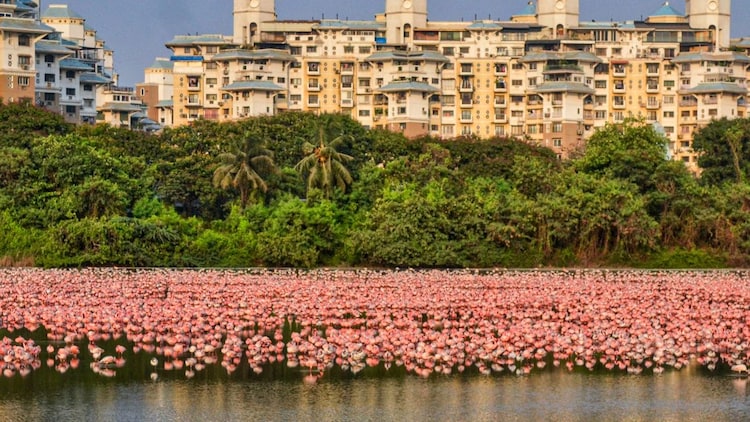
When Mumbai's wetlands are healthy, the flamingos arrive in their tens of thousands, a sea of pink stretching to the horizon.
When the wetlands are damaged, the birds go elsewhere, and the city is left with mudflats and silence.
Their presence is a gift the city has not quite earned, and may not always keep.
- Ends