
BJP's 4 Parivartans: How the party rewrote its Bengal playbook
After its 2021 defeat, the BJP has recast its Bengal campaign with the aim of dethroning the Trinamool Congress through four strategies. The changes seek to shed the party's 'outsider tag' image, localise its message and broaden its appeal through cultural and religious traditions.
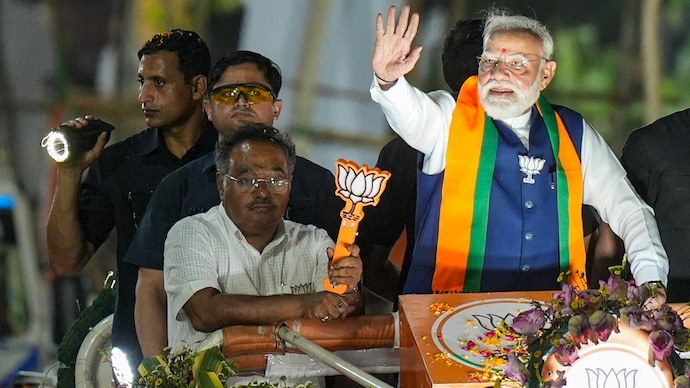

In 2021, the BJP went all in on West Bengal. Prime Minister Narendra Modi held more than 30 rallies. Home Minister Amit Shah campaigned relentlessly, often addressing multiple events in a day. The party brought in several leaders from the Trinamool Congress (TMC) and framed the election as a battle for parivartan or change.
But when the results came, the BJP fell far short of power.
The TMC swept back to power with more than 200 seats in the 294-member Assembly, while the BJP, despite recording its strongest-ever performance in the state, won 77 seats. Nearly 38 per cent of the vote was not enough to stop a landslide.
For the BJP, 2021 became a political lesson. In 2026, what West Bengal is witnessing is the party’s attempt to apply that lesson.
The slogan remains parivartan, but this time the BJP’s campaign is built around changing itself as much as changing Bengal politics.
PARIVARTAN 1: FROM ATTACKS ON MAMATA BANERJEE TO TARGETING SYSTEM
In 2021, the BJP campaign revolved around a direct confrontation with Chief Minister Mamata Banerjee. PM Modi repeatedly used the phrase “Didi O Didi” at rallies, turning the election into a personalised contest against the TMC chief. The line became memorable, but many observers believe it backfired.
Personal attacks often generated sympathy for Mamata Banerjee, reinforcing her image as a combative leader fighting a larger political machine.
In 2026, the BJP appears to have shifted course.
Rather than directly targeting Mamata Banerjee, party leaders have focused their criticism on her nephew and TMC national general secretary Abhishek Banerjee.
Amit Shah has repeatedly argued that another TMC victory would strengthen “bhaipo raj” – a reference to Abhishek Banerjee – rather than Mamata Banerjee’s leadership. "If you vote for TMC again, bhaipo (nephew) will rule here, not Mamata Didi," he said.
The messaging suggests a calibrated strategy: avoid making Mamata Banerjee the victim, while portraying the political system around her as vulnerable to criticism.
PARIVARTAN 2: FROM RAM TO MAACH
In 2021, slogans such as Jai Shri Ram became central to the BJP’s West Bengal campaign. The slogan, often used in confrontational exchanges with TMC supporters, reflected the party’s national political language.
Critics, however, argued that the approach sometimes clashed with Bengal’s cultural identity, which blends religion, language and regional traditions.
This time, the BJP has attempted a softer cultural pitch.
Candidates have embraced local symbols, cuisine and traditions. Anurag Thakur, a former Union Minister, who wore saffron-clad clothes, was seen relishing shorshe ilish (hilsa cooked in a sharp, pungent and creamy mustard seed paste gravy) on camera, while BJP leaders increasingly invoked Maa Kali and Maa Durga instead of relying heavily on overtly national religious slogans.
One rally stage used by PM Modi was designed to resemble the Dakshineswar Kali Temple in Kolkata, reinforcing the party’s effort to connect with West Bengal’s spiritual and cultural identity.
During one campaign stop, jhargram-west-bengal-election-rallies-bjp-tmc-2898592-2026-04-19" target="_self">PM Modi paused at a roadside jhalmuri stall in Jhargram, bought the snack and insisted on paying. The imagery appeared deliberate – a party trying to appear less like an outsider and more rooted in Bengal’s everyday life, be it food or religious traditions.
PARIVARTAN 3: FINDING A BENGALI VOICE
One of the TMC’s strongest political arguments has long been that the BJP is an “outsider” party that does not understand West Bengal. In 2021, the BJP struggled to effectively counter that perception.
In 2026, the party appears to have found a more local voice in senior BJP leader and former Union Minister Smriti Irani. At a rally in Panihati, Irani addressed voters in fluent Bengali, highlighting her family connection to the state.
Irani said, "Tumi Bangla bolte paro. Ami o bolte pari. Amaro dadur bari ekhane. Ekhane jonmo niyechi toh to amra kothai bairer lok?" (Can you speak Bangla? So can I. My grandfather's house is here. Born in this country, how are we outsiders?) Her mother is Bengali.
Irani’s Bengali fluency and cultural familiarity have made her one of the BJP’s strongest campaigners in the state.
In West Bengal, where language is closely tied to identity, the party appears to be relying on leaders who can bridge the perception gap.
PARIVARTAN 4: COMPETING FOR WOMEN'S VOTERS
Perhaps the BJP’s biggest strategic shift has come in its approach toward women voters.
Women form a key pillar of Mamata Banerjee’s support base. Her welfare programmes, including direct cash transfer schemes, have helped build a strong political connection with female voters over the years.
In 2021, the BJP criticised several welfare programmes as “freebie politics”, a line that may not have resonated with women beneficiaries.
In 2026, the tone has changed.
The BJP has largely stopped attacking TMC welfare schemes and instead, pledging double or more than what Lakshmir Bhandar currently provides. At the same time, the party has attempted to challenge Mamata Banerjee’s image as a protector of women.
The BJP has repeatedly highlighted the RG Kar hospital rape-murder case, using it to question the TMC government’s record on women’s safety. PM Modi referenced the incident during campaign speeches and emphasised that the BJP had fielded the victim’s mother as a candidate.
The political message is clear: if women’s security is central to Mamata Banerjee’s appeal, the BJP wants to make law and order a competing issue.
FROM CHALLENGER TO LEARNER
In 2021, the BJP entered West Bengal as an aggressive challenger aiming to break the TMC’s dominance. It left with a stronger vote share but a decisive defeat.
What has emerged in 2026 is a campaign shaped by introspection.
Rather than repeating the same formula, the BJP appears to have altered its language, cultural messaging, leadership projection and voter outreach strategy.
Whether these four parivartans are enough to breach Mamata Banerjee’s political fortress will become clear when the results will be out on May 4.
For now, the BJP’s West Bengal campaign is no longer just about changing the state – it is also about proving that the party itself can change.
Elections 2026 | West Bengal Election | West Bengal Election Constituencies | West Bengal Election Schedule