
Vijay may be short of numbers, but he is long on political force
Vijay met the Governor despite being six MLAs short of the required number. The move highlighted his confidence that political backing would carry him through the confidence vote.
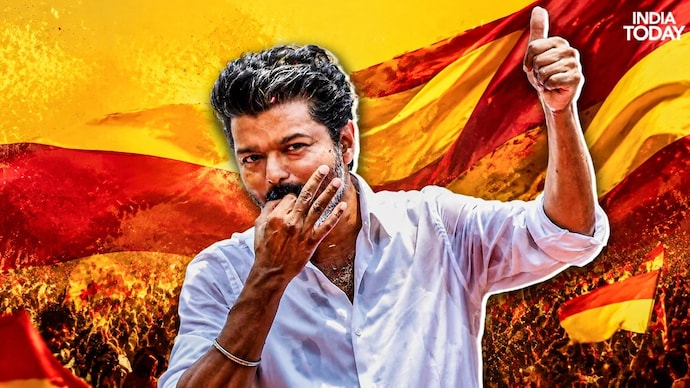

A historic moment has arrived, bringing a tectonic shift in Tamil Nadu politics. The man who rode a silent surge to electoral prominence has now crossed the constitutional threshold of power. Vijay has – prematurely, one might say – met the Governor, submitted his claim confirming support from 112 MLAs, and formally sought an invitation to form the government—not as a claimant scrambling for numbers, but as a leader asserting authority from a position of strength.
By constitutional convention, the Governor is now expected to invite Vijay to form the government and grant him time to prove his majority on the floor of the House. This is not merely a procedure. It is transformation.
For decades, Tamil Nadu politics functioned within a familiar framework — two dominant Dravidian forces, alternating, adjusting, enduring. Today, that equilibrium stands disrupted. Vijay’s confident entry into Raj Bhavan, now Makkal Bhavan, is not just the culmination of an electoral upset; it is the legitimate demand for institutional acknowledgement of a rewritten political grammar on the electoral scrolls.
Even before the formal swearing-in, the tone is unmistakable. Vijay is not negotiating from vulnerability. He is, in effect, challenging other parties to either extend support on his terms or risk being left out of the emerging order. What should have been a moment of numerical anxiety has instead become one of political command.
Indeed, something strange and remarkable is happening in Tamil Nadu.
THE NUMBERS GAP, THE POWER PULL
Vijay’s TVK has secured 108 seats, ten short of a simple majority. In conventional politics, such a situation would trigger frantic outreach, discreet bargaining, ideological compromise and visible coalition crafting. The party short of numbers would be expected to knock on every available door.
Here, the doors are opening towards him.
Parties, including the Congress — now not merely supporting but participating in the government — and sections of others, even fragments within the AIADMK, are reportedly seeking him out with unconditional or near-unconditional backing. The Congress decision has acted as both signal and stimulus. Its move away from the DMK alliance and into the TVK fold has provided political cover — and incentive — for other formations to come to the “aid of the party,” as the phrase goes, without appearing opportunistic.
The direction of political traffic has reversed. The one who lacks numbers holds the leverage. The ones with numbers seek relevance through alignment.
Pre-poll popularity has translated seamlessly into post-poll pull. The result was a tsunami, no doubt, but the waters have receded just enough to leave a stretch of exposed shore. Yet even this ‘short wave’ has transmitted a series of high-frequency political messages.
The first is unmistakable: a decisive rejection of the 50-year Dravidian duopoly. Both DMK and AIADMK have been eclipsed — not merely defeated but diminished in stature and relevance. This is not alternation; it is exhaustion finding expression.
The second is more decisive: this is not merely a vote against. It is a vote towards — towards a recognisable alternative in the name and face of Vijay. He positioned himself not as an extension of the system, but as its interruption. That distinction has proved decisive.
POSITIONING THE PHENOMENON
Vijay’s rise is not accidental. It is structured simplicity.
He did not over-articulate ideology. He did not clutter messaging. He did not decentralise focus. In a crowded political soundscape, he reduced the proposition to its bare essence: the mass leader is the message. The face is the framework. The symbol is the shorthand.
In doing so, he tapped into a vast reservoir of cultural familiarity. Tamil Nadu has always responded to figures who combine visibility with emotional recall. But unlike earlier icons, Vijay arrives without the institutional inheritance of the Dravidian movement. That absence has turned into advantage. He is not seen as a successor. He is perceived as a reset.
THE COMPULSION OF SUPPORT
Why, then, are other parties moving towards him with such urgency?
The answer lies beyond immediate arithmetic. It lies in anticipated consequences, in cold political calculus, and in the unmistakable reading of voter psychology.
Every election is a new event. All it takes is a mood shift in the right segment for outcomes to overturn. That shift has already occurred — visibly, decisively, and across regions. The youth vote, the floating voter, and the politically fatigued middle have converged.
In such a climate, the prospect of a fresh election becomes a political risk few are willing to take. This is no longer a static electorate. Every passing month adds new voters. Between the 2021 Assembly elections and the current 2026 cycle, electoral rolls have expanded significantly, with estimates suggesting an addition of nearly 35 to 45 lakh new voters, a substantial portion of them in the 18–23 age bracket. This demographic is not merely additive; it is directional.
These freshly minted voters — shaped by digital culture, cinematic recall and aspirational politics — are more likely to gravitate towards the figure who has already captured imagination. Incremental demographics, in this context, favour Vijay.
A re-election, therefore, is not neutral. It is potentially amplificatory — for him.
For the losing parties, the implications are stark. Voting for them again may appear redundant, even futile, in the eyes of an electorate that has already made its preference known. The psychology of victory takes hold. People prefer the winner. And the winner takes it all.
In such a scenario, support becomes less about ideology and more about survival. This is not surrender. It is enlightened self-interest — of parties, of MLAs, of political actors who recognise that resistance to a rising force may prove electorally fatal.
CONGRESS BREAKS RANK
The Congress move is not a footnote; it is a pivot.
By not only extending support but participating in the government, it has effectively severed its long-standing operational alignment with the DMK. This is more than immediate arithmetic. It is strategic repositioning. There are indications that this understanding extends into future municipal contests and even the 2029 Lok Sabha elections.
For other parties, this serves as both reassurance and an invitation. If Congress can cross over, others can follow without appearing isolated. The domino effect, in political terms, has begun.
For Vijay, it adds legitimacy. For the DMK, it compounds the dislocation.
A DISORIENTED OPPOSITION
The DMK finds itself in unfamiliar territory. Stalin’s defeat in Kolathur has unsettled not just the numbers but the nerve centre of the party. The loss of a sitting Chief Minister in his own stronghold is not merely symbolic; it is demoralising and destabilising. Authority that once flowed from the top now faces internal recalibration.
The AIADMK, meanwhile, continues to hover in political limbo — present, but peripheral; organised, but uninspiring; visible, but not decisive.
Opposition, for the moment, is fragmented, uncertain and reactive.
BEYOND CASTE, BEYOND TEMPLE
Vijay’s electoral approach has challenged established templates. By fielding Dalit candidates in general constituencies and backing them visibly, he has tested the limits of caste arithmetic.
The results suggest that, under certain conditions — particularly when a larger emotional current is in play — traditional calculations can be overridden. This does not mean caste has vanished. It means it has, temporarily, been subordinated to a broader narrative.
Myths have been dented. Whether they remain broken is a question for the future.
THE YOUTH SURGE
At the centre of this transformation lies the youth — not merely as participants, but as drivers.
The meme generation has met movement politics head-on — and overturned it.
For the Gen Z, kith and kin, voting was akin to a movie outing; the booth a poll-mall with a multiplex, their Unicorn the peppy popcorn, frenzy for fizz; and the climax with their pristine hero — thooya sakthi — vanquishing the evil force — theeya sakthi.
What appears playful carries deeper meaning. Politics, for a segment of voters, has merged with cultural consumption. The act of voting has acquired elements of participation, celebration and identification.
More crucially, this generation has not voted in isolation. It has influenced family decisions, shaped conversations, and, in many cases, persuaded older voters. This is not participation. It is propagation.
Those with stakes in the future have made a collective call; primetime pundits, pseudo-intellectuals, and armchair analysts have no divine right to judge a missile that flew over their misty minds. Today, teen and twenty top the charts, forty is geriatric and anything fifty plus is fossil. And politics and public opinion are the new Benjamin Buttons.
This kind of energy therefore gathers and gains momentum in reverse. Again, a fandom that forgets and forgives in full faith cannot be easily fractured. Karur did not dent. Personal issues have not diluted. Performance, at least in the immediate term, may not entirely determine its continuity.
Vijay is likely to get a longer rope.
GOVERNANCE: THE CLOCK BEGINS
But that rope comes with a clock.
The moment Vijay assumes office, expectation replaces enthusiasm. Tamil Nadu’s fiscal position is not expansive. The exchequer carries strain. Yet the promise basket is wide — welfare assurances, subsidies, basic reforms, social commitments et al, everything with financial implications.
The first signals of governance will likely be symbolic — a flagship promise delivered early, a visible action that converts belief into reassurance. But beyond that lies a dense field of expectations.
There are structural challenges. Eight districts have not returned TVK representatives. Administrative depth must be built. Institutional capacity must be assembled from scratch in many sectors.
And there is the familiar risk — that in consolidating power, the system falls back on familiar intermediaries: old money, old networks, old operators. One only hopes that the new dispensation resists that temptation.
The expectation clock will begin ticking the moment the oath is taken.
THE CONFIDENCE AHEAD
The forthcoming confidence vote will be the first formal test. On paper, the arithmetic is tight. The political climate, however, appears tilted.
Unconditional support may materialise. Tactical abstentions may ease the path. Alignments may shift quietly. It is too early to predict the exact configuration. But the direction is clear.
Vijay may be short of numbers, but he is long on political force.
A NEW CHAPTER, NOT THE LAST WORD
This is not merely government formation. It is the opening of a new chapter.
The old script has been interrupted. The new one has begun but remains unwritten in full. Tamil Nadu has moved from familiarity to experimentation, from duopoly to disruption, from structure to surge.
Whether this surge stabilises into governance, whether charisma evolves into system, whether recall transforms into responsibility — these questions will define what follows.
For now, one fact stands firm. The whistle has not just been heard. It has been heeded.
And Tamil Nadu stands, once again, at the edge of reinvention.