
Bengal verdict exposes deep faultlines, TMC faces anger within state machinery
By 10 am on Monday, policemen on election duty began voicing long-suppressed grievances, from unpaid dearness allowance and poor working conditions to growing disillusionment with 15 years of rule. Among other factors, the TMC has increasingly lost support within its own government workforce.
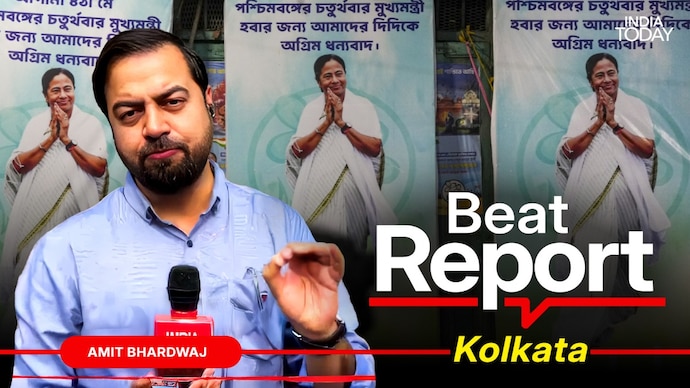

As counting day unfolded across West Bengal, the early trends did more than signal a potential political shift. They exposed a deeper undercurrent within the state machinery. There was a palpable unease among government personnel, many of whom had long remained silent. Conversations with officers on duty revealed not just electoral curiosity, but simmering frustration over years of perceived neglect, institutional constraints, and political interference.
On May 4, the day started on expected lines. The postal ballots opened. The BJP was leading in the trends. Out of curiosity, many officers, some dressed in white uniforms and others in khaki, kept checking what the trends suggested.
A police officer in his late 30s quipped, “The BJP will maintain its lead up till the end.” I checked, what if not. He said, “West Bengal will head towards a dark future. We have already lost a lot. Look at the state of Jharkhand and Bihar police officers. They are far better than us.”
His pain seemed personal, way beyond the common plea over non-disbursement of the dearness allowance to government employees. “We went up till the Supreme Court. Despite the directives to clear our DA, we have been merely given an assurance of clearance by September,” another police officer in white uniform added.
Each of these officers stationed at Netaji Indoor Stadium had a list of common or personal grievances against the Trinamool Congress government. They claimed that in the last fifteen years of the TMC government, the local cadre of the TMC tried to overpower or dominate them.
“We won’t be allowed to lathicharge their cadre even when our jawans faced risk,” the third officer told me by 11 am, when the BJP was heading towards a brute majority in the eastern state.
I had sensed the anger among government employees even during the run of the election in North Bengal. Back then, these government employees spoke about their disenchantment with the Mamata Banerjee government and their yearning for change.
Someone complained about not getting the right posting, others about facing “punishment postings”. These voices became loud and clear by the time Bengal took a saffron turn. Controversies around recruitment schemes and legal troubles for government job appointees, ignoring schoolteachers, topped these lists.
The postal ballots were a reflection of this against the incumbent party.
COUNTING DAY TURNS VOLATILE
When the political temperature increased in West Bengal, with a focus on the Bhabanipur counting centre, the Netaji Indoor Stadium stood witness to one of the initial spats between TMC and BJP workers. I was busy checking the electoral trends when a police constable alerted me about the hungama near the counting centre. Next, I saw youth breaking bricks and resorting to stone pelting. Suddenly, the area outside the counting centre, which had a deserted look, turned into a war zone.
BJP workers accused the TMC cadre of roughing up their workers who were merely celebrating their victory. The paramilitary personnel were called in, the TMC workers were pushed inside their camp, and BJP sympathisers were asked to disperse. However, many TMC camps and officers around Kolkata couldn’t escape the ill fate, the culture that West Bengal has witnessed ever since the Left’s dominance.
Meanwhile, at the Bhabanipur counting centre, West Bengal’s future was being engraved. The Kolkata roads, which would turn green by post-noon on counting days since 2011, were all saffron.
BJP supporters were already cheering for their commander, who took CM Mamata Banerjee head-on twice. “Jai Shree Ram” slogans took over the streets of Kolkata, and the cadre of “Joy Bangla” suddenly disappeared into thin air.
They were hoping Suvendhu Adhikari will be appointed Chief Minister of West Bengal for two successful campaigns against the outgoing Chief Minister Banerjee. Many credited him for the BJP victory with a two-third majority in West Bengal.
TMC UNDERESTIMATED ANTI-INCUMBENCY
Trinamool Congress insiders had told me they were returning to power with nearly 180 seats. Another faction of the party claimed even higher numbers, in the 200 ballpark.
When questioned about the anti-incumbency factor at play, one senior TMC leader countered, saying, “The TMC’s lead in at least 100 assembly segments in the 2024 Lok Sabha polls was more than 20,000 votes. It was when the BJP was seeking votes in the name of the Prime Minister.”
However, general dismay among voters had seeped in. On both polling days, I came across voters speaking about the need for unayan (development), jobs, not financial aid. The TMC also tried to underplay the impact of the RG Kar rape-murder horror, the BJP fielding the victim’s kin Ratna Debnath, and the polarisation of women voters. The results might have made at least a few TMC leaders realise their blunder.
Notably, younger voters were no longer connecting with Mamata Banerjee’s leadership in West Bengal. One TMC faction did acknowledge this. “We have realised that Didi is unable to capture the imagination of young voters. Her political counters at times don’t resonate with the younger crowd; hence, Abhishek Banerjee himself takes charge on certain issues these days.”
However, this realisation was possibly too late. The BJP has now completed its biggest mission, clinching the state where its founder was born.