

Video: Illegal migrants flock border to return as Bengal starts deportation drive
Many of these migrants had allegedly been living illegally in different parts of Bengal and arrived at the border following recent announcements regarding deportation and the setting up of holding centres for foreign nationals.
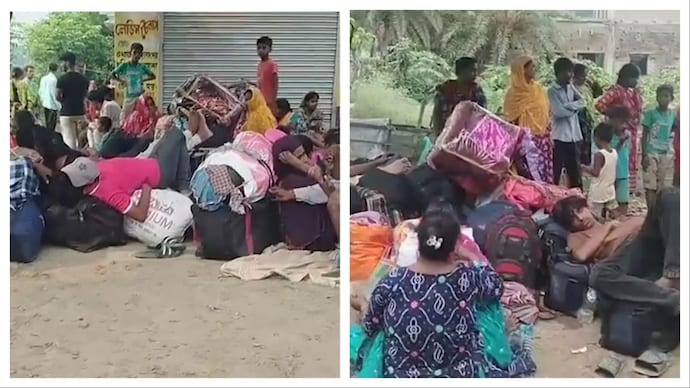


Large groups of alleged illegal Bangladeshi migrants have begun gathering along multiple border points in West Bengal amid the BJP government’s newly launched "detect, delete and deport" policy, with scenes emerging from North 24 Parganas and Malda that signal the state’s anti-infiltration drive has moved from political rhetoric to administrative action.
At the Hakimpur checkpoint in North 24 Parganas' Basirhat subdivision, more than a hundred Bangladeshi men and women assembled on Tuesday morning seeking to return across the international border.
Many of them had allegedly been living illegally in different parts of West Bengal and arrived at the checkpoint following recent government announcements regarding deportation and the setting up of holding centres for foreign nationals.
The rush to the border comes days after Chief Minister Suvendu Adhikari declared that the state would adopt a “detect, delete and deport” policy against infiltrators.
Speaking at a recent meeting with senior BSF officials, Adhikari said those outside the ambit of the Citizenship (Amendment) Act would be treated as illegal entrants.
"Those who are outside the purview of the CAA are infiltrators and will be arrested by the state police and handed over to the BSF," Adhikari had said.
The state government has simultaneously moved to establish holding centres across districts to temporarily house suspected illegal immigrants and release foreign prisoners awaiting deportation or repatriation.
The initiative follows directives issued by the Home and Hill Affairs Department’s Foreigners’ Branch in line with Union government guidelines concerning Bangladeshi nationals and Rohingyas residing illegally in India.
Malda has become the first district where such a holding centre has begun functioning.
Located at Chandan Park in English Bazar town, the facility is currently the only holding centre in the district and has already housed nine suspected Bangladeshi nationals, including three women and six minors.
The detainees were apprehended in Pandua under Gazole Police Station before being shifted to the centre on Sunday.
Security arrangements at the facility remain extensive, with CCTV surveillance and deployment of 12 police personnel, civil defence staff, civic volunteers and support workers for round-the-clock monitoring and maintenance.
Officials said the holding centres are intended to function as temporary transit facilities while authorities verify documents and determine nationality status.
Under the framework, suspected illegal entrants can be held for up to 30 days as district magistrates and designated officers conduct verification procedures, collect biometric details and upload records to central databases before repatriation.
“The holding centre has started functioning. At present, nine Bangladeshi nationals are being housed there. Necessary verification and legal procedures are being carried out. The detainees are being treated in accordance with prescribed legal norms,” news agency PTI quoted a senior police officer in Malda as saying.
The latest move is also being linked to the Immigration and Foreigners Act, 2025, which replaced multiple older laws governing immigration and foreign nationals.
The legislation introduced a technology-driven framework for surveillance, detention and deportation, while also empowering police officers of head constable rank and above to arrest suspected violators without warrants.
POLITICS OVER DEPORTATIONS
At the political level, the developments have intensified Bengal’s long-running debate over infiltration and citizenship.
BJP leaders have welcomed the drive, claiming the state had become vulnerable to illegal migration and extremist networks.
North Malda BJP MP Khagen Murmu said, "Our country and our state need protection. Bengal had become a corridor for Rohingyas, terrorists and ‘jihadi’ elements".
The ruling dispensation, however, has maintained that communities protected under the Citizenship (Amendment) Act would remain outside the scope of the crackdown.
A subsequent Union government exemption order shields Hindu, Sikh, Jain, Buddhist, Parsi and Christian minorities from Afghanistan, Bangladesh and Pakistan who entered India before December 31, 2024.
As crowds continue to gather near border checkpoints and holding centres begin operating under heavy security, West Bengal’s anti-infiltration campaign appears to be entering a more visible enforcement phase, with further detentions, verification exercises and deportation procedures likely to follow in the coming weeks.