
No slots, no 10-minute house help: As maids head to Bengal, apps struggle to keep up
With many workers travelling to West Bengal for the polls, households are increasingly turning to apps like Urban Company, Snabbit, and Pronto, where high demand is tightening availability during peak hours.

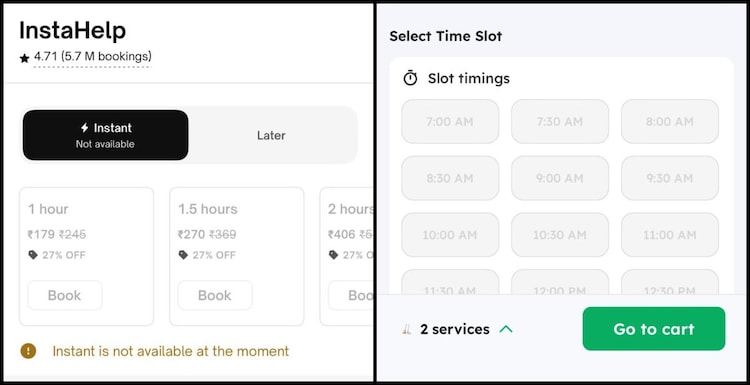
Amid the house help crisis in Delhi-NCR, residents are finding it difficult to secure help through instant service apps.

New Delhi,UPDATED: Apr 24, 2026 13:24 IST
When Delhi-NCR entered a house help crisis, largely triggered by the Bengal elections and fears among migrant workers of not finding their names on voter rolls amid citizenship fears, the next obvious step for many residents was to turn to instant service apps like Snabbit, Pronto, and Urban Company. After all, India is in the middle of a house help revolution where, much like cabs, food, groceries, and electronics, domestic workers can be booked within minutes through apps.
Unfortunately for residents of NCR, it has not been that simple during this crisis. With domestic helps travelling back to their hometowns in Bengal in droves, demand has surged so sharply that booking slots across platforms are nearly impossible to secure.
What’s driving the house help shortage?
Thousands of migrant workers from West Bengal have been heading back home from metro cities and industrial hubs to vote, even at the cost of jobs and wages. Fears triggered by the SIR exercise and political messaging have led many to believe that skipping the vote could put their voting rights or even their citizenship at risk. Bengal is voting in two phases on April 23 and 29.
The ripple effect of this movement is being felt across cities like Delhi-NCR, Mumbai, and Bengaluru. In the National Capital Region, however, the disruption is particularly visible, with households reporting an acute shortage of house helps and increasing reliance on app-based services to manage daily chores.
No slots available for people across Delhi-NCR
Debodinna Chakraborty, a resident of Noida Sector 75, downloaded Pronto, Snabbit, and Urban Company three weeks ago after his help left for Bengal ahead of the elections, combining the trip with her usual month-long annual visit home.
“There have been no available slots for the past two weeks. Many times, Snabbit accepted a booking, but the person never showed up, and the team would eventually issue a refund. On Pronto, I have not been able to book even once,” he shared.
Chakraborty has been managing household chores on his own and considers himself lucky on days when a neighbour’s house help agrees to spare some time to do the dishes and clean his rented flat.
For Tanya Srivastava (name changed on request), a resident of Malviya Nagar in south Delhi, finding a morning or evening slot has become nearly impossible. Her house help travelled to Bengal’s Barrackpore to vote.
“My husband and I are both working, so managing daily household chores has become quite a challenge. All the morning and evening slots are fully booked, and those are the only times we can have someone at home. Work from home isn’t allowed in our offices, which makes it even harder,” she says.
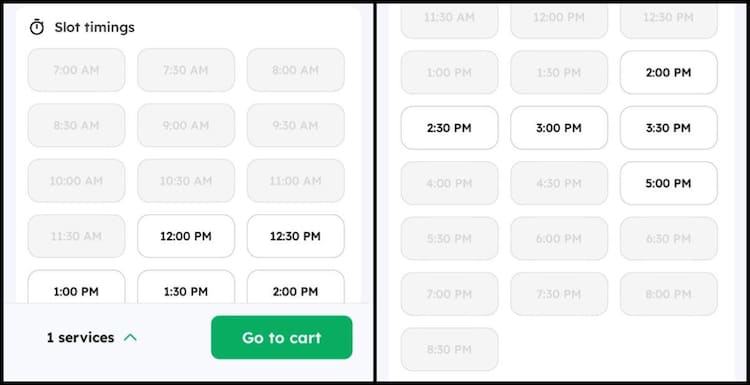
She adds that even noon slots during the weekend have not worked out. Some platforms offer their last available slot as early as 5 pm, leaving little flexibility for working couples.
A different kind of problem arose in a neighbourhood in Noida. Pragya Chawla said regular house helps (many of them non-Bengalis) in her society staged a protest against app-based workers.
“They said they would stop coming to work altogether if app-based workers were allowed to enter the society,” Chawla said.
Residents in Gurugram, North Delhi, and West Delhi reported similar struggles. While homemakers manage with afternoon slots, working households are finding it much harder.
“Returning to a messy home after work is very frustrating. There are piles of dishes, and the house is often in disarray. My husband does not help with chores and relies heavily on apps, even for something as simple as cleaning a fan. It has led to frequent arguments,” Tanya Srivastava admitted.
What service providers say
That was the consumer side of the story. To understand how platforms are responding to the surge in demand, we reached out to companies offering instant house help services to ask how they were managing the surge in demand and whether they planned to expand capacity.
Broomees and Pronto did not respond to queries. However, Urban Company and Snabbit shared their perspective.
Snabbit described the situation as temporary. “At an industry level, we are seeing some movement in workforce availability across metros, which is not unusual during large regional events such as elections,” a spokesperson said, adding that these are short-term patterns rather than a structural shift.
Urban Company, meanwhile, maintained that there is no overall shortage. “We are not experiencing any capacity constraints; however, certain time slots are fully booked due to high demand,” an employee said. The company added that the current spike is limited to specific locations and time slots, with overall operations remaining stable.
The new booming market - Instant house helps
India’s reliance on instant house help services has grown exponentially in recent months. What is emerging is a rapidly expanding market that aims to transform how households manage daily chores, especially when regular help is unavailable.
Snabbit grew from 1 lakh orders a month in August to 3 lakh in October last year and completed nearly 8.5 lakh orders in February this year. rban Company’s instant maid service, InstaHelp, launched in March 2025; it crossed 50,000 daily bookings on February 22.
But with slots hardly available, people are now knocking on neighbours’ doors and flooding WhatsApp groups with SOS-es. Others, meanwhile, are slipping back into Covid-era routines, managing household chores on their own.
- Ends