
Akshay Kumar's box office secret: Low risk, no Rs 1,000 crore, more profit, repeat
Akshay Kumar's release strategy and profit-sharing model is a durable play in a box office trend obsessed with Rs 1,000 crore milestones. But what is this model? Breaking down the actor's style of working in a highly volatile film industry.
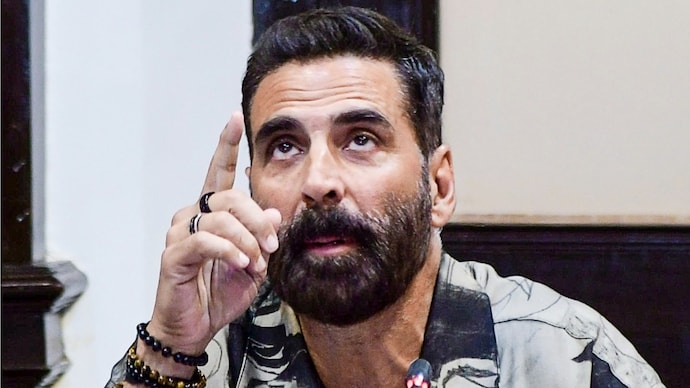

The industry might have been lately obsessed with Rs 500 crore and Rs 1,000 crore benchmarks at the box office, but actor Akshay Kumar continues to be playing a very different game. And if you've ever wondered why he's still everywhere, even when there's no noise around him, this is where it gets interesting.
Why are we discussing this now and why is Akshay Kumar important for this generation? You could just dismiss him and his work, but it's important you understand how an actor of his stature does everything and never waves out. Because sometimes, what looks like a 'routine', is actually very, very calculated.
Here's some food for thought. He comes out, takes over theatres three to four times a year, merely chases grandeur and yet manages to remain one of the most bankable actors in the business. Not many stars today would risk that kind of visibility. He does, and that's the first clue.
At first look, these numbers may not speak much, especially if you are trying to match the towering highs of contemporaries like Shah Rukh Khan, Salman Khan or a pan-India superstar. Nothing against them. But the conversation we are having here matters. Why? Because a closer look would reveal a model carefully built on continuity - something that doesn't feature only peaks, but prioritises steady returns over bold records.
Think of it like this: would you rather have one viral moment or a career that keeps paying off, year after year?
But what is this model really?
Trade expert and producer Girish Johar puts it in simple terms: "It's a game of demand and supply. Every actor sees ups and downs, but Akshay Kumar is one actor who has been consistently performing with limited fluctuation. He is still sought after."
Akshay seems to have designed that consistency for himself. It's not happening just like that. Not happening out of luck. It is a system.
The business of staying visible
Akshay's biggest strength is frequency. While most stars space out releases to build anticipation, he ensures a regular presence. He was the first superstar who didn't mull much over whether to release a film on an OTT platform or not when theatres weren't opened yet in the post-COVID times.
He brought Laxxmi Bomb and released it for the audiences. And once the theatres re-opened, he was again the first star to bring a film - Bell Bottom -- simply because there's no way he's not showing up, irrespective of the timing of the window. While everyone else was waiting for the "right time," he just... was there.
Even with recent outings like Kesari Chapter 2, Sky Force, Jolly LLB 3, Houseful 5 and Bhooth Bangla, the idea is simple: stay visible, stay relevant. And visibility, in today's fractured attention economy, is half the battle won.
Johar points out that even when the numbers are not record-breaking, the audience hasn't disengaged. "His recent outing has also done decent business. That clearly shows audiences still look out for his films and come to theatres," he says.
In a volatile market, that kind of steady footfall is a win in itself. Because consistency, even if it looks modest, builds trust, and trust sells tickets.
Not top-heavy: The real financial play
The real distinction, however, lies in how Akshay structures his films financially. Instead of charging a massive upfront fee, he usually works on a hybrid model: a base remuneration combined with a share in profits. This ensures that the film is not burdened from the start. Sounds simple, but this is where the real change happens.
"He charges a basic remuneration and then comes in as a profit percentage partner. This ensures the film is not top-heavy. Costs are limited, and profits are realised earlier," Johar explains.
The impact is significant. A film doesn't need a blockbuster opening to survive. It just needs to perform steadily. "If money is on the table, everyone gets a share. And if not, the producer doesn't lose as much as they would on a big-budget film," he added.
You would have heard about how inflated star fees often sink projects before release? Well, that's reason why Akshay's approach makes producers far more comfortable returning to him. Less gamble - right there!
Efficiency as strategy
Akshay's famously tight shooting schedules can be looked at as discipline, but they are also a core part of his economics. Smaller shoots reduce costs across the board, and his increasing involvement as a producer or collaborator in any respect ensures tighter control over budgets. Less time on set = less money burned, and he's doing the maths.
Johar goes on to explain, "When he takes on the producer's role, the cost of making the film is also under his purview. If he can bring costs down during the shoot, profitability comes faster."
The focus on efficiency means his films recover quicker and enter the profit zone earlier, often without needing extraordinary box office numbers. Faster recovery is everything in this market.
Is he chasing the Rs 1,000 crore dream then?
Probably. But a more important question to ask is how Akshay's relatively grounded choices stand out in a conversation likely dominated by Rs 1,000 crore ambitions in the trade landscape today, especially in the post-Dhurandhar era?
Johar suggests that is a conscious decision. Because not chasing something is also a strategy if you see.
"Why does every film have to be Rs 1,000 crore? It's about choosing your sweet spot," he says. The producer further explains it with a cricket analogy: not every player is meant to hit sixes every ball. Some are there to keep the scoreboard moving.
"The middle overs are critical. You can't score zero there. You need to keep the clock ticking. Those runs decide the overall total," he emphasises.
Akshay operates in that middle zone: films that may not break records but ensure consistent returns. There's also a fundamental truth that often gets overlooked: "Audiences don't buy tickets because a film is a Rs 1,000 crore project. They come for the story, the songs, the entertainment. Budget is not the deciding factor." Think about your last theatre visit, did you go to a theatre because it was the budget that sold it to you? Right.
A familiar template, reworked for today
There's a sense of deja vu in this model, if you look really closely. Rajendra Kumar, once known as "Jubilee Kumar," delivered multiple releases in succession, many of which ran for over 25 weeks.
Dil Ek Mandir (1963), Mere Mehboob (1963), Sangam (1964), Ayee Milan Ki Bela (1964), and Arzoo (1965) - his strength lay in reliability as much as stardom. Back then, consistency was the currency — much like it is quietly becoming again.
Mithun Chakraborty followed a similar philosophy later, doing a high volume of films each year - Disco Dancer (1982), Pyar Jhukta Nahin (1985), Muddat (1986), Watan Ke Rakhwale (1987), and Waqt Ki Awaz (1988). Not all were blockbusters, but producers kept returning because the economics worked. Different era. Same instinct.
Akshay's approach feels like a contemporary version of that thinking. It is definitely structured, almost calculated, and nicely adapted to today's market realities. Only now, the maths is sharper and the risks are more visible.
The road ahead
That said, even this model requires some recalibration. With theatrical audiences skewing younger, there is a need to align roles more carefully with his on-screen persona. Johar suggests a more measured approach going forward. Because all the systems - reliable or not, need updating with time.
"He needs to be more prudent with his choices. The audience is younger now, so he has to pick roles that suit his age and persona," he says. There is also room for creative reinvention, particularly through collaborations with younger filmmakers.
He goes on, "He should work more with younger directors and writers. They bring a fresh perspective, and with Akshay Kumar, they also get a certain pedigree."
Interestingly, Johar also hints at a shift in format: "He could explore tighter films, even 90-minute thrillers. Something like Tu Yaa Main - imagine Akshay in that story and what he could do with it. We are talking good concepts, strong point of view." In short, evolve, but without losing sight of what's working.
Why it matters
In a post-pandemic industry where revenues have tightened, and big-budget failures can derail studios, Akshay Kumar's model offers something rare and precious: sustainability. And sustainability, right now, might be more valuable than grandeur.
It doesn't rely on one historic blockbuster. It builds a system where films can consistently recover costs and generate profit. A silent success story, may be, but a far more durable one.
Akshay Kumar may not always dominate the box office narrative, but he has built a model that the industry cannot ignore. The actor has proven time and again that real success, perhaps, is not something you get once and live by it, but something which is repeatable. Could this repeatability be the next big thing for a true blockbuster?