
No one uses their sattar minute on the global stage better than Diljit Dosanjh
Diljit Dosanjh drops history on The Tonight Show Starring Jimmy Fallon while Bollywood sticks to thank-you speeches. This is how you use a global mic right!
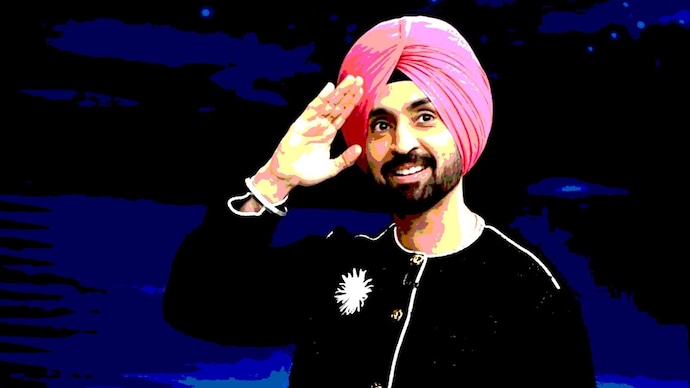

Diljit Dosanjh is on a mission - to put Punjab firmly on the world map, using every tool at his disposal. Music, fashion, appearances, instinct and timing - just being in the right place at the right time. This is Dosanjh's global takeover, and we are witnessing it happening live. But there's more to it than the obvious.
The 42-year-old isn't just interested in being popular in a conventional sense. He's not interested in dissolving into a homogenised, "international-friendly" identity. He seems to be building something far more deliberate: a global presence anchored in a sense of acknowledgement and acceptance of his roots: the Punjabiyat of it all.
That's exactly where he stands apart from many other Indian stars who have had equal, if not greater, access to global platforms, but often choose to play it safe, neutral, and broadly palatable.
Don't take that at face value. Stay with this.
Diljit Dosanjh recently appeared on The Tonight Show Starring Jimmy Fallon, a highly popular US talk show, one of the most visible cultural stages in the West. This is a space designed for quick charm: a few jokes, a rehearsed anecdote, maybe a performance and a polite exit.
This was his second appearance on the show. In 2024, he just performed. This time, he arrived as a guest, promoting his album Aura, speaking about his journey, his audience, his concerts. And then, he did something few would dare to.
He invoked history.
What he did flipped the script subtly. Actually, not entirely subtly, it could also be deemed courageous and quite thoughtful. Sitting across Jimmy Fallon, Dosanjh referenced the Komagata Maru incident – a moment of deep historical pain for Punjabis. His intent was unmistakable and involved no theatrics, no larger-than-life gesture.
Dosanjh sat on that famous couch, in front of the host, and invoked the 1914 Komagata Maru incident.
You could stop at that quote and move on. Many would. But if you stay with it, the meaning deepens. Because while it looked like a simple reference, it was in fact a memory, reclamation, and pride. Diljit compressed it all into a few lines on a global stage. Before we go further, here's the context he was invoking:
What happened in 1914?
In 1914, a Japanese steamship called Komagata Maru left Hong Kong for Canada. Named Guru Nanak Jahaz and carrying 376 passengers, mostly Punjabis, it was denied entry into Canada despite valid documentation. They were held in inhumane conditions for two months and eventually forced back. When they returned to India, 19 were killed, many imprisoned.
More than a century later, apologies have been issued, including one by former Canadian Prime Minister Justin Trudeau in 2016, but the memory remains embedded in community consciousness.
Now return to Dosanjh's moment.
There was something deeply personal in the way he said it. He was talking about an inherited memory, something you only grow up with – almost like Diljit sat with it for ages before a moment like this gave it voice. He talked about the history of his people and implied a sense of quiet redemption for his community. Layered into that was pride, of standing in the same geography, once denied, now celebrated. That contrast, from exclusion to adulation, really made that moment land.
This is exactly where Dosanjh operates differently. He doesn't try to fit in. He leans into who he is: speaking in Punjabi, performing Bhangra, and bringing Punjab, its history into the conversation, even if it means subtly slipping a few details into his answers.
And look at how nonchalantly he does all of it. Even his so-called hesitation, the familiar "my English is not that good", becomes part of the connection. It looks disarming, human, and real. Because he, within that same breath, delivers something as layered, precise, and unforgettable as that Komagata Maru comment.
That duality, humility and clarity, is rare, and it raises an uncomfortable question: What are other Indian celebrities doing on these very platforms?
Think about it.
Most of their international appearances become moments of aesthetic triumph - looks are dissected, brands are credited and poses are perfected. Talk show appearances usually hover around safe anecdotes, rehearsed humour, and promotional soundbites. How many of these moments feel rooted in something deeper - whether cultural, historical or personal? Dosanjh's approach suggests a different possibility.
And then there's the way he arrives. His Bhangra enters the room before he does. He is communicating way before he starts speaking. The folded hands, the glint of warmth and the unapologetically vibrant outfits – embroidered, bejewelled, crowned with a turban – his identity. His presence always has unmistakable pride. He never leaves Punjab behind to go global. He takes it along, totally intact.
Diljit has a way of ensuring his appearances go beyond just promotion. He would say "Main hoon Punjab" or "Punjabi aa gaye oye" – as declarations of space. You could admire that charm, the humour and the music, but don't forget to look closer.
You can admire these Indian stars - many of them genuinely try to put their best foot forward on global platforms. But think for a second: how much of what they say actually stays with you? An actor walks the BAFTA Awards red carpet, delivers a perfectly packaged moment, and moves on. Others headline films on terrorism, patriarchy, poverty or corruption, but when handed the mic, the conversation shrinks to safe gratitude - a director thanked, a team acknowledged, a moment neatly wrapped and forgotten.
Where is the nuance? Where is the memory?
Diljit operates in a completely different register. The moment he takes the mic, there is intent in what he says, when he says it, and how he chooses to say it. Everything feels intentional even when it appears effortless. That's the difference.
Because anyone can have the power to speak, but not everyone knows how to make what they say sound truly powerful.