


- Tamilakam’s Travels: Part 1
- Cosmos, Continent, Country: Part 2
- Tamilakam drew its own map: Part 4
- Name Games: Part 5
- Empires, Elites & Europeans: Part 6
- Dravida to Dravidian: Part 7
- The Caldwell Conundrum: Part 8
- Pundit's Paradoxical Passion: Part 9
- Gods, Kings & Grammar: Part 10
- Tolkappiyar: Part 11
- Valluvar: Part 12
- T’rupparam-Kundram: Part 13
- Epic Clash of Faiths: Part 14
- Tamilakam's Epic Counter: Part 15
- Vaishnavism: Part 16
- Tamil and Sanskrit: Part 17
- Anti-Brahminism: Part 18
- Rise & Rifts Part 19
- Bearded Beginning Part 20
- Alliances & Animosities Part 21
- The Thundering Thandhai Part 22
- Shadows and Succession Part 23
- Anna Arch Part 24
- Agitation Alchemy Part 25
- Anna’s CM Crown Part 26
- The Tricolour Twilight: Part 27
- Karunanidhi’s Coronation: Part 28
- Era of Scams & Defiance: Part 29
- Maximum Guarantee Ramachandran: Part 30
- MGR's 'Thottam' Theatre: Part 31
- The Second Show: Part 32
- Accord, Acrimony, Assaults: Part 33
- DMK’s Tiger-Riding: Part 34
- Jayalalithaa’s Crown: Part 35
- The JJ Juggernaut: Part 36
- Karunanidhi Springs: Part 37
- Role Reversal: Part 38
- Mercury Rises in Poes: Part 39
- Amma’s Comeback: Part 40
- An Arresting Personality: Part 41
- Sandalwood Sunset: Part 42
- Back to Future: Part 43
- Thirumangalam: Part 44
- Sangam, Spectrum: Part 45
- The Lady’s Challenge: Part 46
- Jayalalithaa’s Arc: Part 47
- Kalaignar’s Tryst with Tomb: Part 48
- Dravidian Defiance: Part 49
- Tamil Nadu Through Time: Part 50
Jayalalithaa vs Karunanidhi: The legal battles behind her 2001 comeback
If Delhi had finally steadied after the one-vote convulsions, Tamil Nadu was only beginning to stir. The capital had found a government; the state was preparing for a reversal. Here, one side seemed comfortably in office, the other legally cornered. Yet, in Tamil Nadu, comfort has often proved temporary, and cornered leaders have a habit of charging back through the gate.
Happy Hours in Capital & Chennai
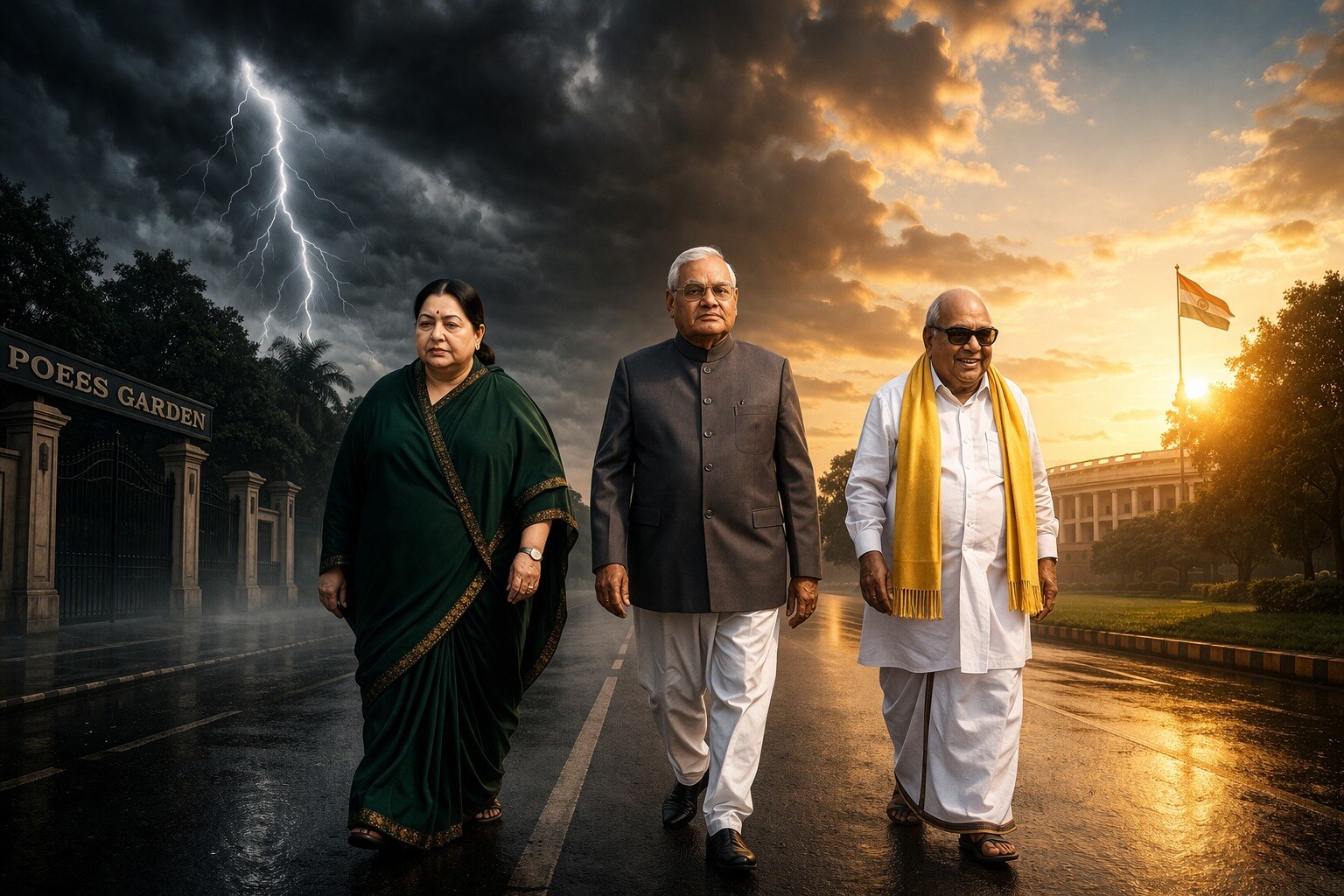
The closing months of 1999 gave Karunanidhi something he had not enjoyed for a while: breathing space. The BJP, freshly returned to power with a sturdier mandate after the October Lok Sabha verdict, no longer had to tiptoe daily around Poes Garden. The AIADMK had moved out of the NDA frame. The DMK had fixed itself. For Vajpayee, this was not merely an alliance rearrangement; it was a change of climate.
The difference was immediately visible. Delhi’s phone lines to Chennai no longer sounded like crisis hotlines. There were fewer placatory flights, fewer emissaries clutching compromise notes, fewer ritual humiliations in waiting rooms. The BJP had exchanged volatility for manageability. Karunanidhi, unlike Jayalalithaa, was not in the habit of converting every disagreement into a countdown clock.
This was the season when the DMK-BJP arrangement looked not merely workable, but oddly comfortable. It was not an ideological marriage, and nobody pretended otherwise. It was a pact of utility. The BJP needed dependable southern ballast; the DMK needed durable national relevance. Each gave the other something useful, and neither insisted on romance.
Governance Without Daily Drama
That relative calm gave Karunanidhi a brief but important window to project what he preferred to project about himself: not merely the poet-politician or the master tactician, but the administrator who could place Tamil Nadu on the threshold of a new economy. If the earlier Dravidian decades had built welfare and social mobility, the turn of the millennium offered a different promise — software, services, infrastructure, and a Chennai that could look beyond Fort St George toward fibre optics and global capital.
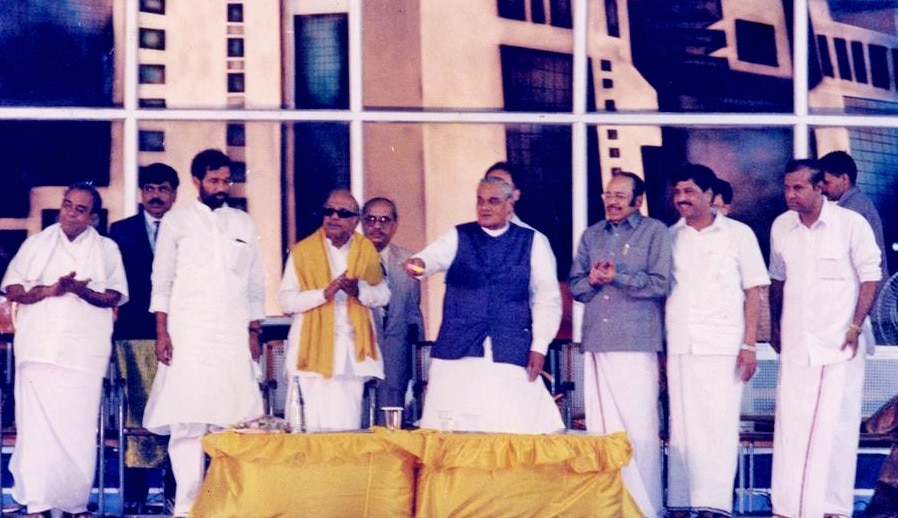
Nothing symbolised that ambition more clearly than TIDEL Park, opened in Chennai in 2000 in the presence of Prime Minister Atal Bihari Vajpayee. It was not just a building, but a billboard for aspiration: glass, steel and server-age confidence rising out of a political culture once defined by rice, ration cards and rhetorical fire. Karunanidhi was trying to ensure that Tamil Nadu did not merely remain socially advanced by Indian standards, but economically future-facing too.
This was not to say that all was sleek and seamless. Chennai still had its bottlenecks, its heat and its urban creaks. But the direction of travel was visible. Tamil Nadu was increasingly being sold as a place where the old Dravidian state had learnt to wear a modem.
Peace After Poes Pressure
At the Centre too, the DMK’s utility became clearer. Murasoli Maran and other DMK figures acquired renewed importance in Delhi. Their presence in the union government was not just symbolic; it gave the DMK a seat at the table in a period when national coalition politics was still volatile enough to reward reliable partners.
There was a delicious irony here. Jayalalithaa, in pulling down Vajpayee in 1999, had imagined herself the decisive player in Delhi’s next script. Instead, she had helped create the vacancy into which Karunanidhi stepped. The rival she wanted cornered in Chennai now had his men breathing easier in Delhi.
Politics in Tamil Nadu often turns to revenge. But for Karunanidhi, this was a quieter and more elegant form of it: not the arrest, the raid or the denunciation, but the simple sight and satisfaction of occupying the room one's opponent had hoped to own.
Cases, Convictions & Cold Steel
If Karunanidhi was using Y2K to project governability, Jayalalithaa was rehearsing her return. The legal cases that had dogged her since 1996 did not merely continue; they began to harden into more serious political danger. The most consequential among them was the Pleasant Stay hotel case, in which a special court convicted her on February 2, 2000 and sentenced her to imprisonment, alongside other proceedings that kept the architecture of prosecution around her both dense and inescapable. That conviction would later become central to the legal barrier that complicated her 2001 candidacy.
But that date lives in Tamil Nadu’s memory for another, darker reason. The conviction triggered a burst of AIADMK fury that soon curdled into horror. Near Dharmapuri, a bus carrying students of the Tamil Nadu Agricultural University was attacked and set ablaze by AIADMK men protesting the verdict. Three young women — Hemalatha, Gayathri and Kokilavani — were burned alive. Others escaped with injuries and trauma that would outlive the news cycle.
It was not merely violence; it was the most ghastly expression of what happens when sycophancy crosses the threshold of just slogans and feet falling and instead becomes combustible. Political devotion, once inflamed, turned into murder with a petrol smell. The state saw, in one appalling burst, how a culture of leader-worship can make ordinary men feel licensed to commit extraordinary barbarity.
Deification, in its most vulgar form, had always lurked beneath the surface of Dravidian Tamil Nadu’s personality-driven politics. But Dharmapuri exposed its ugliest logic: if the leader is wounded, the world may be punished.
That this savagery erupted in response to a court verdict only deepened its significance. Here was a democracy in which the judicial process itself could trigger mob arson on behalf of an aggrieved party boss. The bus, the girls, the flames — they entered the state’s subconscious as a warning of what emotional over-investment in political icons can do when unmoored from restraint.
And yet, in electoral terms, Jayalalithaa did what she had always done best: she outlived the immediate moral burden. For a lesser politician, this would have been a season of attrition. For her, it became one of conversion. She had long understood that in Tamil Nadu, prosecution can be politically sterile unless it is morally persuasive to the public. And moral persuasion, in this state, has always been slippery.
She therefore worked steadily to reframe herself not merely as accused, but as targeted; not merely as litigant, but as victim of vindictive overkill.
The courts were trying to reduce her to a case number. She was striving to return herself to the category of phenomenon. This was the crucial political labour of 2000. Jayalalithaa was not merely waiting for legal relief; she was rebuilding emotional authority.
Her supporters did not necessarily need to believe she was spotless. They merely needed to believe that she had been hunted too hard, humiliated too publicly and cornered too far. That is often enough in Tamil Nadu to restart a career. In all, Jayalalithaa quickly survived the human sacrifice made on her altar.
Old Foes, Fresh Tables
By the time the 2001 assembly election began to appear on the horizon, the alliance tables had once again started spinning. The broad anti-DMK sentiment that periodically gathers in Tamil Nadu had begun to coalesce, and Jayalalithaa, despite legal cloud and recent setbacks, once again became its centre of gravity.
Congress remained uneasily in the AIADMK camp. The Left, too, found itself in that anti-DMK space. The Tamil Maanila Congress, whose birth in 1996 had been inseparable from anti-Jaya sentiment, had drifted into an arrangement that would once have seemed absurd. The PMK too became part of the anti-DMK constellation. Tamil Nadu’s alliance grammar was again proving that yesterday’s betrayal can become tomorrow’s seat-sharing. The binding alibi was the fashionable 'secularism' tag.
Jayalalithaa sharpened the political line with familiar clarity. Aligning with the BJP, she declared, had been a mistake. She had corrected that mistake by bringing Vajpayee down. And she would not return to it. On that count at least, history would vindicate her consistency.
Poacher, Preacher & Jungle Republic
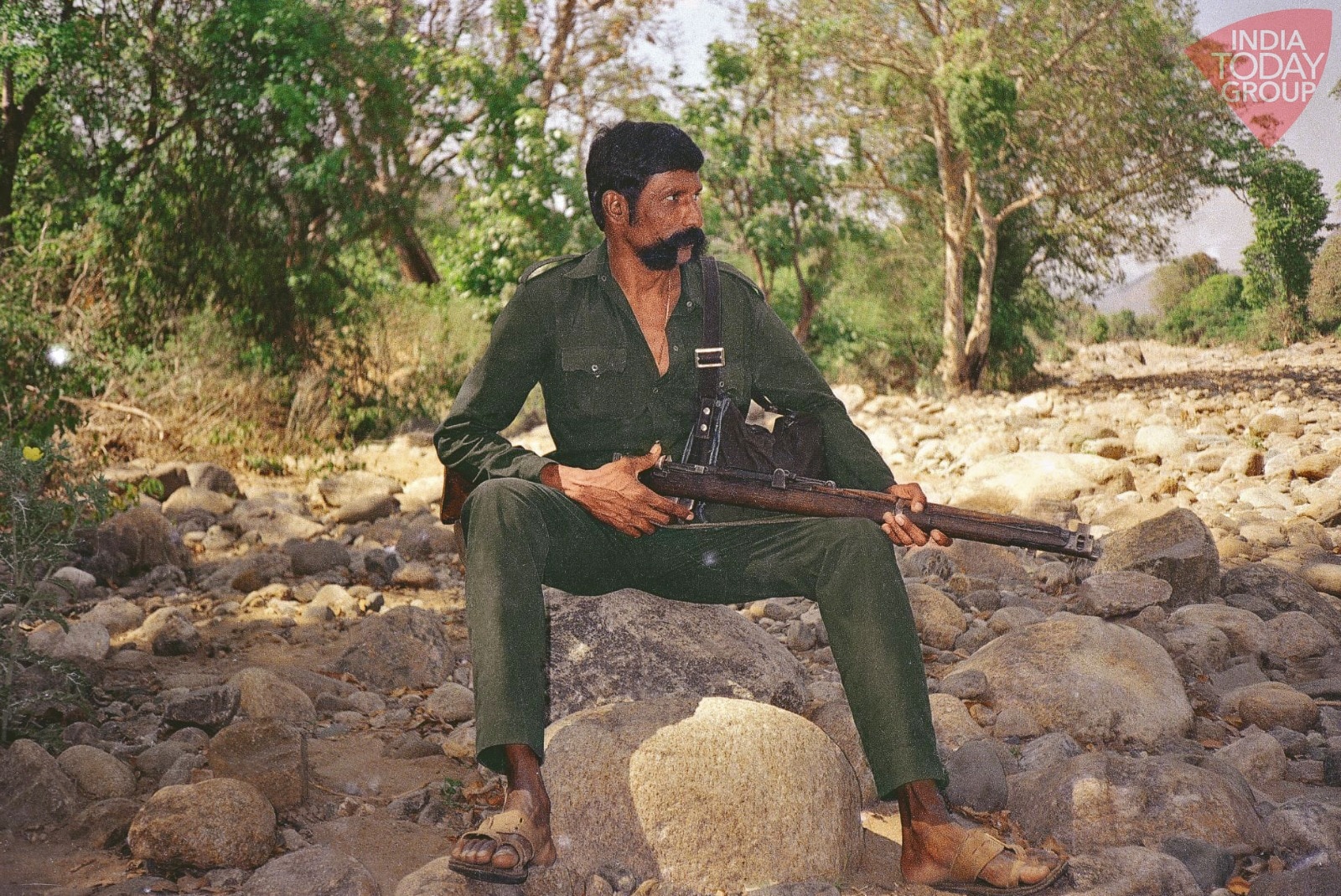
And then, just as Tamil Nadu’s politics was trying to look digital and election-ready, a forest desperado reminded the state that modernity in India is often only one sandalwood tree away from absurdity.
Veerappan, who had haunted the Tamil Nadu–Karnataka borderlands through the nineties as a smuggler, poacher, killer and moustachioed embarrassment, had already established himself by the middle years as a running insult to state authority. The memory of his 1996 killing of STF men lingered as proof that he was not merely an outlaw in retreat, but an irritant who could repeatedly bloody the state’s prestige.
Police forces hunted him, governments denounced him, task forces spent fortunes pursuing him, and yet he remained maddeningly present — a bandit with geography, legend and an innate instinct for drama.
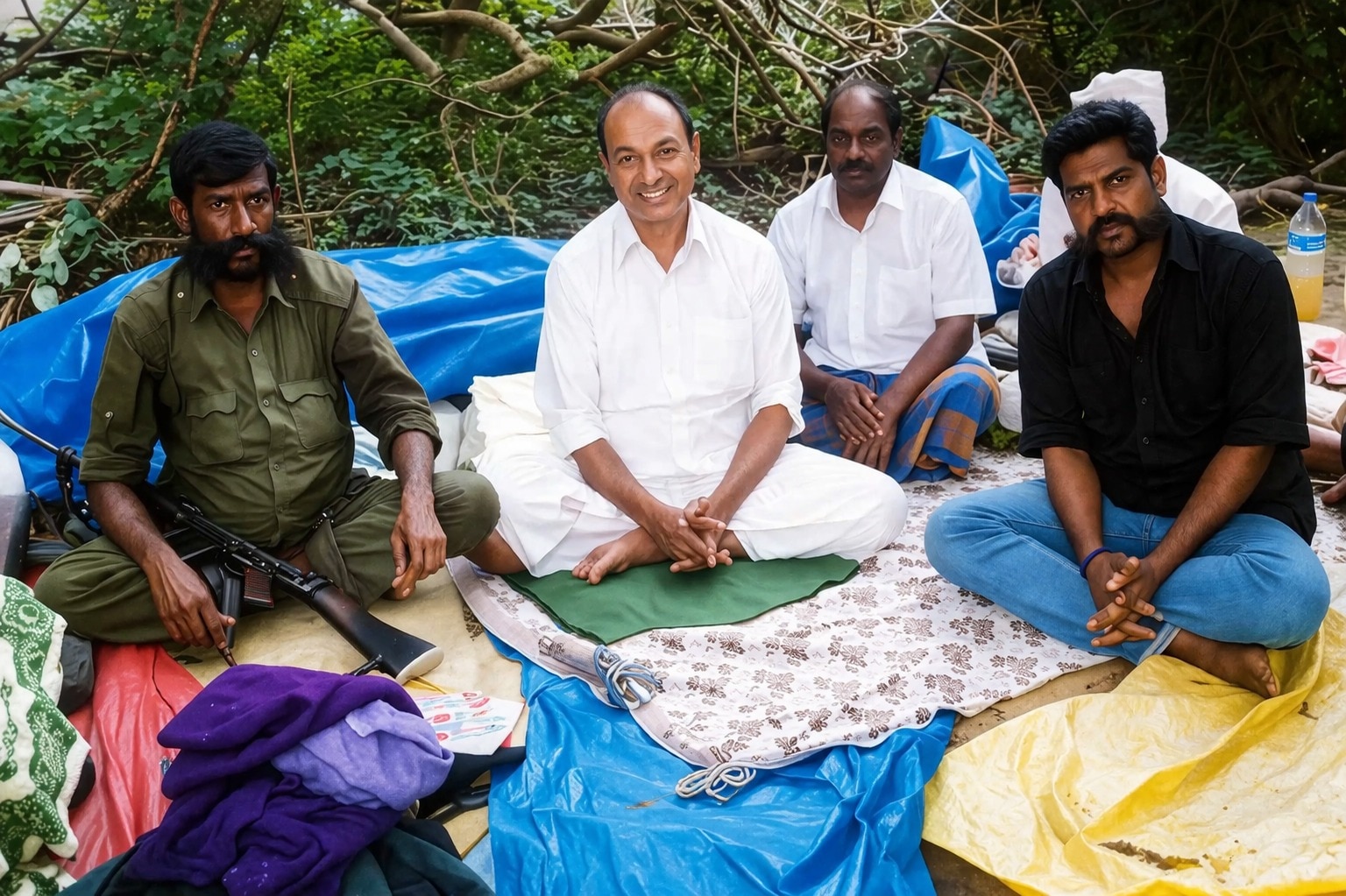
Then came the abduction of Kannada matinee icon Rajkumar in July 2000, and the brigand’s notoriety exploded into the national sphere. What had been a law-and-order headache became a federal dramedy with cultural, linguistic and political undertones. Karnataka panicked. Tamil Nadu sweated. Television feasted. Veerappan, somewhere in the thickets, discovered that he was no longer merely hunted. He was now being negotiated with, with the official authority in the woods, sort of.
This was the phase in which the poacher briefly reinvented himself as preacher, the ideal rogue turning into an idealogue. He spoke not merely as a criminal bargaining for survival, but as a self-styled spokesman of Tamil grievances, a jungle nationalist with cassettes. One moment he was a sandalwood smuggler with blood on his hands; the next he was making demands with the air of a minor liberation front. At one point, he even wrapped himself in symbolic Tamil causes, including the flourish about wanting a Thiruvalluvar statue bang in the middle of Bangalore.
The farce deepened because the state, having failed to catch him, now had to listen to him. From chief minister to secretariat, from chief secretary to common man, everyone seemed to await the next “Voice of Veerappan” dispatch through tapes, television and mediated jungle monologues. The long arms of law stood with folded, awaiting audio updates from the murderer of men and mammals. A complete surrender of authority was treated with the solemnity of negotiation. The brigand was no longer being handled like an outlaw. He was being humoured like an in-law.
And then there was the emissary tamasha. A media go-between, breezing in and out of the forest, like, well, the breeze itself, with remarkable ease, became the bridge between elected governments and the man who had reduced both states to shameful helplessness. In a remarkable physical coincidence, they seem to see not just eye to eye, but moustache to moustache.
The image was surreal enough to deserve its own genre: government by cassette, jungle diplomacy by courier, and a whiskered robber who had somehow made the state behave like his stenographer.
And as popular as Veerappan was his menu: everything that crept, crawled or crooned from crevices or crowded bushes, cooked over campfires. The meet-and-meat tete-a-tete videos of the editor-emissary and his eminent subject sharing meals, messages and matters of statecraft, were chartbusters.
What made it politically damaging for Karunanidhi was not merely the criminal embarrassment, but the visible impotence of the state. The DMK government, for all its digital posturing and developmental sheen, looked oddly powerless before a man in fatigues, foliage and folklore, carrying a rifle across his shoulders and much gore on his fingers. A jungle fugitive had gradually become a parallel power centre, away from civilisation.
The Forest and the Faultline
The Rajkumar kidnapping also carried a more delicate danger. It sharpened Tamil–Kannada tensions at a time when both states were already capable of emotional overreaction on linguistic questions. For once, Tamil Nadu and Karnataka were not obsessing over Cauvery, but over a sandalwood smuggler and a screen star. What might have remained a crime story threatened to become a cultural faultline.
Karunanidhi therefore had to manage not just policing failure, but the tightrope of interstate sentiment. Tamil Nadu politics has always preferred to speak loudly when self-respect is involved. Yet, here was a case in which dignity itself seemed hostage to a rustler bristling in the undergrowth.
Defeat Recast as Destiny
For Jayalalithaa, however, the larger political arc of 2000 into 2001 was becoming clearer by the month. The more she remained under legal pressure, the more she was able to project herself as the embattled protagonist of a vindictive script. Her return was no longer being built on administrative memory alone. It was being constructed on grievance, survival and emotional recuperation.
This was one of her enduring gifts as a politician. She could convert personal adversity into collective sentiment with unnerving efficiency. The very cases that were meant to reduce her public legitimacy began, in the political arena, to feed it. Her supporters did not necessarily need to believe she was spotless. They merely needed to believe that she had been hunted too hard, humiliated too publicly and cornered too far.
That is often enough in Tamil Nadu to restart a career.
The Road Back to Fort
By early 2001, the election climate had begun to tilt. Karunanidhi’s government had pointed to its credit — stability, development optics, an improved Delhi equation, the IT-era image, and a relatively less pompous administrative style than the preceding AIADMK regime. But elections in Tamil Nadu are rarely won on managerial balance sheets alone. They are won at the intersection of alliance arithmetic, public mood and narrative velocity.
And here, the AIADMK front had the upper hand. The anti-DMK vote had consolidated more effectively than the pro-incumbent vote. The broadness of Jayalalithaa’s alliance mattered as much as her own political resurrection. In Tamil Nadu, coalitions often do the heavy lifting before charisma arrives to claim the applause and award.
There was also the old law of the duopoly. The electorate, having installed Karunanidhi in 1996 and sustained him through a relatively stable phase, was once again preparing to leap from the same cliff to the other side. Tamil Nadu does not always punish in half-measures. When it swings, it often does so with both hands.
And there was another layer too. The DMK may have looked more orderly in office, but order is not always emotionally rewarding. Jayalalithaa, by contrast, offered voters what Tamil Nadu politics often craves at moments of churn: drama with direction, grievance with glamour, and a familiar face carrying unfinished vengeance.
Rejected Papers, Rising Heat
And yet, just as the campaign gathered pace, the most dramatic constitutional complication of the election landed at its centre: Jayalalithaa’s own eligibility.
She filed nomination papers despite the cloud hanging over her conviction. She tried in a record four constituencies — Andipatti, Krishnagiri, Bhuvanagiri and Pudukottai — in what was itself a statement of political impudence. But the law was not in a sentimental mood. The returning officers rejected the papers on the ground that her conviction and sentence disqualified her from contesting.
What followed was one of the most extraordinary spectacles in Tamil Nadu electoral history: a leader clearly at the centre of the campaign, clearly the face of the opposition, clearly the claimant to power — and yet legally barred from entering the contest as a candidate.
This was not merely a matter for procedural polemic. It was a constitutional conundrum in full public view. Could a leader who could not contest still politically dominate the election? Could the public deliver a verdict in favour of someone the law had formally excluded from the ballot? Could electoral legitimacy and legal eligibility part ways and still somehow march toward the same destination?
In Tamil Nadu, the answer was about to be yes.
Jayalalithaa did not respond to rejection by retreating. She amplified it. She turned the rejection into proof of persecution, the disqualification into emotional capital, and the technicalities of law into an arena of public injustice. Every rejected paper became a campaign poster in absentia. The rejection did not shrink her campaign; it enlarged her martyrdom.
The Verdict Beyond Eligibility
When Tamil Nadu voted in May 2001, the verdict was emphatic. The AIADMK-led front swept to power with a commanding majority, and the DMK-led alliance was routed far more heavily than the regime’s self-image had anticipated. Karunanidhi retained his personal standing, but the government did not survive the electorate’s broader arithmetic.
The result was a reminder of one of Tamil Nadu’s oldest political truths: the voter may tolerate complexity, but he does not always reward continuity. Development, Delhi relevance and relative calm were not enough to withstand the emotional force of a broad anti-incumbent coalition led by a leader who had turned legal exclusion into political energy.
This was not merely Jayalalithaa’s comeback. It was one of the more audacious returns in Indian politics — a leader defeated, prosecuted, convicted, disqualified, denied the ballot, and yet carried back to power on the shoulders of a verdict too large to ignore.
The electorate, in effect, had said something both politically blunt and constitutionally awkward: if the law would not let her contest, politics would still let her rule.
The Oath Before the Objection
And then came the final twist, one worthy of Tamil Nadu’s typical melodrama.
Despite her disqualification and rejected nominations, Jayalalithaa was sworn in as chief minister in May 2001 by Governor Fathima Beevi. The image was at once contrived, ironic and deeply unsettling to constitutional purists. A leader the election law had kept off the ballot was now entering Fort St George through the front gate and taking the oath of office.
It was an extraordinary moment: the law had said no to her candidature, but politics had said yes to her authority. Between those two verdicts stood the Governor, the Constitution, and a state, all too willing to treat contradiction as destiny.
The move was a great dare even by Tamil Nadu standards. It was also, as a democratic precedent, a live grenade with the pin already loosened. For the moment, however, the political image triumphed over the legal question. Jayalalithaa had returned — not neatly, not quietly, not even entirely lawfully in the eyes of many — but unmistakably.
And thus, as another year, decade, century and millennium began in Tamil Nadu, one lesson stood restored with paradoxical force: in this state, defeat is often temporary, legality negotiable, and comeback a genre unto itself.
The duel had returned home. What followed next would not be calm governance, but confrontation sharpened into spectacle — arrests, reversals, vendetta, constitutional embarrassment and a leader who would soon prove herself, in every sense, an arresting personality.
Next | An Arresting Personality: As Jayalalithaa Reigned & Raged
About


Please rotate your device
We don't support landscape mode yet. Please go back to portrait mode for the best experience