


- Tamilakam’s Travels: Part 1
- Cosmos, Continent, Country: Part 2
- Tamilakam drew its own map: Part 4
- Name Games: Part 5
- Empires, Elites & Europeans: Part 6
- Dravida to Dravidian: Part 7
- The Caldwell Conundrum: Part 8
- Pundit's Paradoxical Passion: Part 9
- Gods, Kings & Grammar: Part 10
- Tolkappiyar: Part 11
- Valluvar: Part 12
- T’rupparam-Kundram: Part 13
- Epic Clash of Faiths: Part 14
- Tamilakam's Epic Counter: Part 15
- Vaishnavism: Part 16
- Tamil and Sanskrit: Part 17
- Anti-Brahminism: Part 18
- Rise & Rifts Part 19
- Bearded Beginning Part 20
- Alliances & Animosities Part 21
- The Thundering Thandhai Part 22
- Shadows and Succession Part 23
- Anna Arch Part 24
- Agitation Alchemy Part 25
- Anna’s CM Crown Part 26
- The Tricolour Twilight: Part 27
- Karunanidhi’s Coronation: Part 28
- Era of Scams & Defiance: Part 29
- Maximum Guarantee Ramachandran: Part 30
- MGR's 'Thottam' Theatre: Part 31
- The Second Show: Part 32
- Accord, Acrimony, Assaults: Part 33
- DMK’s Tiger-Riding: Part 34
- Jayalalithaa’s Crown: Part 35
- The JJ Juggernaut: Part 36
- Karunanidhi Springs: Part 37
- Role Reversal: Part 38
- Mercury Rises in Poes: Part 39
- Amma’s Comeback: Part 40
- An Arresting Personality: Part 41
- Sandalwood Sunset: Part 42
- Back to Future: Part 43
- Thirumangalam: Part 44
- Sangam, Spectrum: Part 45
- The Lady’s Challenge: Part 46
- Jayalalithaa’s Arc: Part 47
- Kalaignar’s Tryst with Tomb: Part 48
- Dravidian Defiance: Part 49
- Tamil Nadu Through Time: Part 50
Thirumangalam, Telecom, Tamil in Delhi & Travel of Law
By the start of 2008, the smoke from Madurai had thinned, but the smell remained. The government still functioned, the old man still wrote, the files still moved, and Tamil Nadu still looked governable enough from the outside. But inside the ruling household, succession had ceased to be a private anxiety and become a public pollutant. What had been a family argument, now had ministries, television channels, district satraps and national consequences.
This was the phase in which Karunanidhi, once admired as an able administrator who could still govern and outwit Delhi in the same afternoon, began to look increasingly like an ageing patriarch whose blood became too thick for the national vein. The state was still being run. But the family was increasingly being managed, and that management itself began spilling into Delhi, the union cabinet and the prime minister’s chair with comic indecency.
A decade earlier, Jayalalithaa had shown Atal Bihari Vajpayee how a Tamil Nadu ally could keep Delhi on edge. Now, ten years later, history returned wearing yellow shawls and dark glasses. If 1999 had seen one mercurial southern ally tug at the Centre’s chair, 2008–09 would show another Dravidian veteran treating the prime minister’s office as if it were a slightly overstaffed extension of Gopalapuram.
Perversion of PM’s Prerogative
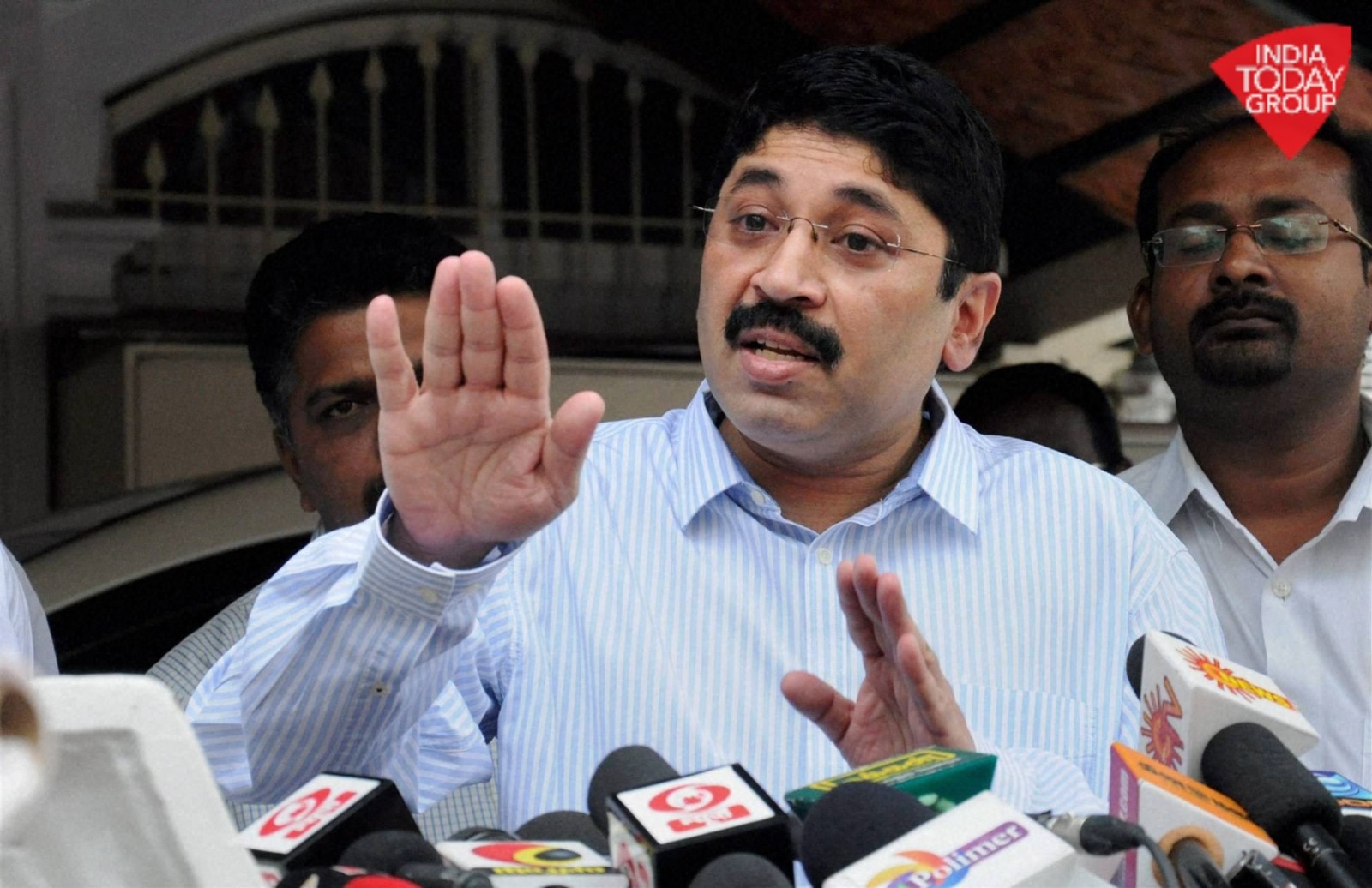
The formal break with the Marans had already begun in 2007. Dayanidhi Maran had been made to resign from the union cabinet after the Dinakaran attack, and Sun TV had by then been nudged out of the warm embrace of Anna Arivalayam. The consequences of those shocks ripened fully in 2008.
The real significance was not merely that a nephew had fallen, or a media empire had been shown the door. It was that a ruling state party had dragged a family quarrel into the national executive and successfully dictated who could and could not remain a union minister. Constitutionally, the composition of the union cabinet is the prerogative of the prime minister. Politically, in coalition India, that noble principle often arrives only after the seat-sharing has been completed and the humiliation already delivered.
Thus, the PMO was made to absorb a family correction from Tamil Nadu as though this were a normal federal procedure. One could almost imagine the file moving across Delhi with the neat notation: ‘Subject: domestic displeasure, immediate ministerial adjustment required’.
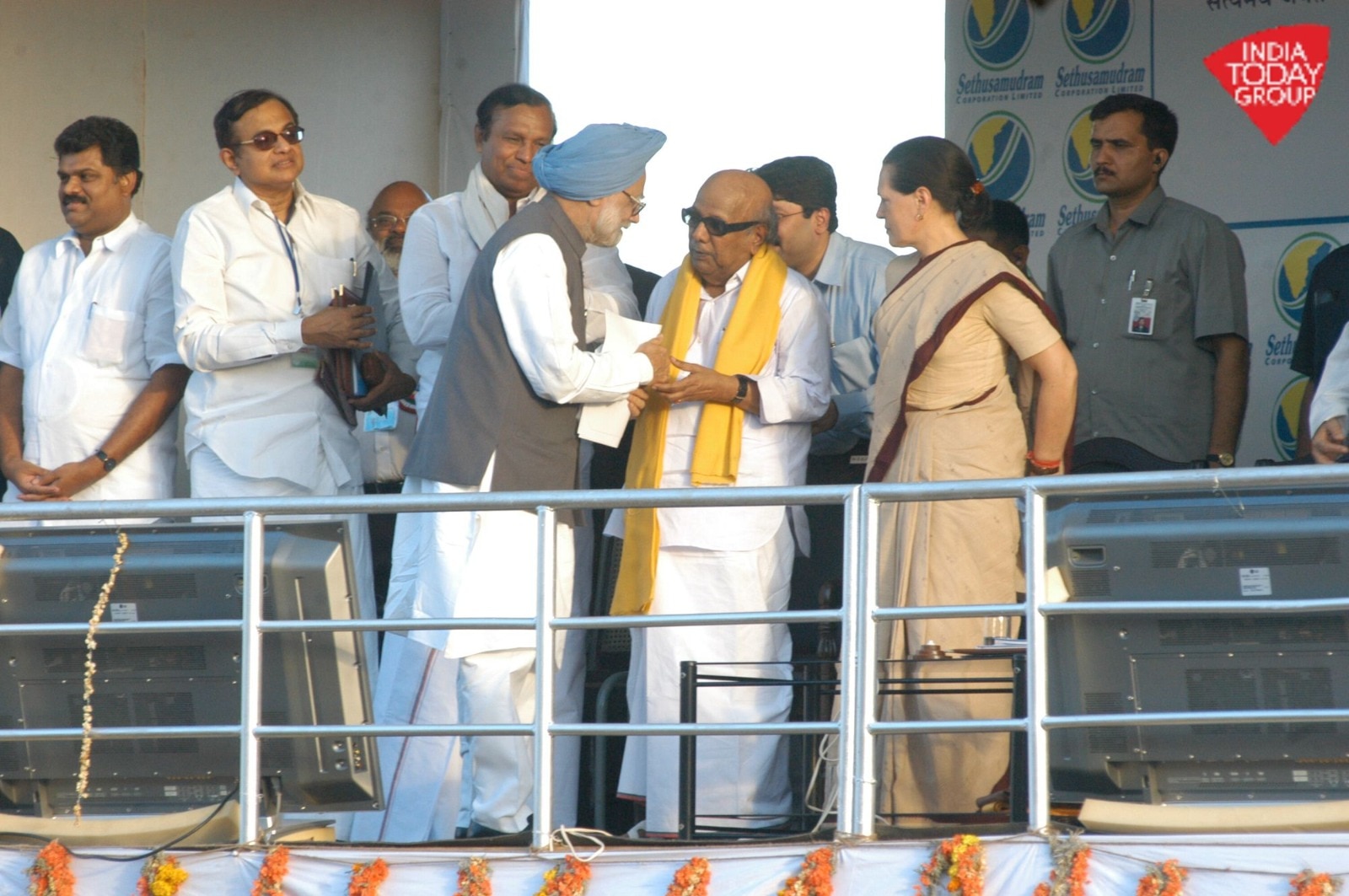
This was no minor embarrassment. It was a demonstration of how far coalition weakness had hollowed out national authority. Manmohan Singh, personally decent and institutionally restrained, was also structurally dependent. And Karunanidhi, who could smell dependence the way seasoned fishermen smell rain, knew exactly how much weight his parliamentary support carried.
The inversion was almost poetic. In 1999, Delhi had learnt that Jayalalithaa could unsettle the Centre through personal insistence. By 2009, it was learning that Karunanidhi could do the same through paternal arithmetic.
The Father & the Heir-Splitting
And if friendship had once been Jayalalithaa’s vulnerability, family had now become Karunanidhi’s. By 2008, the DMK was no longer merely a ruling party with internal ambitions. It was a movement visibly undergoing heir-splitting.
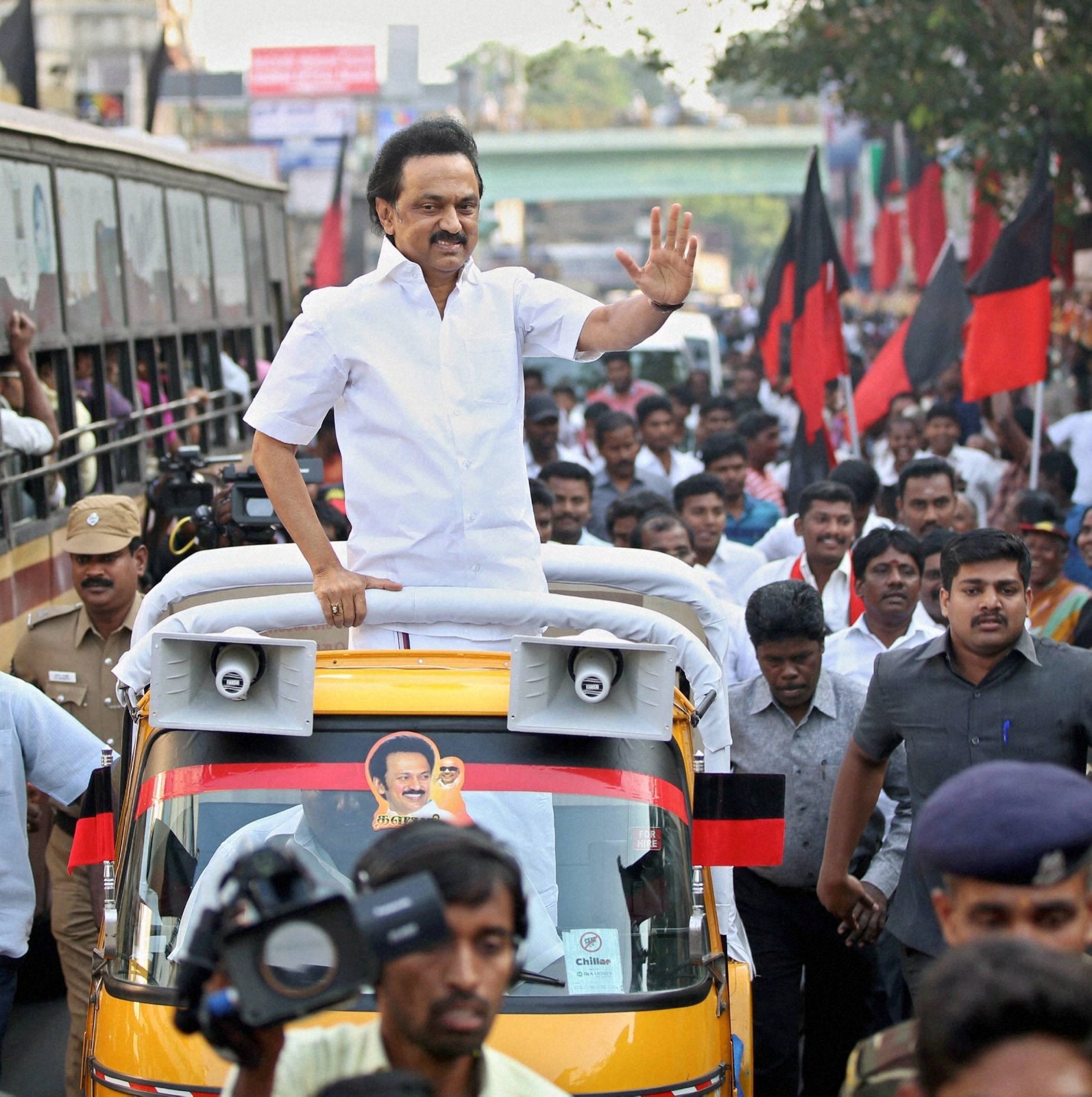
At one level, the succession seemed obvious enough. M.K. Stalin had the organisational patience, the municipal apprenticeship, the visible party route and the respectable bearing of a man who had spent years waiting to be taken seriously and was now finally being allowed to look inevitable. He was the son who understood files, formalities, process and optics.
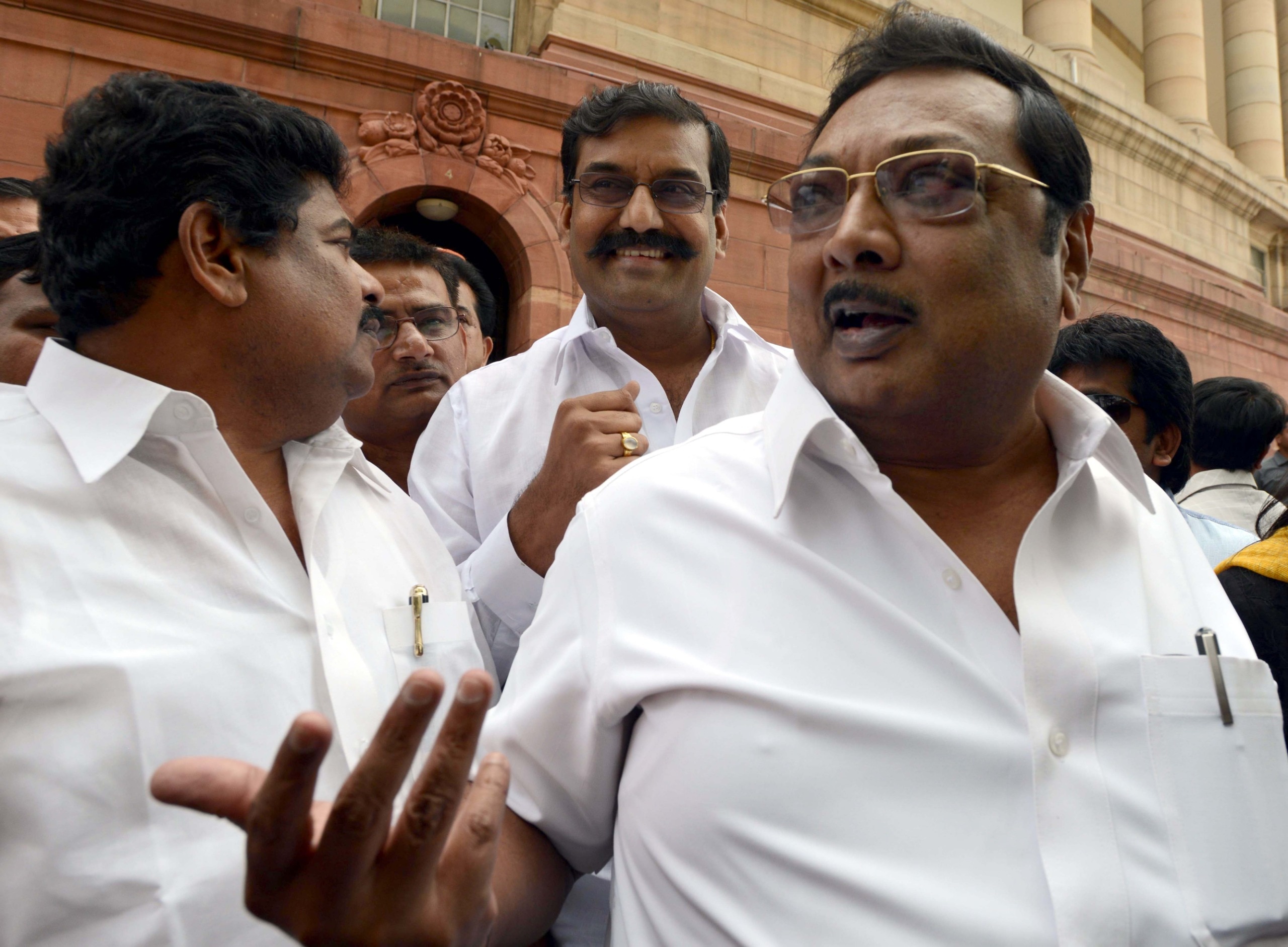
At another level, however, there stood M.K. Alagiri, who had no particular interest in looking inevitable because he had already made himself unavoidable. In the southern districts, especially around Madurai, his relevance did not require theoretical justification. It was made up of fear, loyalty, presence and the kind of influence that does not need party constitutions to be felt.
Daughter Kanimozhi had already been installed in the Rajya Sabha. No further issues.
Between them all sat the father — still supreme, still cunning, still rhetorically nimble — but increasingly forced to divide affection, relevance and reward with the delicacy of a man trying to cut a birthday cake while the children are armed.
This was the phase in which the old DMK, for all its talk of movement, ideology and social justice, began looking unmistakably dynastic in a more modern and vulgar way. It was no longer simply that relatives existed in politics. It was that the party itself increasingly seemed to move according to the pressure points of family accommodation.
Karunanidhi had once been the architect of power. He was now also its household scheduler.
DMK DILEMMA
The southern surge of Alagiri became more formal in this period, though not necessarily more civilised.
Madurai had already functioned as a parallel power centre in the years immediately preceding. But by 2008–09, it was impossible to treat that zone as merely a district fiefdom tolerated out of family convenience. It had become one of the central facts of DMK politics. The message was clear enough: if Stalin represented the future in Chennai’s administrative and party imagination, Alagiri represented a different kind of legitimacy — territorial, raw, unvarnished and electorally useful.
This mattered because the DMK was not merely choosing between personalities. It was being asked, slowly and painfully, what kind of future it wished to become. A party of organisation, governance and calibrated succession? Or a fragile, more dangerous arrangement in which local force and inherited access could repeatedly bend institutional order?
Karunanidhi, being Karunanidhi, chose neither confrontation nor clarity. He did what he often did best: he postponed the final answer while rewarding everyone enough to keep the roof from collapsing. The trouble with such arrangements is that the roof rarely collapses immediately. It first learns to leak.
Thanks to Azhagiri whose rise in party hierarchy and importance was starkly visible, with his visits to Chennai and Gopalapuram, becoming too frequent, accompanied by the usual pomp and posters that herald his strong-arm politics anywhere. The hapless DMK cadre were struck by the glare of two Rising Sons.
Thirumangalam & Price of Consent
If 2008–09 had to be reduced to one single innovation in Tamil Nadu electoral culture, it would not be ideological, legislative or administrative. It would be financial.
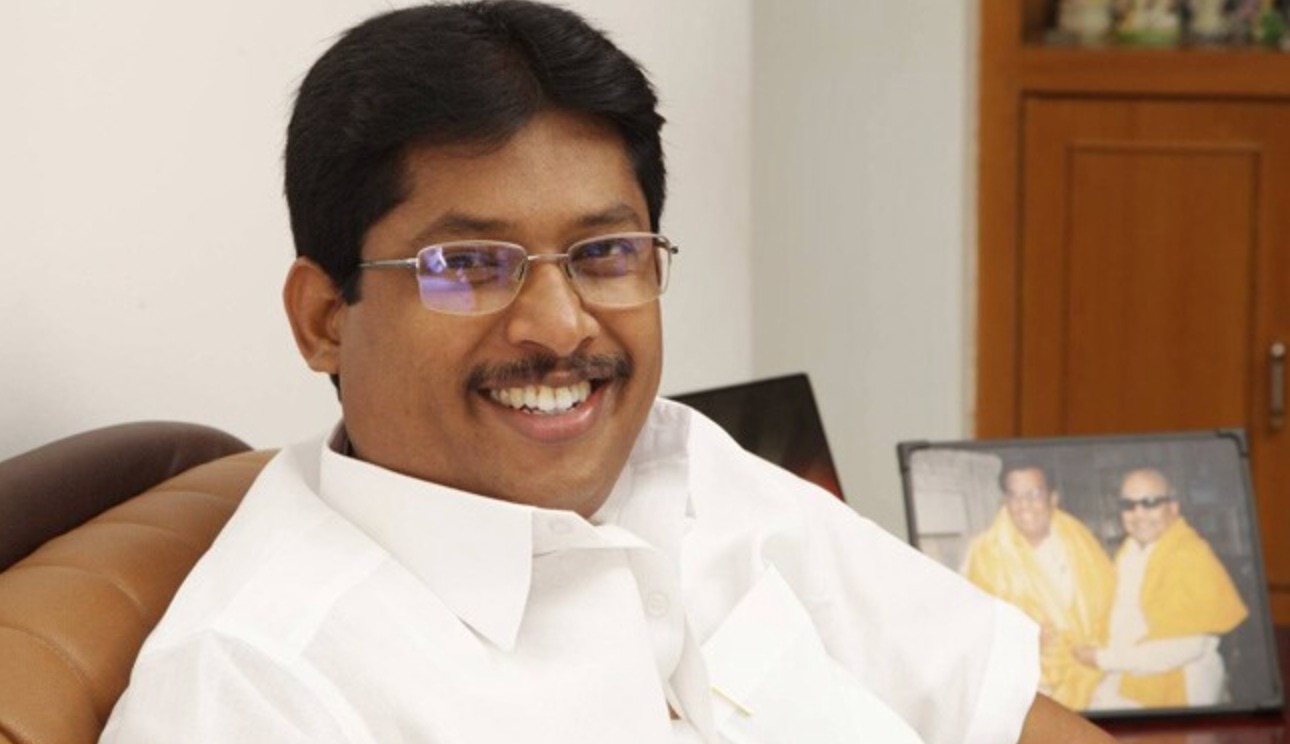
The Thirumangalam by-election of January 2009, triggered by the death of sitting MLA Veerapandi A. Raja, became one of those deceptively local contests that end up altering the political vocabulary of an entire state. What happened there was not the invention of bribery in elections—Tamil Nadu, like the rest of India, had never been a monastery—but its refinement into a method with precision.
Under the broad and widely acknowledged influence of Alagiri’s Madurai machinery, Thirumangalam became the site where cash ceased to be merely inducement and began to resemble a structured campaign tool. Money did not simply hover around the election. It moved through it with discipline, targeting, familiarity and confidence.
This was the moment when cash became campaign.
It would later acquire a notorious shorthand: the ‘Thirumangalam formula’ — a phrase that sounds almost like a benign development scheme until one remembers that what was being distributed was not welfare, but democratic corrosion. The voter was not merely persuaded, mobilised or ideologically appealed to. The voter was being professionally reached.
There was something darkly efficient about it. Tamil Nadu had already mastered the politics of material promise through manifestos and welfare announcements. Thirumangalam now showed how electoral management itself could be made more transactional, more calibrated and more intimate.
The moral shift was profound. Once a political culture begins to normalise the idea that voting can be not only influenced but systematically monetised, it does not merely degrade elections. It rewires expectations. The citizen becomes customer; the vote becomes event-specific settlement.
And because this happened under a ruling formation that still retained administrative polish and public legitimacy in many other areas, the rot entered not with chaos, but with official sanction.
The future, one might say, was being delivered in envelopes.
Delhi, Wheelchairs & Family Quotients
If Thirumangalam showed how Tamil Nadu was learning to conduct elections, Delhi showed how it was learning to conduct the Union government.
By the time the 2009 Lok Sabha elections approached, Karunanidhi had perfected a particular style of coalition negotiation. It was not loud in the Jayalalithaa manner, where instability itself was the message. It was quieter, more layered, more paper-heavy, and in some ways more effective. He did not merely demand relevance. He itemised it.
And increasingly, what he itemised was not only party representation, but family placement.
This was where the transformation became impossible to ignore. The old anti-Delhi Dravidian grammar had once been built on federal dignity, state rights, linguistic pride and regional assertion. By 2009, much of that moral vocabulary had narrowed into a more practical concern: who from the family, the household orbit or the approved circle would get what in the union arrangement.
It was here that Karunanidhi began to lose some of the old sheen he once enjoyed as a master administrator and broad political tactician. He still retained his intelligence, memory and negotiating skill. But he increasingly appeared diminished by the nature of his bargaining. He was no longer merely fighting for Tamil Nadu’s due or even the DMK’s central space. He was often seen as wheeling and dealing — sometimes literally from a wheelchair — to secure portfolios, positions and symbolic comfort for the clan.
The old self-respect tradition had, by then, narrowed alarmingly. It was beginning to look less like dignity for society and more like respect for self, not beyond his kith, kin and skin.
That was not merely political contradiction. It was ideological shrinkage.
Raja, Relevance & Old Smoke
This was also the period in which A. Raja remained not just relevant, but curiously indispensable.
His first tenure in the Telecom Ministry had already attracted murmurs, discomfort and accusations. The issue was not that concerns were absent. They were present enough for Delhi’s more alert circles to raise eyebrows and for opponents to begin connecting dots. But in coalition India, especially under a prime minister structurally dependent on regional arithmetic, allegations are often treated not as warning signs but as administrative weather.
Thus, even as questions hovered around spectrum allocation and telecom decision-making, Raja remained central to the DMK’s bargaining universe. He continued as minister in the same ministry, despite the 2G cloud still hovering over. Honest Singh winked and looked the other way.
This mattered enormously. Because one of the great evasions of the later 2G scandal would be the attempt to pretend that the problem arrived suddenly in 2010 or 2011. It did not. The warning lights had not been switched off. They had simply been ignored because the arrangement remained useful.
The allegations were not absent. They were accommodated.
That single fact would later come back to haunt not only the DMK, but also Manmohan Singh’s increasingly tragic reputation as an honourable man presiding over dishonour with procedural calm.
2009 Polls: Alliances in Fancy Dress
The 2009 Lok Sabha election in Tamil Nadu was one of those magnificent Indian spectacles in which every party accuses every other of betrayal while simultaneously changing partners with the speed and emotional stability of a reality show elimination round.
The DMK remained with the Congress and the UPA, despite friction, mutual irritation and the occasional performance of wounded dignity. The relationship was no romance. It was arithmetic with protocol.
On the other side, Jayalalithaa assembled a broad anti-DMK front that looked, on paper, impressive enough to give Delhi a mild shiver. Her side included the Left parties, PMK, MDMK, and other forces in varying shades of grievance and tactical optimism. It was, in effect, Tamil Nadu’s local branch of the national Third Front fantasy — a periodic Indian ritual in which many parties gather under the belief that if enough contradictions stand together on one stage, they might resemble coherence.
There was also Vijayakanth, still outside the main blocs and still functioning as the state’s increasingly stubborn third irritant. He did not command the alliance tables yet, but he remained electorally useful as spoiler, attractor and floating symbol of anti-duopoly fatigue.
The humour of the period lay in how shamelessly these arrangements kept changing. Yesterday’s ideological adversaries became today’s federal defenders. Yesterday’s opportunists became today’s secular bulwarks. Every alliance was described as principled for exactly as long as the press meet lasted. And thus the orgy of political promiscuity rolled and rollicked with strange bed fellows no longer so.
Tamil Nadu, as ever, accepted all this with the seasoned shrug of a voter who has long understood that in election time, consistency is what parties accuse each other of lacking, not what they themselves attempt.
The Result: Peak Reach, Maximum Exposure
When the results came in during May 2009, Karunanidhi’s side prevailed strongly enough to preserve both relevance and swagger. The DMK-Congress-led UPA alliance won 27 of Tamil Nadu’s 39 Lok Sabha seats, while the AIADMK-led front took 12. It was not the kind of annihilation seen in some earlier years, but it was sufficient to keep the DMK central to Delhi’s post-poll arithmetic and to deny Jayalalithaa the breakthrough she had sought through her larger anti-UPA arrangement.
More significantly, Alagiri himself won from Madurai and entered the national stage with formal dignity now draped over previously local muscle. If politics had once flowed from Delhi to the states, the flow now seemed delightfully reversed. Madurai was no longer merely a city with a temple, a history and a temper. It was now exporting influence directly into the Union Cabinet.
Away from the cosy comfort of Madurai, Azhagiri found the Bhavans of Delhi quite intimidating. But he prevailed thanks to his father's paternal protection, which, incidentally, also prevented any of the capital's blocks from being incinerated by the fury of an impatient, clueless rustic from the wilderness. This southern storm was the ultimate spoof on Parliamentary, coalition democracy.
Even Dayanidhi Maran, who had been politically singled in 2007, found his way back into the national frame after the electoral dust settled. Thus, the family, which had publicly fought over succession and television in one phase, was now once again being redistributed across the heights of Delhi.
If one wished to be charitable, one could call it reconciliation. If one wished to be accurate, one might call it dynasty with portfolio allocation.
The PMO as a Tamil Nadu Sub-Office
The post-2009 Union Cabinet formation offered one of the clearest examples of how far federal inversion had travelled.
In theory, the prime minister chooses his ministers. In practice, coalition India had by then evolved into a system where certain allies arrived not with suggestions, but with lists. Karunanidhi, by this stage, did not merely seek representation for the DMK. He sought calibrated accommodation for his ecosystem. Alagiri, Raja, later Maran — all these names and equations moved through Delhi not as abstract coalition demands, but as products of Tamil Nadu’s family-state overlap.
The comedy, if one can call it that, was complete. The old Dravidian movement had once fought northern domination. It had now reached a point where it could practically supervise the staffing of the Union Cabinet while the now prime minister maintained the face of a man politely pretending this was all perfectly constitutional.
This was federalism by blackmail, softened by procedure.
A decade earlier, Delhi had suffered southern volatility through Jayalalithaa’s moods. Now it was learning to endure southern domestication through Karunanidhi’s calculations. History, as always in Tamil Nadu politics, did not repeat itself exactly. It returned with revised casting.
Sri Lanka Burns, Karunanidhi Fasts Between Feasts
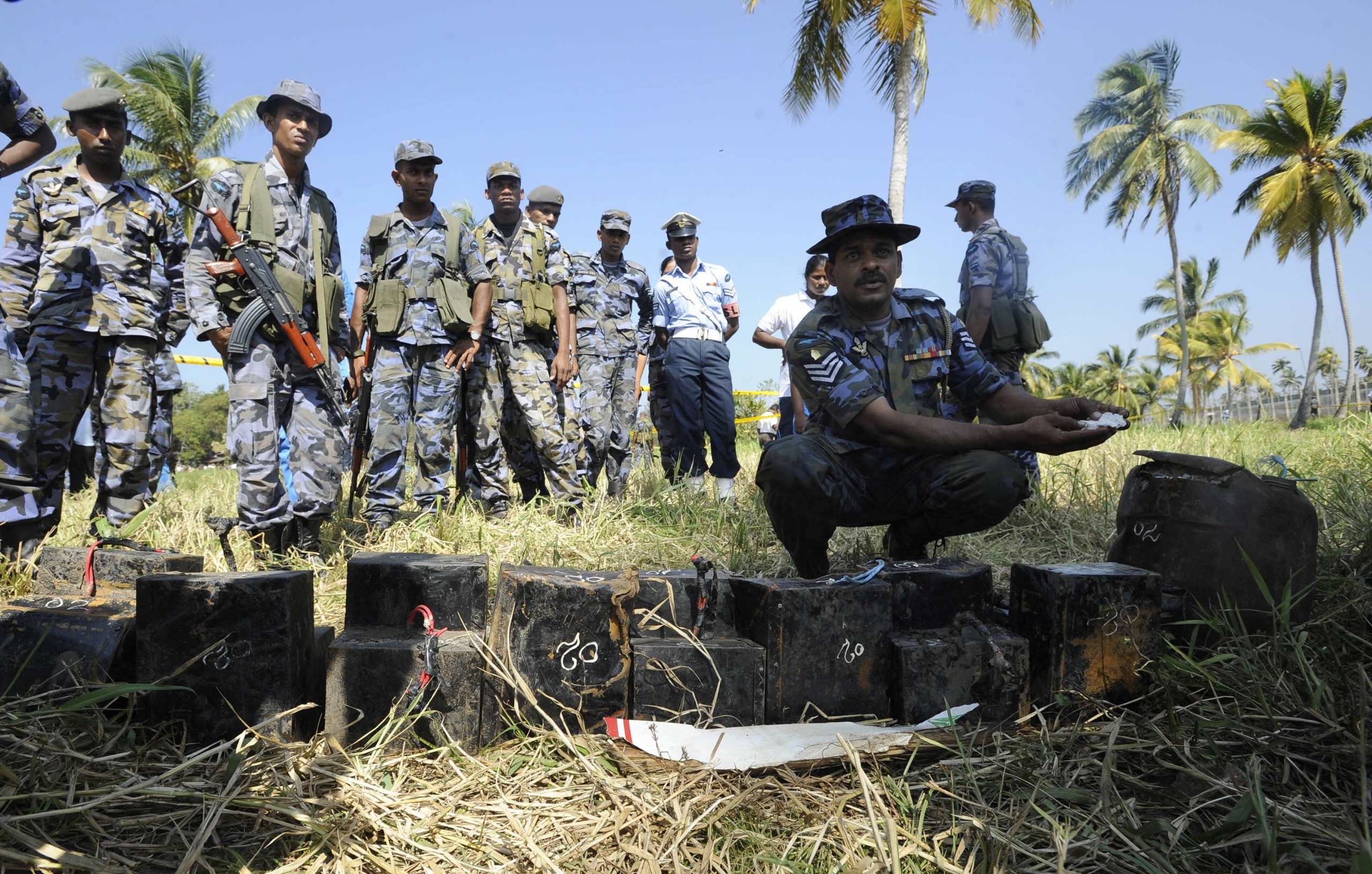
Then there was the most tragic and absurdly revealing episode of the period.
The final moments of the Sri Lankan civil war in 2009 stirred deep emotion across Tamil Nadu. Images, reports and rumours from the island intensified public anger and grief. The destruction of the LTTE, whatever one’s view of that organisation, also brought with it the terrible human cost borne by Tamil civilians trapped in the final carnage. Across the state, there was pressure on parties, leaders and especially on the ruling DMK, which was both emotionally implicated in Tamil sentiment and politically tethered to the Congress-led UPA, whose central government was seen by many as too indulgent of Colombo.
Karunanidhi’s response produced one of the great tragicomic images of modern Tamil politics. In April 2009, he arrived dramatically for a fast, demanding action on Sri Lanka. It had the visual language of moral protest. It also had the chronological sturdiness of a tea break. The fast began after a sumptuous breakfast and ended before lunch, once assurances suitably vague and politically serviceable were obtained.
This was vintage Kalaignar in late form — emotionally aware, politically alert, theatrically timed, and yet unable or unwilling to convert sentiment into sustained confrontation when it really mattered. He wanted to be seen as moved without risking the full cost of rupture with Delhi.
The result was unforgettable. A state in anguish watched its most seasoned Dravidian tactician stage a protest so brief that it entered folklore faster than policy. It was funny, if one ignored the dead. It was devastating, if one did not.
The Law Begins to Travel
Judicial geography was one of the quieter but politically telling developments of these years. Increasingly, high-profile Tamil Nadu cases began moving outside the state, reflecting growing unease about whether local legal atmospheres were sufficiently insulated from political pressure, public passion or institutional familiarity.
This did not happen all at once, nor did every case move in the same phase. But by the latter half of the decade, the pattern had become unmistakable enough to merit attention. The Jayalalithaa disproportionate assets case had already been shifted to Bengaluru. The Kanchi Sankaracharya case would travel to Puducherry. The KU Pa Krishnan murder case too would eventually move beyond Tamil Nadu’s immediate judicial environment.
The implications were not flattering. A state proud of its legal culture and administrative sophistication was now also generating enough distrust in politically sensitive cases for courts to conclude that justice might be better served elsewhere.
That, too, was part of the political weather of the period. Tamil Nadu was not merely producing governments and scandals. It was also producing legal atmospheres that required neutral distance to be trusted.
The law, one might say, had begun applying for transfer.
Deceptive Closing Frame
For all the power the DMK enjoyed in 2009, Jayalalithaa was not politically absent. She was simply outnumbered for the moment.
Her 2009 alliance had looked broad enough to matter, and in parts of the state it did. But it did not deliver the larger anti-DMK breakthrough she had sought. Still, she was too experienced to mistake a temporary setback for permanent decline. If anything, she was now observing something useful: the ruling side was not merely governing. It was overextending itself morally, familiarly and administratively.
She could afford patience. The DMK was gathering contradictions faster than it was gathering innocence.
And therein lay the deeper significance of 2009. Karunanidhi had reached a point of extraordinary reach — Chennai under control, Delhi dependent, family represented, allies managed, opposition contained. But maximum reach often carries maximum exposure.
By the end of 2009, the ruling side looked formidable enough from the outside. Yet beneath the polish, the signs were all there: cash had become campaign, family had become statecraft, Delhi had become negotiable domestic space, and the first strong smell of scandal had begun drifting through the corridors.
The climb had reached its height. The descent, though not yet visible to every eye, had already begun in outline.
Next | Sangam, Spectrum, Scandals & The Poes Surge
About


Please rotate your device
We don't support landscape mode yet. Please go back to portrait mode for the best experience